Portable Units Keep Projects On Schedule
As a result, applications for portable cooling seem to be endless today - and portable cooling is gaining more and more attention.
For instance, portable temporary cooling is not a daily requirement for Colin Murphy, a mechanical engineer with the University of Michigan. However, he now sees its value, especially after the university went through the process of connecting its new central chiller plant to two school buildings that had special cooling needs.
Meanwhile, Lito Aquiat, plant manager for a unique candy plant in Hawaii, is not bashful about singing the praises of portable cooling. "It has helped us tremendously," he said.
A Need For Cool
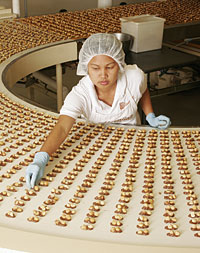
In Aquiat's case, he wanted to be cool - period. Let's just say summers can be hot on the island of Oahu, Hawaii, where the main production plant for Hawaiian Host® is located. In June, July, and August, temperatures on the island average in the high 80s, with 60 percent to 70 percent humidity."It's hot and humid, and we have all this equipment running, which adds even more heat," said Aquiat, an employee who has been with the company for 20 years.
Founded in 1927, Hawaiian Host's claim to fame is being the first company to create chocolate-dipped macadamia nuts. While that is sweet, working in a plant with design problems is not. As Aquiat put it, the plant's air conditioning system is maxed out and doesn't meet the needs of the production and packing areas. The building's system is sufficient in the winter months, but it is inadequate in the summer, he explained.
"We looked for a solution to keep the workers more comfortable and the candy from softening during transport to the cold storage area," said Aquiat.
In his research, he contacted his air conditioning representative for a cost-effective solution to the summer heat. He was referred to Air Reps Hawaii, a MovinCool distributor.
Looking for quick answers on air conditioning, heating and refrigeration topics? Try Ask ACHR NEWS, our new smart AI search tool. Ask ACHR NEWS
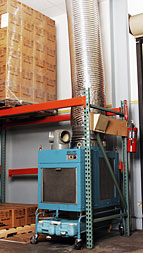
Air Reps Hawaii visited the factory and demonstrated how the portability and all-in-one design of MovinCool spot air conditioners made them the ideal cooling solution for virtually any heat-related problem. Hawaiian Host bought its first MovinCool unit in 1996 and recently purchased another one. The factory now owns seven units, which are used in various locations throughout the plant. "We place the units near the workers, and it really helps," said Aquiat.
Cool Results All Around
As Aquiat knows firsthand, when workers are more comfortable, their productivity is better. Plus, the spot cooling keeps the candy at the right temperature. Two Classic 40 units, four Office Pro 12 units, and one Classic Plus 14 model are used in the factory.The two larger units are used in the candy production and shipping areas. The Classic 40 models feature 39,000 Btuh of cooling capacity and, according to the manufacturer, are capable of ducting up to 60 feet with multiple T-section drops to spot cool multiple areas. These units are used in a wide variety of manufacturing and assembly line applications.
The self-contained Office Pro 12 units feature 11,800 Btuh of cooling capacity, are programmable, have an electronic thermostat control, and are easy to move around to provide on-demand spot cooling. According to the manufacturer, these units are capable of cooling down to 65 degrees F and are specifically designed for areas filled with heat-generating electronics.
The plant also uses a rugged Classic 14 model, which features 13,200 Btuh of cooling capacity, digital temperature controller, spot-nozzle adapters, and the highest cooling capacity for a 115-volt, 15-amp standard outlet. Hawaiian Host uses one of these units equipped with spot nozzles in its research and development lab to temper chocolate.
"The gooseneck is very helpful when working with new chocolate blends," said Aquiat.
The portable A/C units have allowed Hawaiian Host to keep the production line on schedule and its workers cool. And, Aquiat is happy with the service he receives from Air Reps Hawaii.
"Air Reps Hawaii does a great job of taking care of their customers," said John Doran, manager of the heat management department at MovinCool.
"I had a chance to tour the Hawaiian Host factory two years ago. I was impressed with the company and how extremely friendly everyone was. They produce excellent tasting chocolate-dipped macadamia nuts."
Getting College Approval
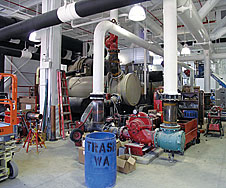
At the University of Michigan, Murphy also saw firsthand the importance and value of temporary cooling. It was put to use in the Electrical Engineering & Computer Science Building and the adjoining Dow Laboratory Building on the university's Ann Arbor campus.The two buildings are joined together, making it a four-story, 100,000-square-foot facility. Both buildings are the daily work environment for hundreds of students, researchers, and faculty members. They contain a variety of labs, classrooms, offices, server rooms, and atrium areas. The new chiller transitional piping was to be tied into the existing system over the Christmas holiday season, while classes were not in session. However, these buildings are not your average facilities.
Inside each, research on leading-edge technologies in a variety of scientific disciplines takes place. In other words, many research experiments do not take a winter holiday break, and neither can the researchers and teaching assistants who oversee the high-tech experiments. Therefore, the cooling to these areas could not be interrupted.
"There were four areas of particular concern where we absolutely needed to maintain the ambient environment with temporary cooling," explained Murphy.
When the need for temporary cooling became clear, Murphy contacted Mark Henry, vice president of Mobile Air Inc., Madison Heights, Mich. Mobile Air has sales and warehouse operations throughout the Midwest region of the country. "Upon reviewing the requirements firsthand, I could see that different types of units would be required for each area to accomplish the job," said Henry.
Critical Lab Applications
The first area of concern was a laboratory where proteins are developed and stored for use in medical and chemical experiments. The proteins are stored in what appears to be a typical chest freezer. However, this freezer is designed to achieve the lowest possible temperatures so that the molecular structure of the proteins nearly stop and are, therefore, preserved. The cost of recreating these proteins is in the millions of dollars."What we needed to do here was cool the condenser of the freezer to prevent the freezer from going off on high pressure during the shutdown," explained Murphy.
One issue typical of laboratories is that they are often sealed environments with no way to vent out the condenser air from a typical portable air-cooled unit. Labs, however, are normally equipped with several sinks or other water and drain sources.
Heat removal was accomplished using a 1.5-ton water-cooled unit from OceanAire Inc., Morton Grove, Ill. OceanAire specializes in the manufacturing of 1- to 5-ton water-cooled and air-cooled portable cooling units. Using a temporary condenser water hose kit, the unit is easily connected to the water and drain source. A 115-volt circuit is all that was needed to power the 1.5- ton unit and it was a very effective method to keep the condenser of the freezer from overheating.
Another portable unit was put into place to cool a piece of equipment used to create incredibly thin layers of semiconductive material used in electronic nanotechnology, where amazing miniaturization of electronics is created. In this instance, the heat load was a little greater, so two 2-ton units were used.
"The job could have been accomplished with a single unit," said Henry.
"However, the room was already wired with 20-amp, 220-volt, 1-phase circuits, so using the two 2-ton units made sense from an easy installation perspective."
Again, a water and drain source was readily available, which made for an easy installation.
Still More Concerns
The third area which needed cooling attention was an office which was converted to a small server room, housing several racks of servers requiring a total of 4 tons of cooling. This room was in a separate area of the building from the laboratories. The area above the drop ceiling, though not a true return air plenum, did have an opening to an adjacent area, which was a true return air plenum."A return air plenum is an ideal place to vent condenser air from portable air-cooled units" said Henry.
The heat from a small area - such as the sever room - was transferred to the plenum using a condenser vent kit, which consists of a special flanged ceiling tile and flex duct, which is connected to the ceiling tile and to the condenser discharge of the unit. The condenser air in the plenum is then brought back to the air handler and is distributed throughout a much larger area. In instances where the main system is operating, the condenser air is conditioned as it is drawn through the air handler.
For this room, four Classic Plus 14 Movincool units were used.
The fourth and final area that required temporary cooling was a 2,500-square-foot room, which was jam-packed with row after row of electronic and computer equipment. This room is normally cooled by two 15-ton Liebert systems, but they were going to be off line due to the piping changeover.
This room presented some real challenges. The most obvious problem was that there was very little free space in the room.
"You need to be careful walking in the room, much less trying to cram 30 tons of cooling units in the space," explained Murphy.
"To complicate matters, the room in question was an interior room with no easy access to an outside opening. The one thing that was in our favor was that the room had a large double door opening, which opened to a wide hallway."
A plan was devised to use three 12-ton air-cooled units placed in the hallway outside of the room. The supply and return air would be brought into the room through one of the existing doorways. Just above the computer room was the mechanical penthouse. A chase located between the computer room and the hallway was used to run the power cord to the penthouse, where plenty of three-phase power was available.
"These Mobile Air Inc. 12-ton units are really designed as an outdoor unit with a propeller condenser fan," said Henry. "A variable-frequency drive [VFD] is used to control the condenser fan, allowing for a zero-degree, low-ambient operation. However, in this application, the VFD allowed the units to operate at a low noise level."
Because the temperature in the hallway was a relatively cool 69 degrees, the VFD spun the fan slowly, creating little fan noise. In order to prevent a buildup of excessive heat from the condenser within the hallway, additional fans were used to help direct the air down hallways and mixed it with the general building air.
Since this project took place in the winter months, taking the heat out of the computer room and adding that heat to the rest of the building was a benefit rather than a hindrance.
Publication date: 07/11/2005
Looking for a reprint of this article?
From high-res PDFs to custom plaques, order your copy today!