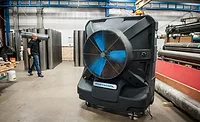
Portable Units Fill Emergency Needs
When serious temperature problems such as these arise, portable air conditioning suddenly has everyone’s attention. And the occurrences are not really as rare as many would think.

Crash Test Dummies
Portable Air Conditioning can keep crash dummies cool. That’s what they discovered at 4/Flight Industries.4/Flight manufactures seats for airplanes, and they are subject to the rules and regulations of the Federal Aviation Administration (FAA). Their customers include airplane manufacturers and major airlines.
“We have to meet stringent guidelines and our seats must pass a variety of tests,” explained Tracy Leonardi, certification engineer for 4/Flight.
The test laboratory is located in Carlsbad, Calif., normally a very temperate area located on the Pacific Ocean near San Diego.
“We test our seats using crash test dummies on a testing sled that generates 16 gravities of load,” said Leonardi. “During certification testing, the FAA require the dummies be conditioned between 66 and 78 degrees Fahrenheit at least four hours prior to each test to replicate conditions inside the aircraft and so the joints perform properly.
“We hadn’t had any trouble with excessive heat in the past, but we hadn’t done much testing in the summer,” she said. “That year the temperature shot up and we needed to do something. We couldn’t afford to fall behind schedule. That was the first time we called Atlas.”
Atlas Sales specializes in portable air conditioners and heating units. John Wheeler is the regional manager for the San Diego area.
Looking for quick answers on air conditioning, heating and refrigeration topics? Try Ask ACHR NEWS, our new smart AI search tool. Ask ACHR NEWS
“A lot of our business is emergency rentals, such as 4/Flight,” said Wheeler. “When Tracy called and explained her problem, I told her we could help. But there were some problems to overcome.”
4/Flight’s lab is a large space, occupying half of a warehouse with high ceilings and no windows. There was no convenient way to deliver cool air and vent hot air.
“We came up with what could be called a low-tech solution to a high-tech problem,” said Wheeler. “We calculated that one of our 12-ton units would do the job, but we still had to move the air into and out of the lab. There was an overhead door at one end of the space, so we got a piece of plywood about three feet high that would span the door, cut some holes in it, opened the door enough to accommodate it, and ran duct tubing from the air conditioning unit into the center of the lab — two input and two outlets.”
“It worked great,” said Leonardi. “Atlas provided power cords with pig tails that installed easily on the diesel generator we had rented. We didn’t need an electrician to get going. And the 12-ton unit had four cam lock connectors, so it was easy to hook up. We ran it during the day, keeping easily within the temperature range. At night, we wheeled it inside. We rented the portable three times over two years and never had any complaints.”
“Many of our customers occupy rented space with no air conditioning or an inadequate supply,” said Wheeler. “They are reluctant to buy new systems that would become the property of the landlord, so they either rent or buy portables. If they buy, they can take it along with them when they move.”
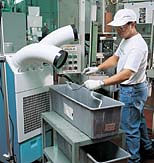
Keeping Servers Running
JNI Corporation needed a solution that would help keep its computer servers up and running.“We had sold our building and were leasing the space back while waiting for our new home to be finished,” said Walt Buechele, facility manager for JNI Corporation.
“Our products provide fiber channel market, primarily Host Bus Adapters (HBA) and their associated drivers found in storage area networks (SANs). Basically, they let servers communicate with each other at very high speeds — around one to two gigabytes per second. We test our products on OEM equipment and the servers don’t like it when the temperature gets hot. The problem is that these refrigerator-sized servers generate a lot of heat. And the space we were in didn’t help. It was originally designed as a physics laboratory. It was 2,000 square feet with 20-foot ceilings. With the heat created by the equipment, we had a need for 12 tons of air conditioning, and the lab’s system only generated five tons.”
Fortunately, Buechele already knew Wheeler from his previous job at Lockheed Martin.
“I called John at Atlas and explained my problem,” said Buechele. “As usual, he had the solution.”
Wheeler delivered two 5-ton units and had them hooked up and running in a day. The work was similar to that done for Lockheed Martin in San Diego.
“We built satellite launch vehicles (rockets) there and needed to create a kind of clean room environment around the upper stage of the vehicle,” said Buechele. “One problem was temperature. We needed it cool and constant. John came up with the right system and placed it outside the portable structure we had devised, using duct tubing to dump cold air into the work area. We maintained a constant temperature and got the job done quickly.
“But those units were rentals,” he said. “At JNI, initially we actually bought a 2-ton unit for a switch room requirement. We purchased this smaller unit for an immediate need in the old facility, with the plan to keep it as an emergency backup for future requirements in the new facility. We’re believers in Murphy’s Law and wanted to be prepared for his visits to our new home.
“You see, it would cost us a small fortune if the building’s chiller failed. We would only have a two-hour window before the equipment would start shutting down. So that 5-ton unit sits in our server room and monitors the temperature. It’s not even circulating air. But if the temperature goes up too high, it kicks in and immediately justifies our investment. What we got from the portables was flexibility. That’s really the main benefit. Of course, it doesn’t hurt that they saved and will continue to save us money, too.”
Cool Aerospace Labs
Lockheed wasn’t the only aerospace company to benefit from the flexibility of portable air conditioning to save money. Boeing in Seattle also had a problem. One of the company’s test labs was located in the middle of a manufacturing plant, and the chiller that cooled it could no longer maintain the 68 degree F temperature they required.“They couldn’t afford to shut down while repairs were made to their system,” said Eric Nakashima, Atlas Northwest regional manager. “They had delicate equipment that had to be kept at a constant temperature. They were faced with the expensive and time-consuming proposition of moving their lab, all their computers, and test equipment to another building and starting their tests over from scratch until their unit was repaired, and repeating the procedure to move back. Fortunately, their maintenance engineers had used Atlas before and assured the lab manager that they could stay up and running while the chiller was repaired.”
Nakashima went to the Boeing facility to evaluate the job. The lab was 20 feet by 25 feet. Eric asked the maintenance engineer if there was some place they could vent the hot air from the air conditioner, and he was assured that a 12-inch hole could be made in one of the wall panels. The company was also able to provide a 220-volt service to run the unit. Based on the size of the room and the heat generated by the equipment, Nakashima recommended a 24,000-Btu unit. There was some skepticism from the lab manager about whether the air conditioner would do the job, so Nakashima offered them a free three-day trial.
“They had nothing to lose,” said Nakashima. “We delivered and set up the unit the next day. The lab continued to operate. After just one day, they decided to rent it for the month. They were so pleased with the flexibility it provided that they purchased two units to use as backups.”
Portable air conditioners have value in other applications as well. But they are particularly important in business environments where they can save money by providing options that would not otherwise be available. The key is having a source that has the expertise and responsiveness to handle emergency situations.
For more information, visit atlassales.com.
Sine is a freelance writer in Beacon, N.Y., specializing in topics that pertain to the HVAC market. He can be contacted at jack.sine@verizon.net.
Publication date: 07/21/2003
Looking for a reprint of this article?
From high-res PDFs to custom plaques, order your copy today!