ACHR News
search
Ask ACHR NEWS AI
cart
facebook twitter instagram linkedin youtube
  • Sign In
  • Subscribe
  • Sign Out
  • My Account
ACHR News
  • NEWS
    • Breaking News
    • New HVAC Products
    • Featured Products
    • Manufacturer Reports
    • HVAC Data
    • Legislation
    • ACHR NEWS Centennial
  • RESIDENTIAL
    • Air Conditioners
    • Furnaces
    • Residential Heat Pumps
    • Ductless
    • Residential IAQ
    • Testing, Monitoring, Tools
    • Components & Accessories
  • COMMERCIAL
    • Air Handlers
    • Rooftop Units
    • Chillers and Cooling Towers
    • Commercial Heat Pumps
    • Boilers and Hydronics
    • VRF/Ductless
    • Commercial IAQ
  • REFRIGERATION
    • Refrigerants
    • Refrigerant Regulations
    • Leak Management
  • CONTRACTOR PRO
    • Geothermal
    • Homeowner Study
    • VRF and VRV Ductless
    • Unitary Trends
  • EDUCATION
    • Training and Education
    • Business Management
    • Service and Maintenance
    • Continuing Education
    • Market Research >
      • HVAC Brand Awareness Report
      • VRV, VRF, VRVZ Report
      • Unitary Trends Report
      • Water Heat Professionals Report
    • Webinars
    • Sponsor Insights
    • eProducts Info
    • White Papers
  • EVENTS
    • HVAC Contractor Forum
    • Industry Events and Webinars
  • MEDIA
    • Videos
    • AHR Expo 2025 Videos
    • Podcasts >
      • ACHR News Podcast
      • HARDI Podcasts
      • AHR Expo Podcasts
      • ACCA Podcasts
    • Interactive Spotlights
    • Quizzes
    • eBooks
    • HVAC Talkback
  • HVAC GROUP
    • ACHR NEWS >
      • Current Issue
      • Digital Edition
      • Subscribe
    • Distribution Trends
    • SNIPS NEWS >
      • Join SNIPS NEWS
    • Engineered Systems News >
      • Join ES News
    • HVACR Directory
    • Contests
    • Newsletters
    • Contact
    • Advertise
    • My Account

Polarized-Media EACs Are Coming Of Age

January 23, 2006
Nonionizing polarized media is an IAQ technology finding broader market uses. It applies an active electric field to capture airborne particles, changing the way particles behave in the air. In smaller residential equipment, this allows an electronic air cleaner (EAC) to operate efficiently within a space only 1-inch wide - the same space as a disposable filter. In larger commercial systems, it can mean high levels of air quality with reduced operating costs.

DISCOVERY AND EARLY YEARS

The first electrically enhanced air filters date back to 1930. They combined elements of both passive and electronic filtration.

As with most high-efficiency filtration products, polarized media has its roots in industrial applications. Although there have been a number of different configurations since then, all of them are based on charging, or polarizing fibers in a filter and particles in the air to generate an electric force between the fibers and particles.

The principle has been around for many decades, however, it is only in recent years that the technology has been fully understood thereby maximizing its effectiveness and providing consistent, reliable performance.

In 1982, two professors from Carleton University in Ottawa designed a residential application that provided a simple means of replacing dirty media. They started Engineering Dynamics Ltd. (EDL) and began manufacturing 1-inch and 2-inch polarized-media EACs, room console units, and overhead ceiling-mount units. Since then, subsequent patents and refinements have created discernable differences in the product designs and features.

The original EDL was acquired in 1997 by Environmental Dynamics Group, now known as Dynamic Air Quality Solutions, the manufacturer of Dynamic air cleaners. Initially the company's focus was residential, but there was a clear need for improved air quality in commercial and industrial applications. This resulted in a focus on technology enhancements, new configurations, and a complete line of commercial products.
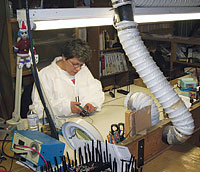
Valerie Barr tests high-voltage power supplies before they go into polarized-media electronic air cleaners.

THE POLARIZING DIFFERENCE

"Polarization is very different from ionization," explained Duke Wiser, president of Dynamic Air Quality Solutions. "A polarized field does not produce any ozone. Also, polarized molecules are not charged and therefore less apt to collect where you don't want them to.

"Ionized particles have either a positive or negative charge and are attracted to oppositely charged surfaces, such as collector plates in precipitating air cleaners," Wiser said. "Charged particles can also collect on walls, ductwork, and clothes."

Polarized-media air cleaners tend to do an excellent job of removing submicron (less than 1 micron in size) particles without efficiency loss. The carbon center screens used in Dynamic air cleaners, for example, also trap odors and volatile organic compounds (VOCs).

Polarization air cleaner effectiveness is best measured by assessing particle levels in a home or building over time. Part of the reason for this is a process called agglomeration. Trapped particles in the air cleaner become polarized, as do any particles that pass through the air cleaner.

Through agglomeration, polarized particles bond with other polarized particles as they collide in the air. As they increase in size, they are collected. This enables the air cleaner to capture very small, submicron particles that tend to suspend in the air rather than move in the airstream.

Looking for quick answers on air conditioning, heating and refrigeration topics? Try Ask ACHR NEWS, our new smart AI search tool. Ask ACHR NEWS →

"Any air cleaning system's effectiveness will be, in part, determined by the air change rates, airflow patterns, and contaminant generation rates," said Wiser.

"Typically in a house we see particle reductions of 70 percent to 90 percent, but because of the low air change rates in a home, it may take a few days.

"In a casino, on the other hand, even though the contaminant level and generation rates are much higher, the air change rates are more than 10 times higher than they are in a house. Significant reductions in both particles and VOCs are almost immediate."

Laser particle counters have confirmed this phenomenon. Over a time period of several days, a reduction in particles under 0.3 microns in size would be observed first. As the smaller particles form larger particles, there is a spike in the number of larger particles. Then the total particle count drops off significantly.
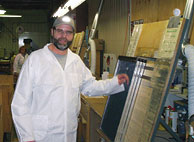
Technicians of Dynamic Air Quality Solutions at the production facility in Carleton Place, Ontario.

TESTING CHALLENGES

The minimum efficiency reporting value (MERV) is the most commonly used measurement for filters. MERV is based on a single pass and is used for measuring passive mechanical filters.

Appropriate testing "is the biggest challenge for manufacturers of polarized-media air cleaners," Wiser explained.

"There is no widely accepted test protocol today that demonstrates the effectiveness of polarized media.

"Single-pass measurements don't account for loading, which is the trade-off for efficiency," said Wiser. "For mechanical filters, loading is detrimental because it increases static pressure. And although static pressure is not an issue for electronic precipitating air cleaners, they lose efficiency as plates and wires get dirty.

"So ratings like MERV do not provide a universal indication of performance under real-world conditions."

Ray Sample fabricates polarized-media, shown with the carbon center screens used in the air cleaner media.

MARKET DRIVERS

Air cleaner size is the biggest benefit within the residential segment, after performance. Polarized-media air cleaners offer a high-performance air cleaner option that can be installed with minimal labor and no ductwork modifications. This makes it a sellable item when technicians are on service, repair, or maintenance calls.

This is a big exception to traditional thinking that implies that the logical time to sell an air cleaner is when the indoor unit is changed out. And we know from influences outside our industry, like the recent success of room air purifiers, that a large demand exists.

Commercially, again with efficiency aside, the biggest benefit is the payback based on energy and operational cost savings. There are many costs associated with commercial filters. The lower static pressure of polarized-media air cleaners means lower energy consumption.

There are also costs associated with shipping, storing, and replacing filters. Polarized-media air cleaners load efficiently, which translates into longer maintenance intervals.

"Casinos were early adopters because of the product's effectiveness at removing tobacco smoke and odors, and casinos' ability to correlate air quality to revenue," Wiser explained. "Other recent high-profile projects include the U.S. Securities and Exchange Commission and Churchill Downs."

COMING OF AGE

Polarized-media air cleaner technology has been an important part of IAQ programs for contractors, engineers, and building maintenance staff that are responding to the heightened consumer awareness about IAQ.

"We estimate that polarized media sales account for 15 percent to 20 percent of the current electronic air cleaner market," said Wiser. "There are a lot of products in the burgeoning IAQ market. Polarized-media electronic air cleaners are a great value. And in the end, it's all about value."

Rob Goodfellow is director of sales and marketing, Residential Products, Dynamic Air Quality Solutions, Princeton, N.J. For more information, visit www.dynamicaqs.com.

Publication date: 01/23/2006

Share This Story

Looking for a reprint of this article?
From high-res PDFs to custom plaques, order your copy today!


Recommended Content

JOIN TODAY
To unlock your recommendations.

Already have an account? Sign In

  • HVAC-enrollment

    The Trades Are Back: HVACR Programs See Nearly 30% Enrollment Spike

    A new wave of future technicians is entering the pipeline.  
    News
    By: Matt Jachman
  • 2025 Top 40 Under 40

    2025 Top 40 Under 40 HVACR Professionals List

    The 11th annual Top 40 Under 40 list highlights those...
    HVAC Contracting
    By: Hannah Belloli-Oster
  • LG Ductless Mini-Split Systems

    The 9 Types of Heat Pumps

    As the U.S. moves toward electrification, heat pumps are...
    Air Source Heat Pumps
    By: Joanna R. Turpin
Subscription Center
  • Create an Account
  • Start a Subscription
  • Manage My Account
  • Sign Up for Newsletters
  • Visit Customer Service
  • Update Preferences

More Videos

Sponsored Content

Sponsored Content is a special paid section where industry companies provide high quality, objective, non-commercial content around topics of interest to The News audience. All Sponsored Content is supplied by the advertising company and any opinions expressed in this article are those of the author and not necessarily reflect the views of The News or its parent company, BNP Media. Interested in participating in our Sponsored Content section? Contact your local rep!

close
  • Piggy Bank
    Sponsored byWatercress Financial

    Energy Prices, Inflation, and HVAC: What Today’s Homeowners Care About

  • Refrigerated Food
    Sponsored bySolstice Advanced Materials

    R-455A Refrigeration: A Cold Storage Solution for the Future

  • Airex Rooftop Units
    Sponsored byAirex Manufacturing Inc

    Consolidating Roof Penetrations: A Growing Trend in Multifamily HVAC Design

Popular Stories

HVAC-Price-Increase-graphic

HVAC Price Increase List: June 2026

Trump-Section-232.jpg

Trump Reduces Section 232 Tariffs on HVAC Equipment to 15%

R410A-Refrigerant-Cylinder.jpg

Refrigerant Recovery is a Revenue Opportunity

Heat-pump-cutaway.jpg

PFAS Rules and A2L Building Codes Continue to Evolve

Kroger.jpg

Kroger to Spend $100 Million to Reduce Refrigerant Leaks

View The ACHR NEWS
Centennial Anniversary Timeline

The ACHR News Timeline Chart
Submit a Letter
Submit a letter to our editors.

Events

November 6, 2025

Next-Gen Data Center Cooling: HVAC Innovation and Real-World Solutions

On Demand As AI workloads and high-density computing push traditional cooling methods to their limits, the data center industry is accelerating the adoption of next-generation HVAC technologies.

June 17, 2026

Decarbonization Without Disruption

This webinar will explore practical HVAC decarbonization strategies that minimize disruption while maximizing long-term performance and ROI.

View All Submit An Event

Poll

Summer Staff

Are you fully staffed for the summer season?
View Results Poll Archive

Products

BNI Mechanical/Electrical Square Foot Costbook, 2026 Edition

BNI Mechanical/Electrical Square Foot Costbook, 2026 Edition

See More Products
Decarbonization Without Disruption - Free Webinar - 6/17/2026

Related Articles

  • Aftermarket Zoning Technology Comes of Age

    See More
  • ERV Comes of Age for DX Systems

    See More
  • GEO Organization Comes of Age

    See More

Related Products

See More Products
  • Optimizing Social Media from a B2B Perspective

  • EHEP002028.jpg

    Principles of Heating, Ventilation, and Air Conditioning in Buildings, 1st Edition

  • 0071829598.jpeg

    HVAC Equations, Data, and Rules of Thumb, Third Edition

See More Products

Events

View AllSubmit An Event
  • May 12, 2026

    Peak Season Prep: Capture Every Dollar Coming Your Way

    On Demand In this session, we’ll break down how to prepare your business to capture every opportunity during peak demand. You’ll learn how to improve response times, convert more inbound inquiries, and use tools like AI to handle calls and texts, book jobs faster, and maximize revenue—without overloading your team.
View AllSubmit An Event
×

Sign Up. Stay Informed.

The #1 trusted source for the HVACR industry since 1926

SUBSCRIBE
  • RESOURCES
    • Advertise
    • Contact Us
    • Advisory Board
    • Classifieds
    • Submit a Letter
    • Directories
    • Store
  • ACCOUNT CENTER
    • Create an Account
    • Start a Subscription
    • Manage My Account
    • Sign Up for Newsletters
    • Visit Customer Service
    • Update Preferences
  • SERVICES
    • Marketing Services
    • Reprints
    • Market Research
    • List Rental
    • Survey/Respondent Access
  • STAY CONNECTED
    • LinkedIn
    • Facebook
    • Instagram
    • YouTube
    • X (Twitter)
  • PRIVACY
    • PRIVACY POLICY
    • TERMS & CONDITIONS
    • DO NOT SELL MY PERSONAL INFORMATION
    • PRIVACY REQUEST
    • ACCESSIBILITY

Copyright ©2026. All Rights Reserved BNP Media, Inc. and BNP Media II, LLC.

Design, CMS, Hosting & Web Development :: ePublishing