ACHR News
search
Ask ACHR NEWS AI
cart
facebook twitter instagram linkedin youtube
  • Sign In
  • Subscribe
  • Sign Out
  • My Account
ACHR News
  • NEWS
    • Breaking News
    • New HVAC Products
    • Featured Products
    • Manufacturer Reports
    • HVAC Data
    • Legislation
    • ACHR NEWS Centennial
  • RESIDENTIAL
    • Air Conditioners
    • Furnaces
    • Residential Heat Pumps
    • Ductless
    • Residential IAQ
    • Testing, Monitoring, Tools
    • Components & Accessories
  • COMMERCIAL
    • Air Handlers
    • Rooftop Units
    • Chillers and Cooling Towers
    • Commercial Heat Pumps
    • Boilers and Hydronics
    • VRF/Ductless
    • Commercial IAQ
  • REFRIGERATION
    • Refrigerants
    • Refrigerant Regulations
    • Leak Management
  • CONTRACTOR PRO
    • Geothermal
    • Homeowner Study
    • VRF and VRV Ductless
    • Unitary Trends
  • EDUCATION
    • Training and Education
    • Business Management
    • Service and Maintenance
    • Continuing Education
    • Market Research >
      • HVAC Brand Awareness Report
      • VRV, VRF, VRVZ Report
      • Unitary Trends Report
      • Water Heat Professionals Report
    • Webinars
    • Sponsor Insights
    • eProducts Info
    • White Papers
  • EVENTS
    • HVAC Contractor Forum
    • Industry Events and Webinars
  • MEDIA
    • Videos
    • AHR Expo 2025 Videos
    • Podcasts >
      • ACHR News Podcast
      • HARDI Podcasts
      • AHR Expo Podcasts
      • ACCA Podcasts
    • Interactive Spotlights
    • Quizzes
    • eBooks
    • HVAC Talkback
  • HVAC GROUP
    • ACHR NEWS >
      • Current Issue
      • Digital Edition
      • Subscribe
    • Distribution Trends
    • SNIPS NEWS >
      • Join SNIPS NEWS
    • Engineered Systems News >
      • Join ES News
    • HVACR Directory
    • Contests
    • Newsletters
    • Contact
    • Advertise
    • My Account

Plate Heat Exchanger As Vaporizer and Condenser

November 21, 2000


Plate heat exchangers (PHEs) have been installed in larger heat pump systems and refrigeration systems since the 1980s. Tech-nicians who deal with these systems need to know some specific details of how they work.

Part one of this article (The News, Nov. 20) covered PHE design, on-site assembly and service, leak indication, freezing risk, and resistance from vibration, pressure, and seismic occurrences. This week the article continues its discussions of the plate heat exchanger as vaporizer and condenser.


VAPORIZER

Particularly as a vaporizer, the PHE presents the characteristics of a high degree of turbulence and high shear forces in the complex channel geometry, which lead to:

  • The capability for stable capacity regulation;
  • Relatively high heat transfer rates, also in the preheating zone;
  • In direct-expansion systems, high heat transfer rates, even in the superheating zone (pressure drop in the superheating zone is reasonably low since this occurs in a continuation of the relatively large number of channels, which are used for vaporization);
  • The flow is homogenous, leading to effective transport of the vapor-phase, oil, and (if present) inert gas; these will otherwise present high resistance to heat transfer. The high shear with resulting homogenous flow eliminates the development of film boiling, which can otherwise seriously impair heat transfer;
  • High overall heat transfer coefficient; also in freezing duties, using high-concentration glycol, ethanol, or CaC12, or for oil-cooling duties;
  • Low fouling resistances; and
  • Due to the pure counter- (or co-) current operation and low fouling resistance, it is possible to operate at a high vaporization temperature compared to the cooled medium. In some cases, it is possible to select the next-smallest size of compressor compared to that which would be required with other types of vaporizers. In any event, high chill factors can be obtained at a reasonable investment cost (Table 3).


  • SUBMERGED VAPORIZATION

    Thermosiphon (natural) circulation is obtained when the pressure drop within the exchanger balances the external liquid head; no pump is needed to feed the liquid to be vaporized to the exchanger.

    The PHE is well suited to this process as the liquid head in the knockout drum is approximately on the same level as the upper PHE connection (outlet). (See Table 4.)

    REFRIGERANT VOLUME

    The total system volume can be kept low and the pipework made in small diameter due to the low refrigerant volume and low circulation ratio (high exit vapor fraction) in the PHE. The knockout drum can also be of relatively small size.

    Submerged vaporization with low liquid-phase velocity in the inlet manifold means that a large number of plates can be installed in the frame. The largest vaporizers have about 300 refrigerant channels (600 plates), with a capacity of about 6 MW on R-12 and 8 MW on ammonia.


    OIL

    In ammonia systems, small quantities of oil can accumulate at the inlet. Oil draining at the lowest point can be used, but is not mandatory. The oil will be entrained in the ammonia and emerge with the partially vaporized fluid, thanks to the high shear forces and the turbulent flow even at low velocities.

    The oil content in CFC vaporizers, however, affects heat transfer. At normal oil concentrations of about 1% to 2%, maximum heat transfer is obtained at an exit vapor fraction of about 0.7. Small oil concentrations can have a positive effect on heat transfer; surface tension effects can explain this.
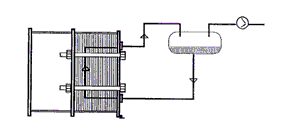


    PHE as submerged vaporizer with thermosiphon circulation.

    DX VAPORIZATION

    Plate heat exchangers have so far been used at capacities up to about 500 kW using direct expansion (DX). It is primarily the brazed PHEs used at these small capacities.

    Pure counter-current operation provides reliable superheating. The pressure drop can be kept low in order to minimize the temperature drop for the refrigerant, and to keep the specific volume at the outlet as low as possible.

    Distribution of the CFCH medium (usually as a two-phase mixture from the expansion valve) to the PHE channels is good provided the number of channels is not excessive. With direct expansion, this is more important, since channel distribution is a function of the relation between channel and inlet-outlet pressure drops.

    An extra restriction at the inlet permits the use of more channels while maintaining good distribution. A fixed throttling at the inlet can, however, lead to difficulties with control; the vaporizing temperature cannot then rise maximally on turndown. The electronically regulated expansion valve cannot easily set the temperature at the vaporizer inlet if a fixed restriction is used.

    Looking for quick answers on air conditioning, heating and refrigeration topics? Try Ask ACHR NEWS, our new smart AI search tool. Ask ACHR NEWS →

    Oil in the channels is entrained and removed from the vaporizer. At small fixed turndown, small quantities of CFC(H)/oil may remain in the inlet manifold, which has a small volume.

    Capacity regulation down to about 20% turndown can generally be permitted. The advantage is that the entire heat transfer surface is available for heat transfer at turndown. The vaporization temperature can then lie above design point.

    As already noted, low loads can be obtained at small nominal velocities, but the shear forces and turbulence mean that oil will still be swept up and out of the vaporizer.

    Choices of vaporizer type and design calculations are made in close cooperation with the designer of the refrigeration plant.


    FREEZE RISK

    The PHE can be designed close to the freezing limit. It is worthwhile repeating the significance of this:

  • Smaller amount of cooled medium to be circulated;
  • Lower brine or glycol concentration; and
  • Low sensitivity demanded by capacity regulation.
  • The PHE does not completely freeze, and the medium continues to circulate. This means:

  • Fast thawing with circulating liquid and the compressor shutdown; and
  • No need to defrost with hot gas.
  • The brazed PHE is a somewhat more rigid construction than the twin-plate PHE, having less internal flexibility. It is therefore somewhat more sensitive to damage due to repeated freezing than is the twin-plate, and is designed with a somewhat higher minimum surface.

    Freeze indication is most readily and quickly obtained via a determination of the pressure drop on the liquid side. An increase in pressure drop occurs instantaneously with the onset of freezing. In systems with varying flow rate, however, this method is evidently less suitable. A low-pressure “pressostat” with a fair margin and/or regulation via minimum liquid temperature from the vaporizer is required.

    Freezing tendency can be minimized through a calculated minimum wall temperature, which lies somewhat above the freezing point. Submerged vaporization permits higher vaporization temperature than does total vaporization-superheating.

    Pure co- or counter-current operation affects the minimum wall temperature. The freezing point will be influenced by the composition of the water. The presence of solid particles increases freezing tendency compared with that for pure water; chemical impurities often reduce the freezing point.


    INDIRECT SYSTEMS

    With the PHE as brine cooler and condenser, the CFC/HCFH system volumes can be kept at an absolute minimum. The brazed units, particularly, permit installation entirely within the framework of the machine, meaning that refrigerant need not exist outside the chilling unit.

    In order to reduce the pumping cost for the viscous brine, the flow in the PHE can be kept low while maintaining turbulent flow. Stable control is thus achieved without discontinuities, which would result from the instabilities, which are the inevitable result of transition to laminar flow regimes.

    The possibility of small temperature differences enable a reduction in vaporization temperatures, compared to DX systems, to be reasonably made. A return to submerged vaporization becomes once more of interest.

    Indirect systems can thus involve advantages not only from the low refrigerant volume, but also from the possibility of stable regulation and relatively high vaporization temperature. This can also be employed to use lower brine concentrations, which in turn has a positive effect on heat transfer rates and pumping cost.

    Stromblad is with Alfa-Laval Thermal, 5400 International Trade Drive, Richmond, VA 23231.

    Publication date: 11/27/2000

    Share This Story

    Looking for a reprint of this article?
    From high-res PDFs to custom plaques, order your copy today!


    Recommended Content

    JOIN TODAY
    To unlock your recommendations.

    Already have an account? Sign In

    • HVAC-enrollment

      The Trades Are Back: HVACR Programs See Nearly 30% Enrollment Spike

      A new wave of future technicians is entering the pipeline.  
      Training and Education
      By: Matt Jachman
    • 2025 Top 40 Under 40

      2025 Top 40 Under 40 HVACR Professionals List

      The 11th annual Top 40 Under 40 list highlights those...
      HVAC Light Commercial Market
      By: Hannah Belloli-Oster
    • LG Ductless Mini-Split Systems

      The 9 Types of Heat Pumps

      As the U.S. moves toward electrification, heat pumps are...
      Heat Pumps
      By: Joanna R. Turpin
    Subscription Center
    • Create an Account
    • Start a Subscription
    • Manage My Account
    • Sign Up for Newsletters
    • Visit Customer Service
    • Update Preferences

    More Videos

    Sponsored Content

    Sponsored Content is a special paid section where industry companies provide high quality, objective, non-commercial content around topics of interest to The News audience. All Sponsored Content is supplied by the advertising company and any opinions expressed in this article are those of the author and not necessarily reflect the views of The News or its parent company, BNP Media. Interested in participating in our Sponsored Content section? Contact your local rep!

    close
    • Piggy Bank
      Sponsored byWatercress Financial

      Energy Prices, Inflation, and HVAC: What Today’s Homeowners Care About

    • Refrigerated Food
      Sponsored bySolstice Advanced Materials

      R-455A Refrigeration: A Cold Storage Solution for the Future

    • Airex Rooftop Units
      Sponsored byAirex Manufacturing Inc

      Consolidating Roof Penetrations: A Growing Trend in Multifamily HVAC Design

    Popular Stories

    HVAC-Price-Increase-graphic

    HVAC Price Increase List: June 2026

    Trump-Section-232.jpg

    Trump Reduces Section 232 Tariffs on HVAC Equipment to 15%

    R410A-Refrigerant-Cylinder.jpg

    Refrigerant Recovery is a Revenue Opportunity

    Heat-pump-cutaway.jpg

    PFAS Rules and A2L Building Codes Continue to Evolve

    Kroger.jpg

    Kroger to Spend $100 Million to Reduce Refrigerant Leaks

    View The ACHR NEWS
    Centennial Anniversary Timeline

    The ACHR News Timeline Chart
    Submit a Letter
    Submit a letter to our editors.

    Events

    November 6, 2025

    Next-Gen Data Center Cooling: HVAC Innovation and Real-World Solutions

    On Demand As AI workloads and high-density computing push traditional cooling methods to their limits, the data center industry is accelerating the adoption of next-generation HVAC technologies.

    June 17, 2026

    Decarbonization Without Disruption

    This webinar will explore practical HVAC decarbonization strategies that minimize disruption while maximizing long-term performance and ROI.

    View All Submit An Event

    Poll

    Summer Staff

    Are you fully staffed for the summer season?
    View Results Poll Archive

    Products

    BNI Mechanical/Electrical Square Foot Costbook, 2026 Edition

    BNI Mechanical/Electrical Square Foot Costbook, 2026 Edition

    See More Products
    Decarbonization Without Disruption - Free Webinar - 6/17/2026

    Related Articles

    • Tranter PHE: Plate Heat Exchanger

      See More
    • Alfa Laval Inc.: Gasketed Plate Heat Exchanger

      See More
    • Plate Heat Exchanger: How Does It Work?

      See More

    Related Products

    See More Products
    • 9781439842126.jpg

      Heat Exchanger Design Handbook, Second Edition

    • 112058072720552801834076395011509172226.jpg

      Heat Pumps, 2nd Edition

    • A-Heat-Pump-Thats-Not-Delivering-Any-Air-DVD-Cover-218x300.jpg

      A Heat Pump That’s Not Delivering Any Air

    See More Products

    Related Directories

    • Polaris Plate Heat Exchangers LLC

      Plate heat exchangers, compact brazed plate heat exchangers, double-wall plate heat exchangers, semi-welded plate heat exchangers and automatic self-cleaning filters/strainers.
    ×

    Sign Up. Stay Informed.

    The #1 trusted source for the HVACR industry since 1926

    SUBSCRIBE
    • RESOURCES
      • Advertise
      • Contact Us
      • Advisory Board
      • Classifieds
      • Submit a Letter
      • Directories
      • Store
    • ACCOUNT CENTER
      • Create an Account
      • Start a Subscription
      • Manage My Account
      • Sign Up for Newsletters
      • Visit Customer Service
      • Update Preferences
    • SERVICES
      • Marketing Services
      • Reprints
      • Market Research
      • List Rental
      • Survey/Respondent Access
    • STAY CONNECTED
      • LinkedIn
      • Facebook
      • Instagram
      • YouTube
      • X (Twitter)
    • PRIVACY
      • PRIVACY POLICY
      • TERMS & CONDITIONS
      • DO NOT SELL MY PERSONAL INFORMATION
      • PRIVACY REQUEST
      • ACCESSIBILITY

    Copyright ©2026. All Rights Reserved BNP Media, Inc. and BNP Media II, LLC.

    Design, CMS, Hosting & Web Development :: ePublishing