NADCA Updates Standard

NADCA also recently unveiled its HVAC Inspectors Program, which was designed to test and certify field technicians on the proper methods of cleaning and checking systems to ensure proper IAQ.
ACR-2002 was released in late 2001 after two years of development. According to John Srofe, past president of NADCA and a member of the committee that developed the standard, ACR-2002 was definitely necessary.
NADCA released a general guideline in 1992, which provided basic information on the cleaning of commercial heating, ventilation, and air conditioning systems.
“Our ’92 standard was the first stab at determining what is clean,” said Srofe. “We did a pretty good job of defining it, but the industry has grown like wildfire since then.”
More specifically, many more IAQ issues have surfaced over the last 10 years, and more tools and procedures are available for cleaning and inspecting systems. With this in mind, NADCA felt the need to release a new standard.
A committee was formed by NADCA, and it spent a great deal of time developing and deciding what needed to be included in the standard. These suggestions were then approved by the NADCA board one section at a time. ACR-2002 also went through public comment and was sent to all sectors of the industry that would be affected by the new guidelines.
Srofe said that the 1992 standard and the 2002 standard are almost impossible to compare. “This [standard] goes so far beyond what the other did,” he said.
Looking for quick answers on air conditioning, heating and refrigeration topics? Try Ask ACHR NEWS, our new smart AI search tool. Ask ACHR NEWS
Standard ACR-2002 not only confronts the cleanliness of the ducts but of the entire HVAC system. In fact, Srofe is calling this latest standard “the bible” of system cleaning.
“We got to first base on the last standard, but we hit more of a home run on this one,” he said.
When To Clean
One of the major portions of ACR-2002 includes guidelines for inspection frequency and determining when it is necessary to clean a system.Inspection frequency depends on several separate factors and differs from application to application. For instance, NADCA says that systems in geographic regions with more humid climates will need more frequent inspections due to the increased potential for microbial amplification. The type of facility will also dictate inspection frequency.
ACR-2002 recommends a yearly inspection on air-handling units for all building classifications, including industrial, commercial, light commercial, residential, healthcare, and marine sectors. Certain parts and components of the system also have their own inspection schedules. For example, according to the standard, the air-handling unit, supply ductwork, and return ductwork must be inspected once every year for industrial buildings. The supply and return ducts for a residential application can be inspected once every two years.
Besides the air-handling unit and the ductwork, the standard recommends inspection of other areas where microbial growth can form, such as humidifiers, controls, VAV boxes, reheating coils, and other internal components.
ACR-2002 also provides information on what technicians should be looking for when inspecting the system and the conditions that will require cleaning. First, cleaning must be performed when system contamination is found. The standard says that if there are significant accumulations of contaminants that can be visually observed, system cleaning is necessary.
The same goes for evidence of compromised performance. If there are blockages or contamination deposits on heat exchange coils, cooling coils, airflow control devices, filtration devices, and air-handling equipment, cleaning must be performed. Finally, NADCA suggests that IAQ management plans include preventive maintenance to minimize the recurrence of system contamination.

How To Clean
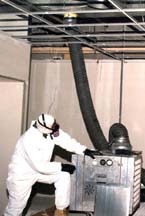
Before cleaning the system, ACR-2002 recommends a project assessment, which will classify the type of building where the application is taking place, an HVAC contamination evaluation, and an environmental impact assessment. The technician must first define the type of building, the type of contamination present in the system, and the effect it has on the building and occupants. After taking these factors into consideration, a technician can decide what kind of cleaning method to use that will be most beneficial for the building and the system.Before cleaning the system, the technician must practice a number of procedures. ACR-2002 gives guidelines for inspecting the hygiene of equipment that will be used to clean the system. It also provides rules for cleaning that equipment, the operating conditions of the system, and so on. More specifically, ACR-2002 says that ducts must be kept at an appropriate pressure differential to surrounding indoor occupant spaces during all cleaning procedures. Also, vacuum collection equipment or a negative air machine must be used to establish pressure differential in the portion of the HVAC system being serviced. An appropriate pressure differential will need to be maintained between the portion of the duct system being cleaned and the indoor occupant space.
After these rules are taken into consideration, the field technician can determine what cleaning method should be used. ACR-2002 presents these choices and goes into detail on how to perform them accurately and efficiently. Mechanical cleaning methods include vacuum units, mechanical and hand brushes, pressurized air sources, pressurized water sources, and other hand tools that can be used to dislodge collected debris.
The final major issue confronted in the standard is the remediation of biological contamination. This section of the standard defines how to remove biological contamination through cleaning methods, the removal of contaminated porous materials, surface treatments, and the use of biocides and coatings.
The Cleanliness Test
At NADCA’s recent annual meeting, “Indoor Environments 2003,” association members had the opportunity to participate in the HVAC Inspectors Program. According to Aaron Mindel, executive director of NADCA, the program provided members with training and information on HVAC systems and components, and why inspections are needed.NADCA developed a manual to go along with the new program, which includes information found in ACR-2002. During the organization’s annual meeting, Mindel said that members were then invited to take a multiple-choice certification test. Over 100 members took the exam to be certified in the appropriate inspection and cleaning procedures.
Mindel believes that the certification program has two primary goals. First, it will help in providing the information and correct procedures required for preventive maintenance due to IAQ issues. It will also help to guarantee the efficiency and effectiveness of a system.
“IAQ is more of a concern now,” said Mindel. “Ten years ago, it wasn’t in the news.”
Srofe stated that consumers, building owners, and building occupants are more aware of indoor air and the effects it has on their health. He also said that as the public begins to learn more and more about ventilation systems and the air they breathe, the more it is necessary for the industry to stay on top of developing adequate standards and guidelines.
This will not be the last time that NADCA’s standards will be redeveloped and revamped. Srofe hopes that ACR-2002 will be looked at every three or four years to make needed additions.
For more information on ACR-2002 or the HVAC Inspectors Program, visit www.nadca.com.
Publication date: 05/12/2003
Looking for a reprint of this article?
From high-res PDFs to custom plaques, order your copy today!