ACHR News
search
Ask ACHR NEWS AI
cart
facebook twitter instagram linkedin youtube
  • Sign In
  • Subscribe
  • Sign Out
  • My Account
ACHR News
  • NEWS
    • Breaking News
    • New HVAC Products
    • Featured Products
    • Manufacturer Reports
    • HVAC Data
    • Legislation
    • ACHR NEWS Centennial
  • RESIDENTIAL
    • Air Conditioners
    • Furnaces
    • Residential Heat Pumps
    • Ductless
    • Residential IAQ
    • Testing, Monitoring, Tools
    • Components & Accessories
  • COMMERCIAL
    • Air Handlers
    • Rooftop Units
    • Chillers and Cooling Towers
    • Commercial Heat Pumps
    • Boilers and Hydronics
    • VRF/Ductless
    • Commercial IAQ
  • REFRIGERATION
    • Refrigerants
    • Refrigerant Regulations
    • Leak Management
  • CONTRACTOR PRO
    • Geothermal
    • Homeowner Study
    • VRF and VRV Ductless
    • Unitary Trends
  • EDUCATION
    • Training and Education
    • Business Management
    • Service and Maintenance
    • Continuing Education
    • Market Research >
      • HVAC Brand Awareness Report
      • VRV, VRF, VRVZ Report
      • Unitary Trends Report
      • Water Heat Professionals Report
    • Webinars
    • Sponsor Insights
    • eProducts Info
    • White Papers
  • EVENTS
    • HVAC Contractor Forum
    • Industry Events and Webinars
  • MEDIA
    • Videos
    • AHR Expo 2025 Videos
    • Podcasts >
      • ACHR News Podcast
      • HARDI Podcasts
      • AHR Expo Podcasts
      • ACCA Podcasts
    • Interactive Spotlights
    • Quizzes
    • eBooks
    • HVAC Talkback
  • HVAC GROUP
    • ACHR NEWS >
      • Current Issue
      • Digital Edition
      • Subscribe
    • Distribution Trends
    • SNIPS NEWS >
      • Join SNIPS NEWS
    • Engineered Systems News >
      • Join ES News
    • HVACR Directory
    • Contests
    • Newsletters
    • Contact
    • Advertise
    • My Account

Making Sense of Refrigerant Blends

May 10, 2001
One aspect of recovery and recycling is dealing with a whole new breed of refrigerants: the blends.

Refrigerant blends have been developed for existing as well as for new equipment. Their properties make them comparable alternatives to previously used substances.

Although the number of blends in the market has thankfully dropped off, the range of offerings is still very extensive.

There are two categories: transitional (service) blends and chlorine-free blends.


Blends in the field

Most transitional or service blends contain HCFC-22 as the main refrigerant. They are primarily service refrigerants for existing equipment that once used R-12, -502, or other CFCs. Correspond-ing products are offered by various manufacturers. Practical experiences covering the necessary steps of conversion are well known.

Chlorine-free HFC blends are long-term substitutes for CFCs and HCFCs. HFCs 404A and 507A are already being used to a great extent.

Two- and three-component blends have a long history in the refrigeration trade. There is a difference between the so-called “azeotropes” (e.g., R-502) with thermodynamic properties similar to single-substance refrigerants, and “zeotropes” with gliding phase changes. The development of zeotropes mainly concentrated on special applications in low-temperature and heat pump systems.

A somewhat more common practice earlier was the mixing of R-12 and -22 in order to improve the oil’s return flow. R-22 was also added to R-12 systems to improve performance, as well as the addition of hydrocarbons in the extra-low-temperature range. The background for this was to provide better oil transport in the colder parts of the system, but also (with R-22/R-12) to reduce the discharge gas temperature with higher-pressure ratios.

This possibility of a specific “formulation” of certain characteristics was the main starting point for the development of a new generation of blends.

Looking for quick answers on air conditioning, heating and refrigeration topics? Try Ask ACHR NEWS, our new smart AI search tool. Ask ACHR NEWS →

No directly comparable substitutes for R-502 and -22 are available from the chlorine-free, single-substance alternative refrigerants.

If flammability and toxicology are issues, and COP, pressure, and temperature conditions are to be comparable, the only substitutes that remain for the long term (in addition to R-134a) are blends.


Substitutes

Substitutes for R-502 have first priority, as they are needed in large quantities and are already affected by phaseout regulations in many countries.

A zeotropic blend (such as R-502) behaves as a single-substance refrigerant with regards to evaporation or condensing processes. The phase change with zeotropic fluids occurs in a “gliding” form over a certain range of temperatures.

This temperature glide can be more or less pronounced. It is mainly dependent upon the boiling points and the percentage proportions of the individual components.

Certain supplementary definitions are also being used depending on the effective values. These terms include “near-azeotrope” or “semi-azeotrope” for a fairly small glide.

In practice, this means a small increase in temperature in the evaporation phase and a reduction during condensing. In other words, based on certain pressures, the resulting saturation temperatures differ in the liquid and vapor phases (Figure 1).

To enable a comparison with single-substance refrigerants, the evaporating and condensing temperatures have been mostly defined as mean values. As a consequence, the measured subcooling and superheating conditions (based on mean values) are unreal. The effective results — related to dew and bubble temperature — are less in each case.

These factors are very important when assessing the minimum superheat at the compressor inlet (usually 5 to 7 K) and the quality of the refrigerant after the liquid receiver.

With regard to a uniform and an easily comprehensible definition of the rated compressor capacity, there are international (EN12900) and U.S. (ARI540) standards to apply. Evaporating and condensing temperatures refer to saturated conditions.

Referring to Figure 1, the evaporating temperature is according to Point A, and the condensing temperature is according to Point B. Also in this case, the assessment of the effective superheating and subcooling temperatures will be simplified.

It must, however, be considered that the actual refrigeration capacity of the system can be higher than the rated compressor capacity. This is partly due to an effectively lower temperature at the evaporator inlet.

A further characteristic of zeotropic refrigerants is the potential concentration shift when leakage occurs. Refrigerant lost in the pure-gas and liquid phases is mainly noncritical. Leaks in the phase-change area (such as after the expansion valve, and within the evaporator and condenser-receiver) are considered more significant. It is, therefore, recommended that soldered and welded joints are used in these sections.

Extended investigations have, in the meantime, shown that the effect of leakage leads to less-serious changes in concentration than was previously thought. In any case, it is certain that the substances that are dealt with here cannot develop any flammable mixtures, either inside or outside the circuit. Essentially similar operating conditions and temperatures as before can only be obtained by supplementary charging with the original refrigerant in the case of a small temperature glide.
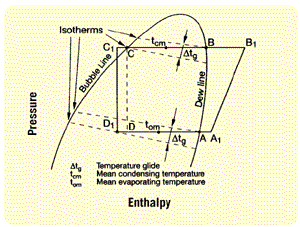


Figure 1. Evaporating and condensing behavior in zeotropic blends.

Practical Handling

Further conditions and recommendations concerning the practical handling of blends must also be considered.

  • The equipment always has to be charged with liquid refrigerant. When vapor is taken from the charging cylinder, shifts in concentrations may occur.
  • Since all blends contain at least one flammable component, the entry of air into the system must be avoided. A critical displacement of the ignition point can occur under high pressure and evacuating when a high proportion of air is present.

  • The use of blends with a significant temperature glide is not recommended for equipment with flooded evaporators. A large concentration shift is to be expected in this type of evaporator, and as a result, also in the circulating refrigerant mass flow.
  • Renz is with Bitzer International of Sindelfin-gen, Germany. Information can be obtained through Delta Heat Transfer, 770-967-0030.

    Publication date: 05/14/2001

    Share This Story

    Looking for a reprint of this article?
    From high-res PDFs to custom plaques, order your copy today!


    Recommended Content

    JOIN TODAY
    To unlock your recommendations.

    Already have an account? Sign In

    • HVAC-enrollment

      The Trades Are Back: HVACR Programs See Nearly 30% Enrollment Spike

      A new wave of future technicians is entering the pipeline.  
      News
      By: Matt Jachman
    • 2025 Top 40 Under 40

      2025 Top 40 Under 40 HVACR Professionals List

      The 11th annual Top 40 Under 40 list highlights those...
      HVAC Contracting
      By: Hannah Belloli-Oster
    • LG Ductless Mini-Split Systems

      The 9 Types of Heat Pumps

      As the U.S. moves toward electrification, heat pumps are...
      News
      By: Joanna R. Turpin
    Subscription Center
    • Create an Account
    • Start a Subscription
    • Manage My Account
    • Sign Up for Newsletters
    • Visit Customer Service
    • Update Preferences

    More Videos

    Sponsored Content

    Sponsored Content is a special paid section where industry companies provide high quality, objective, non-commercial content around topics of interest to The News audience. All Sponsored Content is supplied by the advertising company and any opinions expressed in this article are those of the author and not necessarily reflect the views of The News or its parent company, BNP Media. Interested in participating in our Sponsored Content section? Contact your local rep!

    close
    • Piggy Bank
      Sponsored byWatercress Financial

      Energy Prices, Inflation, and HVAC: What Today’s Homeowners Care About

    • Refrigerated Food
      Sponsored bySolstice Advanced Materials

      R-455A Refrigeration: A Cold Storage Solution for the Future

    • Airex Rooftop Units
      Sponsored byAirex Manufacturing Inc

      Consolidating Roof Penetrations: A Growing Trend in Multifamily HVAC Design

    Popular Stories

    HVAC-Price-Increase-graphic

    HVAC Price Increase List: June 2026

    Trump-Section-232.jpg

    Trump Reduces Section 232 Tariffs on HVAC Equipment to 15%

    R410A-Refrigerant-Cylinder.jpg

    Refrigerant Recovery is a Revenue Opportunity

    Heat-pump-cutaway.jpg

    PFAS Rules and A2L Building Codes Continue to Evolve

    Kroger.jpg

    Kroger to Spend $100 Million to Reduce Refrigerant Leaks

    View The ACHR NEWS
    Centennial Anniversary Timeline

    The ACHR News Timeline Chart
    Submit a Letter
    Submit a letter to our editors.

    Events

    November 6, 2025

    Next-Gen Data Center Cooling: HVAC Innovation and Real-World Solutions

    On Demand As AI workloads and high-density computing push traditional cooling methods to their limits, the data center industry is accelerating the adoption of next-generation HVAC technologies.

    June 17, 2026

    Decarbonization Without Disruption

    This webinar will explore practical HVAC decarbonization strategies that minimize disruption while maximizing long-term performance and ROI.

    View All Submit An Event

    Poll

    Summer Staff

    Are you fully staffed for the summer season?
    View Results Poll Archive

    Products

    BNI Mechanical/Electrical Square Foot Costbook, 2026 Edition

    BNI Mechanical/Electrical Square Foot Costbook, 2026 Edition

    See More Products
    A2L Refrigerants - Free Webinar - May 21, 2026

    Related Articles

    • Air-Cooled Compressor.

      Making Sense of Compressor Frost Patterns

      See More
    • Making Sense Of Filter Selection

      See More
    • The Professor: The Art and Science of Creating Refrigerant Blends

      See More

    Related Products

    See More Products
    • Lessons Learned in a Boiler Room: A common sense approach to servicing and installing commercial boilers

    • low grade.png

      Low GWP Refrigerant Safety: Flammable & Mildly Flammable Refrigerants Manual

    See More Products

    Events

    View AllSubmit An Event
    • May 21, 2026

      The A2L Genie is Out of the Refrigerant Canister – What Now?

      On Demand Join this webinar to learn about key updates to refrigerant regulations. We will cover practical installation and servicing content gathered from thousands of our interactions with contractors across the US and Canada.
    View AllSubmit An Event
    ×

    Sign Up. Stay Informed.

    The #1 trusted source for the HVACR industry since 1926

    SUBSCRIBE
    • RESOURCES
      • Advertise
      • Contact Us
      • Advisory Board
      • Classifieds
      • Submit a Letter
      • Directories
      • Store
    • ACCOUNT CENTER
      • Create an Account
      • Start a Subscription
      • Manage My Account
      • Sign Up for Newsletters
      • Visit Customer Service
      • Update Preferences
    • SERVICES
      • Marketing Services
      • Reprints
      • Market Research
      • List Rental
      • Survey/Respondent Access
    • STAY CONNECTED
      • LinkedIn
      • Facebook
      • Instagram
      • YouTube
      • X (Twitter)
    • PRIVACY
      • PRIVACY POLICY
      • TERMS & CONDITIONS
      • DO NOT SELL MY PERSONAL INFORMATION
      • PRIVACY REQUEST
      • ACCESSIBILITY

    Copyright ©2026. All Rights Reserved BNP Media, Inc. and BNP Media II, LLC.

    Design, CMS, Hosting & Web Development :: ePublishing