Is Basic HVAC Tech Training Enough?

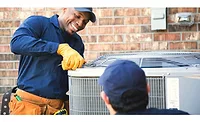
Nate Adams, a student at Bates Technical College in Tacoma, Wash., takes on a brazing project.
Many schools that provide the basics in HVACR training are saying the baseline of those basics seems to be getting higher and higher. And for the most part, they say that’s because the industry is constantly getting more and more new technologies - and new regulations - that, in turn, get added onto the curriculum.
But that doesn’t mean all graduates will be automatically ready to enter the industry beyond entry level.
“Many employers have the expectations that a student completing a program should be able to get into a service truck and be as productive as a 10-year veteran,” said Mart Peila, HVACR instructor, at Bates Technical College in Tacoma, Wash. “But in reality, the gap between entry-level knowledge and what the experienced tech should know has grown exponentially. The industry has had more changes in the past few years than have taken place in the previous 40.”
It is a thought echoed by many of Peila’s peers at technical schools, community colleges, and even high schools across the country.
To find out what kind of training is going on these days - and to see how that lines up with what the industry needs - The NEWS contacted a number of instructors to find out about their programs and expectations. The feedback, while but a small portion of the educational universe, does give a snapshot of what’s happening at the starting point for launching a technician into the industry.
A LOT OF BASICS
A good example of how detailed the basics can be is at Northwest Mississippi Community College in Senatobia, Miss. The first year of the two-year program lists Basic Compression Refrigeration, Basic Electricity, Tools and Piping, Refrigeration System Components, Professional Service Procedures, and Controls. The second year has Air Conditioning 1 & 2, Heating Systems, Heat Load and Air Properties, Commercial Refrigeration, and Refrigerant Retrofit and Regulations. Another component in the program at the school is its recognition with the Partnership for Air-Conditioning, Heating, Refrigeration Accreditation.What that all adds up to are “graduates who for the most part will be entry-level,” said Whit Perry, HVACR instructor. “But occasionally we have a student who becomes very knowledgeable and begins running calls shortly after being employed.”
For Perry, a key aspect in continuing training is working with local unions. “The Local 614 Steamfitters union works with us on a continual basis because our students are more knowledgeable than the guy coming off the street. They still go through the apprenticeship but they are usually a cut above.”
The training also extends to the faculty at Northwest Mississippi and shows how it can extend beyond the classroom. “Our full time faculty is National Association of Technician Excellence (NATE) certified. We try to take as many industry courses as we can and encourage the students attend with us. We hope to get them in a routine of continuing their involvement with the local distributors.”
He added, “We continue to push ourselves as well as our students. We try to continually raise the bar and not lower it.”

Jeryll McWhorter: “With our tight economy, we’ve been asked to do more with less, as well as develop new courses.”
THE APPRENTICE CONNECTION
The importance of making sure students continue on with their training is important to Peila at Bates Technical College. “More than 30 apprenticeship programs train their students through partnerships with Bates. The goal of the Bates HVAC program is to provide students with skills that will allow entry-level employment.”The school, like others, has a detailed instructional program. Peila said this includes “safety, basics involving theory, installation and service; and electrical as well as communication and customer service skills.”
He noted that both trade associations and manufacturers “provide up-to-date equipment for our students’ training needs.” Peila added, “The support of our local supply houses is paramount to our students success. It is organizations and companies like these that make it possible for programs to keep our training up to industry standards.”
That tri-level of support - associations, manufacturers, and wholesalers - was echoed by other educators.
Peila said another focus in the classroom is codes, regulations, and certifications. “The discussion of codes and standards is a major part of our training. The state of Washington requires technicians to hold a journeyman electrical certificate to perform any electrical work on HVAC or refrigeration equipment.”
He said of Bates students, “They will have the basic skills to go to work for an employer and be productive. As I tell my students, the real learning will start when you go to work. We provide the foundation for you to learn on.”
Sometimes it is, according to Piela, “a balancing act of curriculum development for a career training program. Instructors must consider what new information should be included in the program without going beyond the needs of entry-level technicians.” To help figure that out, he said, requires “a strong industry advisory committee that can ensure that curricula are in keeping with employer expectations for entry-level technicians.”
REGULATIONS
At Triangle Tech in Pittsburgh, there are demonstrations of the expectations of a school before the first teaching word is uttered in class and of the coordination needed between the school and the industry.For example, Triangle Tech is a degree granting, post-secondary proprietary school accredited by the Accrediting Commission of Career Schools and Colleges and is licensed by the Pennsylvania State Board of Private Licensed Schools of the Pennsylvania Department of Education.
The program encompasses residential and commercial refrigeration labs and theory, heating, ventilation and air conditioning lab and theory, sheet metal, heat pumps, estimating, transport refrigeration, direct digital controls, environmental engineering, and environmental controls and pneumatics.
One aspect of the program demonstrates the recurring theme of many schools that only so much can be taught. Instructor Mark DeBoe said, “Due to the variations in local codes and the wide area our students come from, local codes are not covered specifically, but it is impressed upon our students to always check the local building codes.”
He, too, sees a starting point. “Our students are trained for entry-level positions with various types of companies. Graduates have found employment with HVAC contractors, commercial refrigeration contractors, supply houses, control companies, and manufacturers.”
A key for him is that the source doing the hiring needs to know what they are getting. “The companies that hire our graduates know what they are taught in school. They also know what their skill sets are. Employers come to us looking for entry-level people and are very happy with our graduates.”

Mark Peila: “The industry has had more changes in the past few years than have taken place in the previous 40.”
ADJUSTING
Sometimes, in addition to adding on specific aspects of study, a school can find itself adding on entire programs. At DeKalb Technical College in Clarkston, Ga., an advisory board made up of industry professionals was pushing the step up in specific training. The result has been the addition this academic year of two programs at DeKalb - Commercial Refrigeration and Building Automation Systems. These are in addition to the existing HVAC offerings.“Our graduates are prepared to work as entry level service technicians,” said instructor Jeryll McWhorter. “Some who complete our associate’s degree program and with further training and education can enter such fields as sales and application engineering.”
And everywhere in the academic world the green aspect of the industry is a factor. Like other schools, DeKalb discusses and provides testing in Environmental Protection Agency 608 Certification. “Additionally,” said McWhorter, “we expose our students to the competencies contained in the Industry Competency Exam (ICE) and NATE.
“And there is a focus on sustainability. We have created a new Green Technologies Academy” for just such a focus.
This growth and change comes in a tough economic climate. Said McWhorter, “With our tight economy, we’ve been asked to do more with less, as well as develop new courses.”
FRONT END
For some who eventually enter the HVACR field, first exposure was not at the post-secondary level. High schools also play a part, a fact that is recognized each summer at the SkillsUSA Championship. In the HVACR competition there are gold, silver, and bronze medals awards for both secondary and post-secondary students.A good example of the dynamics at the secondary level is at Foothill High School in Henderson, Nev. The NEWS’ 2009 Instructor of the Year was the school’s HVAC instructor, Larry Ball.
He works in conjunction with a local community college, the College of Southern Nevada, where he actually conducts the classes. His students are as young as high school sophomores. Some students come from multi-generational families who have been in HVACR and because of that are focused on the trade at an early age.
Ball’s own father was involved in HVAC work. Teaching, he said, “Is a way to give back to the industry and get qualified techs in the field.”
EXPECTATIONS
For contractors doing hiring, expectations of those coming out of vo-tech schools and colleges encompass an understanding of the theoretical and practical of HVACR.“One of the qualities we look for in a candidate for potential employment is that he or she grasps the ‘theory’ of the refrigeration process as a whole,” said Rich Morgan, president and CEO of Magic Touch Mechanical of Mesa, Ariz. “This involves a good understanding of the mechanical, electrical, and air distribution systems and how they work in conjunction with each other to complete the refrigeration process.”
He added, “As a person who was working in the field for a number of years prior to attending a trade school myself, I can state from experience that upon having a better understanding of the theory of refrigeration, it gives a clear understanding of the ‘why’ we practice certain tasks in the field and transforms a technician from a parts-changer to a troubleshooting technician and customer advisor.”
John Blackall of Blackall Mechanical Inc. of Dallas agreed with the focus on theory and practical. “Having been in the business for 30 years and having gone through trade school myself, my expectations for them are to be able to understand the theory of the refrigeration system - how and why it works, the components within the system, and why things like superheat and subcooling are so important.
“Beyond that, they need to know how to read electrical diagrams, and be able to troubleshoot the basic BTU 10-ton and less control system. If they do not have this level of knowledge, then they cannot perform at a level B tech position.”
Noted James Gallet of Envirotech Heating & Cooling, Shawnee, Kan., “I do believe that someone coming from a trade school as a service technician should have very good knowledge of low voltage circuits, the refrigeration processes, and airflow basic knowledge. They should be able to use certain troubleshooting tools such as electrical meters, digital thermometers, and refrigeration gauges.
“The technician should also be EPA-certified and able to charge systems using superheat and subcooling methods.”
BEYOND
One thing is clear. No matter how high the expectations of a contractor concerning the level of training given to a student in an HVACR program, there is only going to be a finite amount of information offered. That may be because of the limits to the mechanical equipment coming into the lab and - just as likely as one educator said - the limits of the human mind in a couple of years to absorb the accelerating levels of information the industry is dishing out.That’s why training is ongoing and never ending, say every educator interviewed. There are two- and four-year HVACR schools, apprentice programs, union run schools, trade association seminars, and those classes offered by manufacturers and wholesalers - just to name a few.
And every contractor knows ongoing training ends up their responsibility as well, whether it involves plugging employees into manufacturer, wholesaler, and association classes - and/or doing some of their own training as well.
In the last category, consider the efforts of Energy Air, a contractor in Orlando, Fla., as an example. “We have an in-house training program called F.A.C.T. – Florida Air Conditioning Training,” said Kati Trisler, director of marketing. “It started as a three-year program, but we have just added a fourth year of courses. The content was developed in house and classes are taught in both English and Spanish.
“Our leadership felt there was a need for this kind of updated training in the industry.”
Publication date: 06/21/2010
Looking for a reprint of this article?
From high-res PDFs to custom plaques, order your copy today!