Investigating Furnace Failures
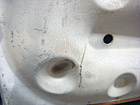
Side view of a 90 percent efficient serpentine chamber missing an eyelet and vertical crack from dimple.
When you or one of your company’s service technicians leaves a customer’s house, are you 100 percent confident that your customer and their family are safe? Do you and your service technicians know how to properly and thoroughly inspect a furnace heat exchanger? It goes way beyond safety checking the obvious components. The most important part of a safety inspection is checking for gas leaks, checking carbon monoxide levels and inspecting the heat exchanger.
I have been in the HVAC service industry for about 50 years. Thirty years ago, I realized that service technicians, utility technicians, and otherwise excellent service people have no concept of how to safety check a furnace heat exchanger. Other than conducting a carbon monoxide test, looking for something obvious like blower interference, or a clear massive crack in the heat exchanger, I know that a large percentage of HVAC field technicians and those working for gas utility companies are not properly trained on the appropriate way to conduct a residential furnace heat exchanger safety inspection.
Trained individuals who can accurately determine the integrity of a furnace heat exchanger face another obstacle: second opinions by those who may not be trained or who are undertrained.
For example, many times a gas company technician will tell a homeowner that the furnace is fine after I or one of my employees has found a crack. I can’t count the number of times I have had to meet a gas company technician and show him where the crack is located in a heat exchanger. They always say the same thing “Well, it wasn’t there last week when I looked” or “This is the first time I missed a crack.” Gas company technicians have no business diagnosing the integrity of a furnace heat exchanger if they don’t know how. They should get the proper training, or not look at furnaces at all.
IT REALLY IS A MATTER OF LIFE AND DEATH
I have written other articles on heat exchanger inspection techniques and cannot stress enough the importance of proper training on residential furnace heat exchanger inspection. One comment that has always been made about me is that I have a passion for what I teach. The reason for this passion is the fact that I have been in homes after a fatality from carbon monoxide poisoning due to a faulty heat exchanger that could have been prevented had the furnace been serviced and inspected by a properly trained individual.I have been hired as an expert witness in court cases involving carbon monoxide poisonings due to cracked heat exchangers; in several of them death was a result of carbon monoxide. One reason that prompted me to write this particular article is this: I was scheduled to testify on Dec. 7, 2007 at a trial on the behalf of a deceased man’s family. This gentleman rented his house for over 15 years and died in February 2002 from carbon monoxide poisoning from a furnace with a 12-inch crack in the heat exchanger.
The expert that was going to be used in this case for the defendant (the landlord) has 18 years of experience in the HVAC field. After he examined the heat exchanger, he pulled the blower and found the unit was missing a filter and the blower was working at 40 percent capacity so the heat exchanger was stressed by lack of airflow, in his opinion. He said he conducted a CO test and found 0 ppm.
This furnace was manufactured in 1976 and was installed in a wide-open basement with approximately six windows and no partitions. The furnace was removed and put into storage to be used as evidence for the trial. When I conducted the research for my testimony on the trial, I inspected the furnace at the storage facility. In less than 10 minutes I found at least one 12-inch crack in the heat exchanger cell. Now this is the part that infuriated me: the expert for the defendant, upon hearing my findings, said he thoroughly inspected the furnace and that the heat exchanger must have cracked when it was transported to storage. This was a seasoned technician who was trusted to determine if the furnace was safe. How could he miss a crack like this in the heat exchanger, especially when it was of such importance? This case was eventually settled out of court.
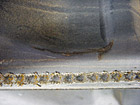
Photo of crack look at back of furnace.
HOW CRACKS OCCUR
Our industry lacks education on proper heat exchanger safety inspection. There is an easy inspection method for every style of furnace heat exchanger manufactured. I have trained HVAC technicians, gas company technicians and home and building inspectors from coast to coast for nearly 30 years. I look at furnaces across the country, and have determined that the same defects occur consistently across the board. I can assure you that approximately one out of two furnaces over five years old will have a crack in the heat exchanger.How can this happen?
In a have previously stated I only cared where heat exchangers crack, not why. The fact is I do care why. There are usually combinations of causes which create excessive stress on the metal of heat exchangers.
For starters, older homes, 40-50 years and older, were built with very ample duct systems. Every room had a custom trunk line for return air. The ductwork was designed to take all the pressure off of the furnace.
Years ago, the original cost of the heating system was 10 times the cost, or more, compared to what is spent on the heating systems of new homes today. Today, most new homes don’t have proper air returns. Add the fact that installers now oversize many furnaces, which the returns can’t handle. This in turn causes metal stress, which causes cracks.
Other causes may include:
• Filters that are too restrictive not allowing proper airflow over the heat exchanger, cause metal stress.
• Filters that aren’t changed often enough, which also restrict the airflow over the heat exchanger, again cause stress.
• Furnace running during the home construction process often referred to as dry-in. The out-gassing from the construction materials damages the heat exchanger.
• Water leaks from a humidifier that is not properly maintained.
• Water leaks from the evaporator coil.
• A poor manufacturing design.
It is inappropriate to simply blame the manufacturer. The items listed above are the usual causes of heat exchanger failures. In some cases, heat exchangers that last a long time usually operate in a near perfect world where the above causes never come into play. However, looking closely at the list again, you will find that contractors and owners must sometimes bear responsibility.

Close up view of crack in wide chambered heat exchanger. The technique to inspect this type is by removing burners and using your hand to feel crack.
COMMON FAILURES
All heat exchangers have one thing in common: the style of the chamber, regardless of brand, will fail in the same place.In a lot of cases, replacing the heat exchanger won’t solve the problem, because the cause will still exist. It is important to educate your customer about changing the furnace filter and scheduling a yearly service and safety check.
A cracked heat exchanger and a carbon monoxide leak are two different things. A cracked heat exchanger is an unsafe utility whether it leaks carbon monoxide or not. However, the American Gas Association states that a crack or hole less than 1/8 inch in size is acceptable. Granted, but in my experience a crack will not get better; it will only get worse with each cycle of the furnace. The crack expands each time the heat exchanger heats up.
At any time a furnace can change the way it burns and start producing carbon monoxide. It takes two things to get carbon monoxide poisoning: the presence of carbon monoxide and a passage way into the living area, which is usually the duct system.
One thing I would like to stress is when companies ask me about changing the brand of furnace they use because they might see failures during our classroom training, I always tell them the same thing; if your distributor treats you like you treat your customer, there is no need to change brands. Don’t put up with bad service, lack of availability of parts, or any pricing issues.
I don’t condemn or endorse any brand of furnace. They are all metal to me. Any brand of furnace will last if it is installed properly, with proper ducting, proper return air, etc. Installers have a great deal to do with preventing premature heat exchanger failure. They need to be sure the furnace is properly sized, conduct a temperature rise, static pressure readings, and derate the furnace for proper gas pressure.
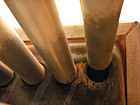
Tubular type chamber showing collector box where tube failed.
USE THE TOOLS PROPERLY
There are many tools on the market to inspect heat exchangers such as scopes, cameras, etc. If they help you with one type of chamber, it will be worth using, but remember, nothing will replace the knowledge of knowing where to look with your own eyes at each style of heat exchanger. There isn’t any residential furnace on the market that can’t be checked thoroughly only using your eyes, knowledge, and a few basic tools.Cameras and scopes can be useful to inspect some furnaces, such as clamshell types, but are very limited in certain types of chambers. There are many sections of furnace heat exchangers that you can’t see with a camera or scope. You can’t take a picture of what you can’t see with your eyes. With the proper training, any individual in the service industry will be able to conduct a furnace safety inspection with confidence, and upon finding any cracked heat exchanger, will be able to show it to the customer.
The pictures that accompany this article show some examples of heat exchangers and defects that can be easily found with the correct training and proper tools. You would not be looking at the pictures of these cracked heat exchangers had these furnaces been installed and/or maintained properly.
When I teach a class, I bring every brand of furnace intact as well as the chamber outside of the furnace for hands-on training.
Contractors can best protect themselves and their customers by ensuring that they have the proper knowledge with regard to heat exchanger safety. There are too many people in this industry who claim to provide expert advice on this matter, but far too few really understand what it is they are looking for.
The most important point I can ever impress upon a person in one of my classes is that you don’t want to ever make a mistake about diagnosing a crack in a heat exchanger. You don’t want to be wrong. If you are, it can mean the difference between someone waking to see the sun come up and that person never waking up again.
Publication date: 02/18/2008
Looking for a reprint of this article?
From high-res PDFs to custom plaques, order your copy today!


