ACHR News
search
Ask ACHR NEWS AI
cart
facebook twitter instagram linkedin youtube
  • Sign In
  • Subscribe
  • Sign Out
  • My Account
ACHR News
  • NEWS
    • Breaking News
    • New HVAC Products
    • Featured Products
    • Manufacturer Reports
    • HVAC Data
    • Legislation
    • ACHR NEWS Centennial
  • RESIDENTIAL
    • Air Conditioners
    • Furnaces
    • Residential Heat Pumps
    • Ductless
    • Residential IAQ
    • Testing, Monitoring, Tools
    • Components & Accessories
  • COMMERCIAL
    • Air Handlers
    • Rooftop Units
    • Chillers and Cooling Towers
    • Commercial Heat Pumps
    • Boilers and Hydronics
    • VRF/Ductless
    • Commercial IAQ
  • REFRIGERATION
    • Refrigerants
    • Refrigerant Regulations
    • Leak Management
  • CONTRACTOR PRO
    • Geothermal
    • Homeowner Study
    • VRF and VRV Ductless
    • Unitary Trends
  • EDUCATION
    • Training and Education
    • Business Management
    • Service and Maintenance
    • Continuing Education
    • Market Research >
      • HVAC Brand Awareness Report
      • VRV, VRF, VRVZ Report
      • Unitary Trends Report
      • Water Heat Professionals Report
    • Webinars
    • Sponsor Insights
    • eProducts Info
    • White Papers
  • EVENTS
    • HVAC Contractor Forum
    • Industry Events and Webinars
  • MEDIA
    • Videos
    • AHR Expo 2025 Videos
    • Podcasts >
      • ACHR News Podcast
      • HARDI Podcasts
      • AHR Expo Podcasts
      • ACCA Podcasts
    • Interactive Spotlights
    • Quizzes
    • eBooks
    • HVAC Talkback
  • HVAC GROUP
    • ACHR NEWS >
      • Current Issue
      • Digital Edition
      • Subscribe
    • Distribution Trends
    • SNIPS NEWS >
      • Join SNIPS NEWS
    • Engineered Systems News >
      • Join ES News
    • HVACR Directory
    • Contests
    • Newsletters
    • Contact
    • Advertise
    • My Account

Down With Pressure, Up With Efficiency

By Barbara A. Checket-Hanks
November 17, 2002
LAKE LANIER, GA — In today’s economy, customers are more aware than they have been in a long time of the importance of getting the most out of their energy dollars. Efficient operation of evaporative condensers can help. In general, this means reducing the discharge pressure.

Banks Tomas, a project engineer for Uni-Temp Refrigeration, Norcross, GA, addressed evap condenser efficiency in his session paper, “Operating A More Energy-Efficient Refrigeration System,” presented at the recent conference of the Refrigerating Engineers and Technicians Association (RETA).

Big redesigns may sound good, but Tomas pointed out that “Operators rarely have the luxury of making major design changes to their refrigeration system, and even if they do, it can sometimes take years to put into effect.

“In the interim, they must make the most of their system within the constraints of the maintenance budget.”

For condensers, this means lowering the discharge pressure.
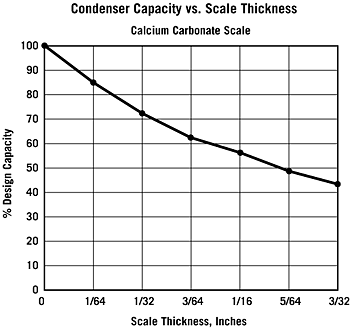
Figure 1. Condenser capacity vs. scale thickness. The scale measured is calcium carbonate. (Courtesy of Baltimore Aircoil Co.)

HIGHER PRESSURE = HIGHER COSTS

Many factors affect discharge pressure, which then affects electrical consumption. Tomas gave the following example.

Let’s say you have a 1,000-ton ammonia refrigeration system with a –20 degrees F suction temperature, designed to maintain an 85 degree discharge temperature/151.7-psig pressure during summer months. “However, due to various problems, you can only maintain your discharge temperature at 95 degrees, 181.1 psig,” Tomas said.

“If this condition existed through June, July, and August, in those three months alone your company would pay approximately $14,500 in additional electrical costs.” This is based on a $0.05/kWh rate and a run time of 540 hours/month.

“It is easy to see how quickly the costs can add up when your discharge pressure is higher than necessary,” he said. In addition to cost savings, when you reduce your system’s head pressure, you can achieve slightly higher compressor capacity ratings and “the potential for greater compressor life due to reduced compression ratio.”

Looking for quick answers on air conditioning, heating and refrigeration topics? Try Ask ACHR NEWS, our new smart AI search tool. Ask ACHR NEWS →

The obvious answer, said Tomas, is to add more condenser capacity. But before you do that, make sure the existing condensers are operating at design capacity.

CHECK THE COILS

“Most people realize that coil condition is a factor in the effectiveness of a condenser,” Tomas stated, “but they may not realize how critical this aspect is.” The more scale, the lower the efficiency. (See Figure 1.)

“Even with a scale accumulation of a mere 1/64th of an inch, the condenser is already operating approximately 15% below design capacity.” The solution is an effective water treatment program with regular monitoring.

Note: Make sure the company you select is familiar with your local water conditions.

Treatment should handle both scale and biological growth, Tomas said, plus other local conditions.

THE BENEFITS OF PURGING

Noncondensible gases, namely air, tend to accumulate in high-pressure areas, such as condensers and high-pressure receivers, Tomas pointed out.

“Inside the condenser, the air displaces condensing surface area and acts as an insulator, effectively reducing the capacity of the condenser. Many people mistakenly believe they should only be concerned about air if their system runs in a vacuum,” he said. “Although systems in a vacuum are more susceptible to air problems, all systems accumulate air over time from performing maintenance or adding refrigerant to the system.” Oils also can break down under certain circumstances, forming noncondensible gases.

“The best way to remove noncondensibles is to install a purger,” Tomas said. There are several options available. “In most cases, these purgers offer a very attractive payback and should be strongly considered for all systems, whether running in a vacuum or not.”

PIPING ARRANGEMENT

Another area in which service and maintenance staff can improve evaporative condenser discharge pressures is through the piping arrangement.

“Piping of evaporative condensers can be complicated,” Tomas advised, “and if you have any doubts, consult a quality refrigeration engineer or contractor.” He then offered the following recommendations.

Trapping: Liquid drain lines in a system with multiple condensers, or a single condenser with multiple coil sections, must be properly trapped.

“This eliminates the potential for liquid backup in condensers due to differing pressures that may exist at each condenser outlet,” Tomas said. “Any backup of liquid in the condenser reduces the effective capacity of the condenser.”

He suggested two methods for trapping multiple condensers:

1. If the liquid drain header enters the top of the receiver, each individual liquid drain line should have P-traps at the drain header.

2. If the liquid drain header enters the bottom of the receiver, each liquid drain line can tie directly into the header. P-traps aren’t needed, Tomas said, because “The entire header is effectively trapped.” None of the liquid drain outlets should be tied together until after the header.

Height: Ensure minimum height requirements between the trap and the condenser outlet.

“This height allows for any backup of liquid due to pressure differences between the condenser coils to occur in the vertical portion of pipe, not in the condenser coil,” Tomas stated.

Note: In bottom-feed receivers, the minimum height is the distance between the liquid outlet and the highest possible operating level in the receiver, not the drain header.

Valve locations: On condenser outlets, make sure valves and reducers are located in the vertical portion of the drain lines.

“Concentric reducers or globe valves in the horizontal portion of the liquid drain line immediately leaving the condenser can cause a liquid backup in the condenser,” Tomas said. “Locate these valves and fittings as low as possible in the vertical portion of the liquid drain line.”

HOW LOW CAN YOU GO?

Can your discharge pressure go too low? Perhaps.

“At low discharge pressure, oil separators may not separate oil properly due to high velocities,” Tomas pointed out. “Usually, pressure down to 140 psig does not pose a problem.” If you find your system is below that level, consult your compressor/separator manufacturers.

Also, keep in mind that “Discharge pressure must remain high enough to allow for effective defrost conditions at your facility.

“Finally, in direct-expansion systems, discharge pressure may become too low to allow thermal expansion valves to work properly because of low pressure difference.”

Publication date: 11/18/2002

Share This Story

Looking for a reprint of this article?
From high-res PDFs to custom plaques, order your copy today!


Barbara Checket-Hanks is Service & Maintenance Editor. E-mail her at barbarachecket-hanks@achrnews.com.

Recommended Content

JOIN TODAY
To unlock your recommendations.

Already have an account? Sign In

  • HVAC-enrollment

    The Trades Are Back: HVACR Programs See Nearly 30% Enrollment Spike

    A new wave of future technicians is entering the pipeline.  
    Training and Education
    By: Matt Jachman
  • 2025 Top 40 Under 40

    2025 Top 40 Under 40 HVACR Professionals List

    The 11th annual Top 40 Under 40 list highlights those...
    News
    By: Hannah Belloli-Oster
  • LG Ductless Mini-Split Systems

    The 9 Types of Heat Pumps

    As the U.S. moves toward electrification, heat pumps are...
    Heat Pumps
    By: Joanna R. Turpin
Subscription Center
  • Create an Account
  • Start a Subscription
  • Manage My Account
  • Sign Up for Newsletters
  • Visit Customer Service
  • Update Preferences

More Videos

Sponsored Content

Sponsored Content is a special paid section where industry companies provide high quality, objective, non-commercial content around topics of interest to The News audience. All Sponsored Content is supplied by the advertising company and any opinions expressed in this article are those of the author and not necessarily reflect the views of The News or its parent company, BNP Media. Interested in participating in our Sponsored Content section? Contact your local rep!

close
  • Piggy Bank
    Sponsored byWatercress Financial

    Energy Prices, Inflation, and HVAC: What Today’s Homeowners Care About

  • Refrigerated Food
    Sponsored bySolstice Advanced Materials

    R-455A Refrigeration: A Cold Storage Solution for the Future

  • Airex Rooftop Units
    Sponsored byAirex Manufacturing Inc

    Consolidating Roof Penetrations: A Growing Trend in Multifamily HVAC Design

Popular Stories

HVAC-Price-Increase-graphic

HVAC Price Increase List: June 2026

Trump-Section-232.jpg

Trump Reduces Section 232 Tariffs on HVAC Equipment to 15%

Refrigerants-and-gauge.jpg

HVAC Industry Warns of Counterfeit Refrigerants Entering U.S. Supply Chain

U.S. Supreme Court building

95% Furnace Efficiency Rule to Get New Hearing

Midea-training.jpg

HVAC Workforce Crisis Expands Beyond Technicians to Instructor Shortages

View The ACHR NEWS
Centennial Anniversary Timeline

The ACHR News Timeline Chart
Submit a Letter
Submit a letter to our editors.

Events

November 6, 2025

Next-Gen Data Center Cooling: HVAC Innovation and Real-World Solutions

On Demand As AI workloads and high-density computing push traditional cooling methods to their limits, the data center industry is accelerating the adoption of next-generation HVAC technologies.

June 17, 2026

Decarbonization Without Disruption

This webinar will explore practical HVAC decarbonization strategies that minimize disruption while maximizing long-term performance and ROI.

View All Submit An Event

Poll

Summer Staff

Are you fully staffed for the summer season?
View Results Poll Archive

Products

BNI Mechanical/Electrical Square Foot Costbook, 2026 Edition

BNI Mechanical/Electrical Square Foot Costbook, 2026 Edition

See More Products
Decarbonization Without Disruption - Free Webinar - 6/17/2026

Related Articles

  • Correctional Facility Locks Up Energy Costs With Energy Efficiency Project

    See More
  • School's HVAC System Mixes Maintainability With Efficiency

    See More
  • Gaining Security Along With Efficiency

    See More

Related Products

See More Products
  • Building Information Modeling: Planning and Managing Construction Projects with 4D CAD and Simulations

  • pewtpm.png

    Pressure Enthalpy Without Tears Manual

  • Manual Q.jpg

    Manual Q - Low Pressure, Low Velocity Duct System Design

See More Products

Events

View AllSubmit An Event
  • November 19, 2025

    Balance Cost and Efficiency with Self-contained Systems

    On Demand Discover the newest advancements in self-contained systems, including new technologies and design improvements. We will delve into the principles and applications of self-contained Variable Air Volume (VAV) system design, highlighting their benefits and implementation strategies.
View AllSubmit An Event

Related Directories

  • UPE Co.

    End of life HVAC services, recovery & purchasing of Lithium Bromide Solution and refrigerants. We purchase air-cooled, absorption, centrifugal chillers and Rooftop Package Units. Do not scrap your old equipment until you speak to us.
×

Sign Up. Stay Informed.

The #1 trusted source for the HVACR industry since 1926

SUBSCRIBE
  • RESOURCES
    • Advertise
    • Contact Us
    • Advisory Board
    • Classifieds
    • Submit a Letter
    • Directories
    • Store
  • ACCOUNT CENTER
    • Create an Account
    • Start a Subscription
    • Manage My Account
    • Sign Up for Newsletters
    • Visit Customer Service
    • Update Preferences
  • SERVICES
    • Marketing Services
    • Reprints
    • Market Research
    • List Rental
    • Survey/Respondent Access
  • STAY CONNECTED
    • LinkedIn
    • Facebook
    • Instagram
    • YouTube
    • X (Twitter)
  • PRIVACY
    • PRIVACY POLICY
    • TERMS & CONDITIONS
    • DO NOT SELL MY PERSONAL INFORMATION
    • PRIVACY REQUEST
    • ACCESSIBILITY

Copyright ©2026. All Rights Reserved BNP Media, Inc. and BNP Media II, LLC.

Design, CMS, Hosting & Web Development :: ePublishing