Competing In Mature Industries
1. Demand that is saturated and slow growing;
2. Excess supply of competition too willing to discount;
3. Eroding margins, profits, and returns;
4. Emphasis on cost-cutting to stay ahead of margin erosion; and
5. Consolidation of competitors.
These difficult conditions are not apt to change, because a growing excess of global supply wants a bigger piece of the slow-growth, post-consumer-demand U.S. market.
About 20 percent of the players in any given industry are apt to be doing well in spite of mature conditions. By looking at both financial results for an industry group and at individual firms' operations within an industry, I infer that:
1. 20 percent of the players may be making 100 percent of the real profits, but only 80 percent of the reported profits. Because the best are expensing investments for the future which are aimed at the living edge of targeted customer needs while aggressively writing off assets that served dying or nonexistent needs, they report less profits than they could.
Looking for quick answers on air conditioning, heating and refrigeration topics? Try Ask ACHR NEWS, our new smart AI search tool. Ask ACHR NEWS
2. Another 30 percent of the firms report 20 percent of the profits, but most are unknowingly harvesting their businesses. They are managing the past - cutting costs, postponing write-offs with wishful thinking - all to report profits and pay unnecessary taxes.
3. The bottom 50 percent are breaking even or reporting losses while doing the same as the second group. Because of depreciation, they may generate a little positive cash flow in spite of accounting losses. Although terminal, many hang on hoping for better times while practicing different types of denial thinking. They might rearrange some furniture, but they are not doing any significant restructuring or experimentation.
What Are The Solutions?
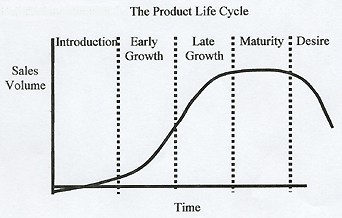
There are no specific success formulas for all businesses, but many firms have ineffective operating strategies, because they are based on some simplistic and outdated strategic assumptions. Three of the most common ones we might call “lifecycle” thinking; “cost-curve” fixation; and “lead-niche-or harvest” activity. Each of these themes has value if applied carefully, but if applied loosely, they have plenty of pitfalls.Enough managers have seen the diagram for the "product life cycle" above to skip a detailed description. This diagram also parallels the consumer-led growth of the U.S. economy from 1946 to the present. Now that 75 percent of Americans have more activities and possessions than they have waking hours to consume, aggregate demand for more and more industries will grow with the population rate of 1 percent.
Some of the pitfall thinking stimulated by this product life cycle diagram:
1. “Our industry isn't going anywhere, lets milk the business and diversify into some sexy growth business.” So, for example, U.S. firms harvested portable radios in the 1960s while the Japanese microsegmented the market with lifestyle models and have stimulated growth ever since. Conclusions: Don't get bored with mature products too quickly; reinvent them and niche. And, don't believe the outside experts’ forecasts for an industry; they’re often wrong. Instead stay close to the living edge of customer needs and trust personal hunches more.
2. “There is too much capacity in the industry; let's liquidate, sell, or consolidate with our competitors.” There is, for example, worldwide auto manufacturing capacity of well past 70 million, and still growing rapidly in China and now India, versus an annual global demand for about 50 million. There still is, however, a shortage of just-in-time, quality, demand-pull capacity which allows the consumer to design their car today and get it in two weeks. There is an excess of mass-produced, ram-and-jam-it through the channel capacity. Conclusion: Become customer-needs, just-in-time, quality driven to do well, and let traditional companies suffer.
Being The Low Cost Competitor
The firms that are obsessed with cutting costs and discounting prices reason that: whoever can get their costs for goods and/or services down the fastest can cut prices faster, win market share, achieve growing economies of scale to lower costs further to support another round of discounting, etc. Wal-Mart has succeeded in part due to this strategy.Some of the pitfalls for this competitive assumption are that:
1. It assumes that all products and services are like raw commodities, yet most winning firms today are increasingly providing niche or customized solutions to customers in a value-added way.
2. The few firms that do achieve large-scale economies risk: becoming targets for deep-pocketed new entrants; dying of a thousand cuts due to nichers; and achieving diseconomies of scale for people, service quality, and general flexibility in a fast changing world. Size economies did not work well for Sears, K-mart, and monster supermarket chains against Wal-Mart's dramatically better logistical platform. Major TV broadcasters and newspapers are being niched to death by many digital channels, services, and products. Blockbuster is wilting for a number of reasons, a big one being the success of Netflix mailing out-and-back DVDs on a subscription basis to heavy movie rental users.
3. This volume game is best played by companies with big egos and public or deep-pocketed capital which would rule out many privately-held firms that cannot generate enough capital internally and quickly.
Conclusions: Cost efficiency over competitors is of secondary importance to targeting customer needs and filling them in a significantly differentiated way other than price. Because price concessions are immediately apparent to and matched or beaten by too many competitors, there is rarely a sustainable competitive advantage in initiating them. A great majority of competitors should consider other strategies now that mass-market demand for standard products and services doesn't exist.
There is, furthermore, no correlation between volume (or market share) and profitability. In a growing, mass market U.S. economy there was a positive correlation which ended in 1974. Today we want to identify profitable win/win relationship customers and retain them at a greater rate than the competition. If customers leave for lower prices at which we would lose money, then it is better to downsize all elements of the business while keeping the best customers to become more focused and profitable with less headaches.
Lead, Niche, Or Harvest/Sell - Now
Conventional wisdom is that in mature industries each firm should pick one of several pathways to boldly pursue. To "lead" implies cost-volume-price leadership as well as to buy, merge, or bluff out competitors to rationalize excess capacity. Be the last blacksmith or airline in business and then you will make money.The pitfalls of "leading" with cost-price-volume have already been addressed. And the problem of acquiring and consolidating the weakest 80 percent of the competitors is that real money would be paid for obsolete assets and poorly culturized employees to get bigger when that may not help.
We might conclude that, to get bigger, firms must start thinking smaller by targeting and perfectly serving smaller niches within their existing customer base. The whole notion of economies of scale doesn't work in a world with demanding customers who have fragmenting needs or in a world of faster change that requires corporate agility.
The "niche" option is not an option; it is critical for all businesses. The problems are:
1. The term is overused and misunderstood, so we all should spend time getting more knowledgeable about how to define, target, and pursue niches.
2. Niching is difficult. We have to identify overlooked or emerging needs and address them with leading-edge solutions in a patient, focused way. Within the product life cycle diagram, we need "startup stage" skills, not administrative skills that most managers in mature industries have.
3. The first priority is to determine which customers are in our core niche - the 20 percent of the customers who are yielding 120-140 percent of most firms' operating profits - and serve them better. Product and volume oriented firms are already selling to many different types of customers and don't know it.
The option to "sell" is a real one. If the chief executives of marginal firms can reassess themselves and their ineffective strategies and do their own turnaround, great. But, if they aren't prepared to change dramatically starting with themselves, then they will do better to sell sooner rather than later.
To "harvest" is difficult today, because customers, suppliers, investors, and employees are ever quicker to leave sinking ships. And, the excessive competition, environmental change, and slow-growth demand can wipe out firms quickly.
Conclusions
As markets mature, customers can be more demanding and competition more intense. We must continually sharpen our strategic thinking and customer segmenting. Simplistic strategies will fail us, especially the ones that are based on financial optimization, cost reduction, and volume with its supposed economies of scale, because standard products and services have yielded to fragmented and changing demand.Bruce Merrifield is president of Merrifield Consulting Group Inc., Chapel Hill, N.C. For more information, call 919-933-7474, e-mail bruce@merrifield.com, or visit www.merrifield.com.
Publication date: 10/31/2005
Looking for a reprint of this article?
From high-res PDFs to custom plaques, order your copy today!