ACHR News
search
Ask ACHR NEWS AI
cart
facebook twitter instagram linkedin youtube
  • Sign In
  • Subscribe
  • Sign Out
  • My Account
ACHR News
  • NEWS
    • Breaking News
    • New HVAC Products
    • Featured Products
    • Manufacturer Reports
    • HVAC Data
    • Legislation
    • ACHR NEWS Centennial
  • RESIDENTIAL
    • Air Conditioners
    • Furnaces
    • Residential Heat Pumps
    • Ductless
    • Residential IAQ
    • Testing, Monitoring, Tools
    • Components & Accessories
  • COMMERCIAL
    • Air Handlers
    • Rooftop Units
    • Chillers and Cooling Towers
    • Commercial Heat Pumps
    • Boilers and Hydronics
    • VRF/Ductless
    • Commercial IAQ
  • REFRIGERATION
    • Refrigerants
    • Refrigerant Regulations
    • Leak Management
  • CONTRACTOR PRO
    • Geothermal
    • Homeowner Study
    • VRF and VRV Ductless
    • Unitary Trends
  • EDUCATION
    • Training and Education
    • Business Management
    • Service and Maintenance
    • Continuing Education
    • Market Research >
      • HVAC Brand Awareness Report
      • VRV, VRF, VRVZ Report
      • Unitary Trends Report
      • Water Heat Professionals Report
    • Webinars
    • Sponsor Insights
    • eProducts Info
    • White Papers
  • EVENTS
    • HVAC Contractor Forum
    • Industry Events and Webinars
  • MEDIA
    • Videos
    • AHR Expo 2025 Videos
    • Podcasts >
      • ACHR News Podcast
      • HARDI Podcasts
      • AHR Expo Podcasts
      • ACCA Podcasts
    • Interactive Spotlights
    • Quizzes
    • eBooks
    • HVAC Talkback
  • HVAC GROUP
    • ACHR NEWS >
      • Current Issue
      • Digital Edition
      • Subscribe
    • Distribution Trends
    • SNIPS NEWS >
      • Join SNIPS NEWS
    • Engineered Systems News >
      • Join ES News
    • HVACR Directory
    • Contests
    • Newsletters
    • Contact
    • Advertise
    • My Account
HVAC ContractingTechnical

Brushing Up On Fiberglass Duct Insulation

June 15, 2003
For nearly 50 years, fiberglass insulation has been used as a component of air duct systems to maintain comfort and IAQ. HVAC fiberglass insulation meets four requirements of a duct system:

  • Temperature control — Delivering heated or cooled air at the temperature level best suited to building needs;

  • Acoustical control — Absorbing noise generated by air-handling equipment and by air moving through ducts;

  • Condensation control — Preventing condensation that could damage insulation and other HVAC system components or possibly lead to microbial growth; and

  • Energy conservation — Reducing HVAC system operating costs and energy use by lowering heat loss or gain through the air duct wall.

    Although new materials are introduced from time to time to serve as new HVAC duct system materials, the fact is that nearly all duct insulation products continue to use fiberglass technology, for reasons of safety, cost effectiveness, and performance.

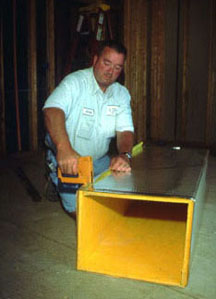
    Fiberglass duct liner fabrication. (All photos courtesy of CertainTeed Corporation.)

    Fiberglass Duct Insulation Types

    There are four basic types of HVAC fiberglass insulation products: duct liner, duct wrap, duct board, and flexible ducts. Here is a review of the composition of each:

    1. Duct liner. Used in the interior of sheet metal ducts, fiberglass duct liner products come as flexible blankets or rigid boards of fiberglass insulation. The airstream surface is formed of either a coating or a fibrous mat. Liners are offered in a variety of thicknesses and density combinations, from 1/2 to 2 inches. Those with tough airstream surfaces resist puncturing, tearing, and surface wear during fabrication, installation, operation, and cleaning. Although most liner products are intended for application in square and rectangular ductwork, products specifically designed for round duct are available. Specifiers can choose between rotary and textile fiberglass insulation. Textile fibers perform well in most applications and provide a strong and durable product. Rotary fibers provide incremental R-value and NRC-value improvement over textile.

    Fiberglass duct wrap.
    2. Duct wrap. Fiberglass duct wrap is applied to the outside of sheet metal duct. It is a blanket-type thermal insulation composed of glass fibers bonded together with a thermosetting resin. Duct wrap can be used for both round and rectangular duct. It normally has a vapor-retardant facing of foil scrim kraft (FSK) or vinyl. Unfaced duct wrap insulation is also available when vapor-retardant facing is not required. Rigid board insulation with reinforced FSK or all-service jacket facings (ASJ) are used as exterior insulation on large metal ductwork. Some manufacturers have reformulated their fiberglass duct wrap recently to be more user friendly, with less irritation to the installer.

    Fiberglass duct board is shown being fabricated.
    3. Duct board. Fiberglass ducts are fabricated from 1-, 1-1/2-, or 2-inch-thick boards. The board consists of insulation materials made from resin-bonded inorganic glass fibers. The outside surface of the board has manufacturer-applied reinforced aluminum/FSK laminate facing that serves as an air barrier and water vapor retardant. Some products are available with mat-faced or coated airstream surfaces. Surfaces on these products can be easily cleaned using industry-approved methods.

    4. Flexible ducts. Flexible fiberglass insulated ducts consist of a spiral-wire-reinforced inner air core, wrapped with fiberglass insulation, and jacketed with a vapor-retardant reinforced foil or plastic film. These ducts provide an efficient, economical way to connect trunk ducts and room diffusers or registers. Flexible fiberglass ducts should be used in restricted lengths.
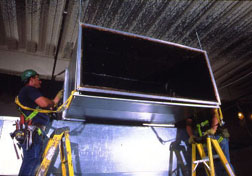
    Ductwork with fiberglass duct liner is shown being installed.

    Installation Overview

    Details on the installation of all fiberglass duct insulation products can be found in the North American Insulation Manufacturers Association (NAIMA) fibrous glass standards or the Sheet Metal and Air Conditioning Contractors’ National Association (SMACNA) HVAC duct construction standards. The following is a very brief recap of general installation procedures:

    Duct liner — The products can be precision cut using both manual and automatic cutting equipment, so that all joints are neatly and tightly butted with no interruptions or gaps. The duct liner should be adhered to the sheet metal ductwork using an adhesive meeting American Society of Testing Materials (ASTM) requirements. Next, the liner is further secured to the ductwork using mechanical fasteners, assuring no greater than 10 percent compression of the liner thickness. Some duct liner already provides clean “buttered” transverse edges, although some circumstances may require the use of adhesive to “butter” raw, exposed liner edges.

    Duct wrap — Before installation of duct wrap begins, the sheet metal ducts should be clean, dry, and sealed. Wrap is cut to “stretch out” dimensions, which require the measurement of the duct perimeter, with the addition of extra wrap that will form an overlapping stapling and taping flap. The insulation is wrapped around the perimeter of the duct, with the facing out, while adjacent sections are tightly butted with an overlapping flap. Seams are stapled. Where a vapor retarder is required, all seams, joints, tears, punctures, and/or other penetrations of the wrap are sealed with a pressure-sensitive vapor retarder tape.

    Duct board — Fiberglass duct board systems can be fabricated in either a shop or on the jobsite. Once cut to the required size, fiberglass duct sections are first stapled closed. The next step is sealing joints, using either UL-listed pressure-sensitive foil tape, UL-listed heat-activated aluminum foil tape, or UL-listed fiberglass fabric or mastic when the duct system is part of a fire-rated assembly. More detailed fabrication and installation instructions can be obtained that are in accordance with NAIMA or SMACNA fibrous glass duct construction standards.

    Flexible duct — Since there are several types of flexible duct, it is best to follow the manufacturer’s instructions on recommended maximum length of duct sections, connections, locations, and support systems. SMACNA’s HVAC Duct Construction Standards - Metal and Flexible provides full and detailed instructions on proper installation and can be obtained at www.smacna.org.
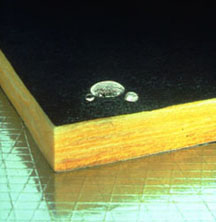
    Fiberglass duct board with moisture resistant enhancement.

    Fiberglass Duct Insulation And IAQ

    In 1994, OSHA issued the first federal proposal for comprehensive regulation of indoor air quality (IAQ). It addressed the 30 percent of all “non-industrial work environments” believed to have IAQ problems. OSHA outlined a detailed inspection and compliance program of maintenance, ventilation, relative humidity, and carbon dioxide control. Its goal was to significantly reduce the incidence of “sick building syndrome” and the bacterial infection known as Legionnaire’s Disease.

    For everyone from HVAC contractors and designers to building owners and managers, concerns about IAQ have prompted an emphasis on prevention, rather than correction. Independent studies have found there is no link between poor IAQ and well-maintained fiberglass HVAC insulation. Furthermore, most fiberglass insulation ductwork provides the following benefits:

    Can be cleaned: The duct board and liner used in HVAC systems have surfaces that can be cleaned with commonly available duct cleaning equipment as outlined in NAIMA’s duct cleaning guide.

    Has antimicrobial agents: The airstream surface of many duct liner and duct board products contains an EPA-registered antimicrobial agent in order to reduce the potential of microbial growth that may affect the product. The antimicrobial properties are intended to only protect the product. Fiberglass insulation products comply with ASTM standards for mold growth.

    Does not erode: Fiberglass duct board and duct liner are manufactured and tested to handle air conveyance well above normal operating conditions. They will not degrade when exposed to streams of hot or cold air and they do not allow glass fiber to enter the airstream.

    Has moisture-repellent properties: Some manufacturers, such as CertainTeed, now feature a moisture-repellent airstream surface enhancement that is significantly more moisture-resistant than previous type of duct insulation. The feature was developed for specifiers who want to alleviate any concerns about moisture that may enter a duct system due to improperly sealed duct joints or poorly installed and maintained duct systems. The breathable surface coating preserves the sound-dampening performance of the insulation by allowing sound waves to pass through the open-cell structure and into the sound-absorbing glass fiber mat.

    The best way to ensure that an HVAC system continues to provide quiet air delivery and occupant comfort in a cost-effective manner is to follow a regular maintenance schedule.

    David L. Tomchak is industrial marketing manager of CertainTeed Corporation, Valley Forge, Pa. He can reached at david.l.tomchak@saint-gobain.com or at 610-341-7762. For more information on fiberglass duct insulation, visit www.certainteed.com.

    Publication date: 06/16/2003

  • Share This Story

    Looking for a reprint of this article?
    From high-res PDFs to custom plaques, order your copy today!


    Recommended Content

    JOIN TODAY
    To unlock your recommendations.

    Already have an account? Sign In

    • HVAC-enrollment

      The Trades Are Back: HVACR Programs See Nearly 30% Enrollment Spike

      A new wave of future technicians is entering the pipeline.  
      News
      By: Matt Jachman
    • 2025 Top 40 Under 40

      2025 Top 40 Under 40 HVACR Professionals List

      The 11th annual Top 40 Under 40 list highlights those...
      News
      By: Hannah Belloli-Oster
    • LG Ductless Mini-Split Systems

      The 9 Types of Heat Pumps

      As the U.S. moves toward electrification, heat pumps are...
      HVAC Commercial Market
      By: Joanna R. Turpin
    Subscription Center
    • Create an Account
    • Start a Subscription
    • Manage My Account
    • Sign Up for Newsletters
    • Visit Customer Service
    • Update Preferences

    More Videos

    Sponsored Content

    Sponsored Content is a special paid section where industry companies provide high quality, objective, non-commercial content around topics of interest to The News audience. All Sponsored Content is supplied by the advertising company and any opinions expressed in this article are those of the author and not necessarily reflect the views of The News or its parent company, BNP Media. Interested in participating in our Sponsored Content section? Contact your local rep!

    close
    • Piggy Bank
      Sponsored byWatercress Financial

      Energy Prices, Inflation, and HVAC: What Today’s Homeowners Care About

    • Refrigerated Food
      Sponsored bySolstice Advanced Materials

      R-455A Refrigeration: A Cold Storage Solution for the Future

    • Airex Rooftop Units
      Sponsored byAirex Manufacturing Inc

      Consolidating Roof Penetrations: A Growing Trend in Multifamily HVAC Design

    Popular Stories

    HVAC-Price-Increase-graphic

    HVAC Price Increase List: June 2026

    Trump-Section-232.jpg

    Trump Reduces Section 232 Tariffs on HVAC Equipment to 15%

    R410A-Refrigerant-Cylinder.jpg

    Refrigerant Recovery is a Revenue Opportunity

    Heat-pump-cutaway.jpg

    PFAS Rules and A2L Building Codes Continue to Evolve

    Kroger.jpg

    Kroger to Spend $100 Million to Reduce Refrigerant Leaks

    View The ACHR NEWS
    Centennial Anniversary Timeline

    The ACHR News Timeline Chart
    Submit a Letter
    Submit a letter to our editors.

    Events

    November 6, 2025

    Next-Gen Data Center Cooling: HVAC Innovation and Real-World Solutions

    On Demand As AI workloads and high-density computing push traditional cooling methods to their limits, the data center industry is accelerating the adoption of next-generation HVAC technologies.

    June 17, 2026

    Decarbonization Without Disruption

    This webinar will explore practical HVAC decarbonization strategies that minimize disruption while maximizing long-term performance and ROI.

    View All Submit An Event

    Poll

    Summer Staff

    Are you fully staffed for the summer season?
    View Results Poll Archive

    Products

    BNI Mechanical/Electrical Square Foot Costbook, 2026 Edition

    BNI Mechanical/Electrical Square Foot Costbook, 2026 Edition

    See More Products
    Decarbonization Without Disruption - Free Webinar - 6/17/2026

    Related Articles

    • July 11, 2014: New Instructional Training DVD Released on Fiberglass Duct Board Fabrication

      See More
    • Duct Insulation on the Rise in Retrofit

      See More
    • Fiberglass Duct Wrap Plays Integral Role in Indianapolis Hospital’s LEED Strategy

      See More

    Related Products

    See More Products
    • 1966.gif

      HVAC Duct Construction Standards - Metal and Flexible

    • HVAC Air Duct Leakage Test Manual, 2nd Edition

    • 1987.gif

      HVAC Duct Systems Inspection Guide

    See More Products

    Events

    View AllSubmit An Event
    • June 9, 2026

      Before You Go All In on AI: Set Up Your Business to Actually Win

      On Demand In this webinar, we'll walk you through exactly what to get in place before you add AI to your business. You'll leave with a clear picture of where you stand today and a practical action plan to set yourself up for real results.
    View AllSubmit An Event

    Related Directories

    • KNAUF Insulation North America

      Knauf Performance+® is the only full portfolio of fiberglass mechanical and building insulation that's formaldehyde-free and the first to be Asthma & Allergy Friendly® certified.
    ×

    Sign Up. Stay Informed.

    The #1 trusted source for the HVACR industry since 1926

    SUBSCRIBE
    • RESOURCES
      • Advertise
      • Contact Us
      • Advisory Board
      • Classifieds
      • Submit a Letter
      • Directories
      • Store
    • ACCOUNT CENTER
      • Create an Account
      • Start a Subscription
      • Manage My Account
      • Sign Up for Newsletters
      • Visit Customer Service
      • Update Preferences
    • SERVICES
      • Marketing Services
      • Reprints
      • Market Research
      • List Rental
      • Survey/Respondent Access
    • STAY CONNECTED
      • LinkedIn
      • Facebook
      • Instagram
      • YouTube
      • X (Twitter)
    • PRIVACY
      • PRIVACY POLICY
      • TERMS & CONDITIONS
      • DO NOT SELL MY PERSONAL INFORMATION
      • PRIVACY REQUEST
      • ACCESSIBILITY

    Copyright ©2026. All Rights Reserved BNP Media, Inc. and BNP Media II, LLC.

    Design, CMS, Hosting & Web Development :: ePublishing