ACHR News
search
Ask ACHR NEWS AI
cart
facebook twitter instagram linkedin youtube
  • Sign In
  • Subscribe
  • Sign Out
  • My Account
ACHR News
  • NEWS
    • Breaking News
    • New HVAC Products
    • Featured Products
    • Manufacturer Reports
    • HVAC Data
    • Legislation
    • ACHR NEWS Centennial
  • RESIDENTIAL
    • Air Conditioners
    • Furnaces
    • Residential Heat Pumps
    • Ductless
    • Residential IAQ
    • Testing, Monitoring, Tools
    • Components & Accessories
  • COMMERCIAL
    • Air Handlers
    • Rooftop Units
    • Chillers and Cooling Towers
    • Commercial Heat Pumps
    • Boilers and Hydronics
    • VRF/Ductless
    • Commercial IAQ
  • REFRIGERATION
    • Refrigerants
    • Refrigerant Regulations
    • Leak Management
  • CONTRACTOR PRO
    • Geothermal
    • Homeowner Study
    • VRF and VRV Ductless
    • Unitary Trends
  • EDUCATION
    • Training and Education
    • Business Management
    • Service and Maintenance
    • Continuing Education
    • Market Research >
      • HVAC Brand Awareness Report
      • VRV, VRF, VRVZ Report
      • Unitary Trends Report
      • Water Heat Professionals Report
    • Webinars
    • Sponsor Insights
    • eProducts Info
    • White Papers
  • EVENTS
    • HVAC Contractor Forum
    • Industry Events and Webinars
  • MEDIA
    • Videos
    • AHR Expo 2025 Videos
    • Podcasts >
      • ACHR News Podcast
      • HARDI Podcasts
      • AHR Expo Podcasts
      • ACCA Podcasts
    • Interactive Spotlights
    • Quizzes
    • eBooks
    • HVAC Talkback
  • HVAC GROUP
    • ACHR NEWS >
      • Current Issue
      • Digital Edition
      • Subscribe
    • Distribution Trends
    • SNIPS NEWS >
      • Join SNIPS NEWS
    • Engineered Systems News >
      • Join ES News
    • HVACR Directory
    • Contests
    • Newsletters
    • Contact
    • Advertise
    • My Account

Breathing Right With DCV

December 1, 2005
Demand controlled ventilation (DCV) systems are designed to save energy by using building occupancy indicators that usually measure CO2 levels to regulate the amount of outside air that is drawn in for ventilation. If there was any doubt about this system, Purdue University, the National Institute of Standards and Technology, and a few other organizations got together recently to study the effectiveness of DCV.

This group performed an economic analysis of DCV with the help of a computer simulation known as the Ventilation Strategy Assessment Tool (VSAT). The analysis was designed to determine the conditions under which DCV is most likely to be cost-effective.

In addition, field tests were conducted to verify the savings and identify potential problems in the application of DCV (see Figure 1). The results also included a set of design recommendations.

Figure 1: Demand-controlled ventilation (DCV) proved itself cost-effective in field tests in McDonald’s PlayPlace areas (pictured above) and Walgreens drug stores.

Features

Analysis of DCV systems coupled with economizers covered a variety of new and existing buildings with a wide range of occupancy schedules. The sites included a small office building, a sit-down restaurant, a retail store, and several school spaces - a class wing, an auditorium, a gymnasium, and a library. In all cases, the DCV-plus economizer system showed greater savings and quicker payback than an economizer-only system. Payback periods were typically two years or less.

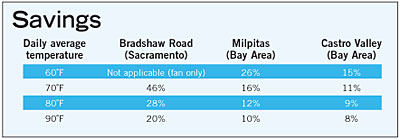
Field tests conducted in coastal and inland climate zones in California included sites such as McDonald's PlayPlace areas, modular school rooms, and Walgreens drug stores. The largest savings occurred in inland buildings with low occupancy rates and high ventilation loads (see Table 1 and Figure 2).

According to the team's report, no substantial savings were found in buildings with high occupancy rates that varied only a little, such as modular school rooms. Also, timers or controllable thermostats meant that HVAC units only operated during normal school hours.

According to the project team, several conclusions from the study can help designers decide where and how to implement DCV:
  • The greatest savings and shortest payback periods occur for buildings that have variable and unpredictable occupancy levels, with high occupant densities at peak occupancy.

  • Savings vary with climate. In California, greater savings occurred in hot, inland climates than in mild, coastal climates. In the end, the research team concluded that potential savings from DCV are greatest in cold climates, where heating dominates.

  • A nonzero minimum ventilation rate will keep nonoccupant sources of indoor contamination at acceptable levels. According to the project team, it helps to establish minimum ventilation rates based on the expected types and strengths of pollutant sources.

  • In buildings with an economizer cycle, allow the economizer to override the DCV system at times when the additional ventilation would provide "free" cooling.

    Table 1: Savings vary with climate. For a given temperature, measured cooling energy savings at the site in Sacramento were greater than those at Bay area sites because occupancy rates were lower. (Source: California Energy Commission.)
  • Select DCV systems that are able to increase outdoor air intake before the building opens in the morning to deal with concentrations of contaminants that may build up overnight.

  • Always calibrate and maintain sensors according to manufacturer recommendations.

  • According to the project team, avoid placing CO2 sensors for ventilation control near doors, windows, air intakes or exhausts, or occupants. It also recommended to not use a single sensor located in a common return to control ventilation rates for multiple spaces with different occupancies.

    The VSAT tool is available for evaluating the impact of set points, minimum ventilation rates, and operating schedules during the DCV system design phase. (The program can be downloaded from the Web at www.energy.ca.gov/pier/buildings/tools.html.)

    Figure 2: Cooling energy use with and without DCV. A McDonald’s in the Sacramento, Calif., area consumed significantly less energy when DCV was in use. Tests also showed indoor air quality stayed within acceptable limits. For a hot day with an average temperature of 80 degrees F, the estimated savings were about 28 percent. (Source: California Energy Commission.)

    Applications

    The DCV technology evaluated in this project is used on packaged air conditioning systems, which are typically found in small commercial buildings. Facilities likely to benefit from DCV include auditoriums, gyms, and re-tail stores, the study said.

    Meanwhile, the changes to Title 24 that took effect in California on Oct. 1, 2005, require DCV in all spaces where an HVAC single-zone system includes an economizer and that has an occupant density of greater than or equal to 25 people per 1,000 square feet. Exceptions include classrooms, areas where space exhaust is greater than the design ventilation rate, and spaces with processes or operations that generate dust, fumes, mists, vapors, or gases. The new code also requires acceptance tests to ensure the technology is properly installed.

    In the end, as interest in DCV increases, the project team concluded that its impact on comfort and productivity should be studied to provide additional information for designers and building owners.

    Reports documenting this project and providing more details may be downloaded from the California Energy Commission Web site at www.energy.ca.gov.

    Publication date: 12/05/2005

  • Looking for quick answers on air conditioning, heating and refrigeration topics? Try Ask ACHR NEWS, our new smart AI search tool. Ask ACHR NEWS →

    Share This Story

    Looking for a reprint of this article?
    From high-res PDFs to custom plaques, order your copy today!


    Recommended Content

    JOIN TODAY
    To unlock your recommendations.

    Already have an account? Sign In

    • HVAC-enrollment

      The Trades Are Back: HVACR Programs See Nearly 30% Enrollment Spike

      A new wave of future technicians is entering the pipeline.  
      News
      By: Matt Jachman
    • 2025 Top 40 Under 40

      2025 Top 40 Under 40 HVACR Professionals List

      The 11th annual Top 40 Under 40 list highlights those...
      HVAC Commercial Market
      By: Hannah Belloli-Oster
    • LG Ductless Mini-Split Systems

      The 9 Types of Heat Pumps

      As the U.S. moves toward electrification, heat pumps are...
      News
      By: Joanna R. Turpin
    Subscription Center
    • Create an Account
    • Start a Subscription
    • Manage My Account
    • Sign Up for Newsletters
    • Visit Customer Service
    • Update Preferences

    More Videos

    Sponsored Content

    Sponsored Content is a special paid section where industry companies provide high quality, objective, non-commercial content around topics of interest to The News audience. All Sponsored Content is supplied by the advertising company and any opinions expressed in this article are those of the author and not necessarily reflect the views of The News or its parent company, BNP Media. Interested in participating in our Sponsored Content section? Contact your local rep!

    close
    • Piggy Bank
      Sponsored byWatercress Financial

      Energy Prices, Inflation, and HVAC: What Today’s Homeowners Care About

    • Refrigerated Food
      Sponsored bySolstice Advanced Materials

      R-455A Refrigeration: A Cold Storage Solution for the Future

    • Airex Rooftop Units
      Sponsored byAirex Manufacturing Inc

      Consolidating Roof Penetrations: A Growing Trend in Multifamily HVAC Design

    Popular Stories

    HVAC-Price-Increase-graphic

    HVAC Price Increase List: June 2026

    Trump-Section-232.jpg

    Trump Reduces Section 232 Tariffs on HVAC Equipment to 15%

    R410A-Refrigerant-Cylinder.jpg

    Refrigerant Recovery is a Revenue Opportunity

    Heat-pump-cutaway.jpg

    PFAS Rules and A2L Building Codes Continue to Evolve

    Kroger.jpg

    Kroger to Spend $100 Million to Reduce Refrigerant Leaks

    View The ACHR NEWS
    Centennial Anniversary Timeline

    The ACHR News Timeline Chart
    Submit a Letter
    Submit a letter to our editors.

    Events

    November 6, 2025

    Next-Gen Data Center Cooling: HVAC Innovation and Real-World Solutions

    On Demand As AI workloads and high-density computing push traditional cooling methods to their limits, the data center industry is accelerating the adoption of next-generation HVAC technologies.

    June 17, 2026

    Decarbonization Without Disruption

    This webinar will explore practical HVAC decarbonization strategies that minimize disruption while maximizing long-term performance and ROI.

    View All Submit An Event

    Poll

    Summer Staff

    Are you fully staffed for the summer season?
    View Results Poll Archive

    Products

    BNI Mechanical/Electrical Square Foot Costbook, 2026 Edition

    BNI Mechanical/Electrical Square Foot Costbook, 2026 Edition

    See More Products
    A2L Refrigerants - Free Webinar - May 21, 2026

    Related Articles

    • Ductword Puzzle

      Start the Week Off Right With the Latest DuctWord

      See More
    • Murphy's Law: Utility Gets it Right with NATE

      See More
    • Contractor Comes Up With Right Solution

      See More

    Related Products

    See More Products
    • Building Information Modeling: Planning and Managing Construction Projects with 4D CAD and Simulations

    See More Products
    ×

    Sign Up. Stay Informed.

    The #1 trusted source for the HVACR industry since 1926

    SUBSCRIBE
    • RESOURCES
      • Advertise
      • Contact Us
      • Advisory Board
      • Classifieds
      • Submit a Letter
      • Directories
      • Store
    • ACCOUNT CENTER
      • Create an Account
      • Start a Subscription
      • Manage My Account
      • Sign Up for Newsletters
      • Visit Customer Service
      • Update Preferences
    • SERVICES
      • Marketing Services
      • Reprints
      • Market Research
      • List Rental
      • Survey/Respondent Access
    • STAY CONNECTED
      • LinkedIn
      • Facebook
      • Instagram
      • YouTube
      • X (Twitter)
    • PRIVACY
      • PRIVACY POLICY
      • TERMS & CONDITIONS
      • DO NOT SELL MY PERSONAL INFORMATION
      • PRIVACY REQUEST
      • ACCESSIBILITY

    Copyright ©2026. All Rights Reserved BNP Media, Inc. and BNP Media II, LLC.

    Design, CMS, Hosting & Web Development :: ePublishing