Blends 101: an introduction to refrigerants
- Azeotrope: a blend that behaves like a single component refrigerant. When a blend forms an azeotrope, it displays unique and unexpected properties.
- Zeotrope: a blend that behaves like a mixture of the individual components. Zeotropes have predictable properties based on combinations of the pure components’ properties.
In addition, it is sometimes helpful to classify some blends as near-azeotropes. These blends have predictable blend properties; however, the difference between these properties and what is observed for single-component refrigerants is not that significant.
Many of the problems associated with system operation using a blend will not be noticeable with near-azeotropes.
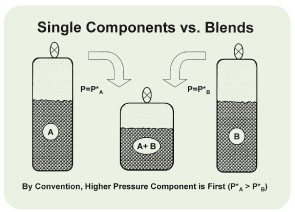
Fractionation
Fractionation is the change in composition of a blend because one or more of the components is lost or removed faster than the other(s).Two basic behaviors of refrigerant molecules help explain why fractionation occurs.
1. Pure refrigerants exert pressure on the cylinder (or a system) because the molecules are moving around. At higher temperatures they move around faster, which means more pressure. At lower temperatures there is less movement, so lower pressure.
Different refrigerants have different energies at the same temperature, and therefore generate higher or lower pressures.
2. Molecules of refrigerant are constantly moving from liquid to vapor and vapor to liquid at the surface of the liquid. Vapor and liquid at equilibrium transfer the same number of molecules back and forth; boiling liquid transfers more from liquid to vapor; and condensing vapor transfers more from vapor to liquid.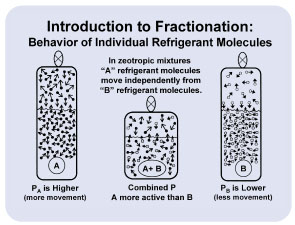
Different refrigerants transfer back and forth to the vapor at different rates.
When vapor is removed from a cylinder or system containing a zeotropic blend, two things are going to happen:
1. The vapor being removed is at the wrong composition. It will have more of the higher-pressure, higher-capacity refrigerant component.
2. The liquid that is left behind boils more of the high-pressure component out of the liquid to replace the vapor. Eventually, the liquid composition changes because more of the higher-pressure component leaves compared to the bulk liquid composition.
In order to avoid charging the wrong composition and fractionating the remaining blend, zeotropic blends must be removed from the cylinder as a liquid. This can be done by turning the cylinder over so the valve is on the bottom, or forcing the product through a dip tube to the valve.
Liquid charging does not mean that liquid refrigerant should be pushed into the suction line of the system and that it be allowed to slug the compressor. After the initial charge into the high side of a system, the compressor can be started and charging can be completed by flashing the refrigerant from liquid to vapor in the charging hose or across specially designed valves.
Any method which allows the refrigerant to go to vapor before it hits the compressor should work. Generally, the refrigerant needs to be added slowly at this point.
A system at rest will allow the refrigerant to pool and the vapor to come to an equilibrium concentration. Leaks that occur in vapor areas of the equipment will allow fractionation of the blend.
The worst case will occur when about half of the refrigerant charge has leaked.
Recharging the system after repair will result in a blend with slightly reduced capacity and operating pressures. In smaller systems, where charge size is critical, it will be best to pull any remaining refrigerant and charge with fresh blend. In larger systems, you will need to make a decision whether the remaining charge should be pulled or not.
Note: For low-fractionation-potential blends, you will not see much shift in composition anyway, and therefore, the charge can be topped off after repair without loss of properties.
In running systems, it has been found that the circulation composition is the bulk blend composition. In liquid and suction lines there is no second phase, and in the heat exchangers there is a lot of turbulence, so leaks will lose both vapor and liquid. Testing has shown that leaks from a running system do not cause fractionation, and a normally cycling system will not fractionate much during the off cycle.
In other words, in most cases, servicing blends does not require full recovery of the charge.
System components beware
Flooded evaporators are designed to keep a pool of boiling liquid refrigerant surrounding a bundle of tubes. The water, brine, or product to be cooled flows through the tubes. The vapor which boils off this pool is returned to the compressor, condensed, then poured back into the pool.In the case of zeotropic blends, the vapor which boils off this pool of refrigerant will be at the fractionated composition. If the properties at this composition differ significantly from what the compressor expects, then the system could develop high head pressures, high amperage draw at the compressor, reduced cooling effectiveness (capacity) in the evaporator, etc.
Normally, it is not recommended to use blends in this type of system.
Suction accumulators are placed in the suction line before the compressor to keep liquid from flowing into the compressor. The liquid slug is trapped in the accumulator where it can boil off to vapor, combining with other suction gas. Zeotropic blends will fractionate in the accumulator, giving a short-lived spike of higher pressure vapor back to the compressor.
Systems with suction accumulators should not be overcharged with the expectation that the accumulator will protect the compressor, because this may lead to frequent pressure spikes.
Also, this type of system should never be charged by dumping liquid refrigerant into the suction line and allowing it to vaporize in the accumulator, because high-pressure trips may occur.
Excerpted from “2000 Refrigerant Reference Guide,” third edition, from National Refrigerants, Philadelphia, PA. For more information, call 800-262-0012.Alkyl benzene oil — A synthetic refrigeration oil similar to mineral oil; it offers better low-temperature mixing with HCFCs.
Azeotrope — A mixture of two or more refrigerants that acts as a single fluid. The components of azeotropic mixtures will not separate under normal operating conditions.
Blend — A mixture of two or more refrigerant components.
CFC — Chlorofluorocarbon; a refrigerant comprised of carbon atoms connected to only chlorine and fluorine atoms. The common CFCs are R-11, -12, -13, -113, -114, and -115.
Disposal — The process leading to and including (1) the discharge, deposit, dumping, or placing of any discarded appliance into or on any land or water; (2) the disassembly of any appliance for discharge, deposit, dumping, or placing of its discarded component parts into or on any land or water; or (3) the disassembly of any appliance for reuse of its component parts.
Elastomer — Material which can be stretched or squeezed and, immediately on release of the stress, returns to its approximate dimensions.
Ester oil — A general term referring to the family of polyolester lubricants. These complicated chemicals contain ester functional groups which make them more polar and thus more compatible with HFC refrigerants.
HCFC — Hydrochlorofluorocarbon; a refrigerant comprised of carbon atoms connected to chlorine, fluorine, and hydrogen atoms. The common HCFCs are R-22, -123, -124, and -142b.
HFC — Hydrofluorocarbon; a refrigerant comprised of carbon atoms connected to fluorine and hydrogen only. The common HFCs are R-134a, -125, -143a, -152a, -32, and -23.
Hygroscopic — A tendency for refrigeration oils to absorb moisture from the atmosphere.
Low-loss fitting — Any device that is intended to establish a connection between hoses, appliances, or recovery/recycling machines, which is designed to close automatically or will be closed manually when disconnected, thereby minimizing the release of refrigerant from hoses, appliances, and recovery recycling machines.
Mineral oil — Traditional refrigeration oil refined from petroleum products, generally not compatible with new HFC refrigerants.
Miscibility — Ability of a gas or liquid to dissolve uniformly (mix) in another gas or liquid.
Ozone depletion — The interruption by free chlorine radicals of the normal ozone creation/breakdown process which occurs in the upper atmosphere. The free chlorine causes ozone molecules to come apart, then ties up the free oxygen used to make more ozone. The result is a net decrease in the ozone concentration.
Polyalkylene glycol (PAG) oil — A general term that applies to a family of synthetic oils based on polyalkylene glycol chemistry. PAGs are used primarily with HFC refrigerants in the automotive air conditioning industry.
Pumpdown (out) — The withdrawal of all refrigerant from the low side of a system by pumping it into either the condenser or the liquid receiver.
Reclaim — To reprocess refrigerant to at least the purity specified in the ARI Standard 700, Specifications for Fluorocarbon Refrigerants, and to verify this purity using specified analytical methods.
Recovery — To remove refrigerant from a system, regardless of condition, and store it in an external container without necessarily testing or processing the refrigerant in any way.
Recovery efficiency — The percentage of refrigerant recovered compared to the total amount in the appliance.
Recycle — To extract refrigerant from an appliance to attempt to clean water, oil, acidity, and particulates from it. These procedures may not necessarily return the refrigerant to ARI 700 purity. The refrigerant may be returned to the same system after recycling.
Self-contained recovery equipment — Recovery equipment that is capable of removing refrigerant from an appliance without the assistance of components within the appliance.
System-dependent recovery equipment — Recovery equipment that requires the assistance of components contained in an appliance to remove the refrigerant.
Zeotrope — A blend that behaves normally as a mixture of refrigerants. The properties are a combination of the individual component properties, and the vapor composition is different from the liquid, which promotes fractionation and temperature glide effects.
Looking for a reprint of this article?
From high-res PDFs to custom plaques, order your copy today!