Portable Rules Spark Confusion
Manufacturers uncertain about the impact of pending DOE regulations
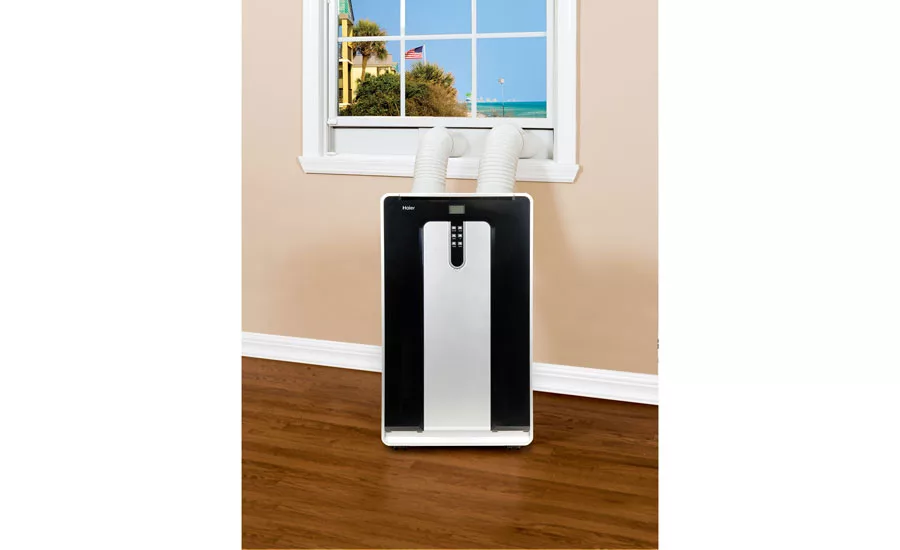
Earlier this year, the U.S. Department of Energy (DOE) issued a new determination stating that the federal agency can now regulate portable air conditioners. While the new rules are intended to cover residential products, there is some confusion in the industry about whether the new regulations will affect commercial units, as well.
THE NEW RULES
Portable air conditioners were not previously regulated by the DOE, so the agency issued a new determination in April that classifies portable air conditioners as a covered product under the Energy Policy and Conservation Act (EPCA).
In addition to the final determination stating that the DOE will now regulate portable air conditioners, the agency also issued new rules for test procedures for portable air conditioners and is currently developing energy conservation standards for these units.
As part of the determination to regulate these products, the DOE defined portable air conditioners as: “A portable encased assembly, other than a packaged terminal air conditioner, room air conditioner, or dehumidifier, that delivers cooled, conditioned air to an enclosed space and is powered by single-phase electric current. It includes a source of refrigeration and may include additional means for air circulation and heating.”
While some believe the DOE intended this definition to refer to residential portable air conditioners, others worry it is too broad and opens up the possibility that commercial portable air conditioners will also be regulated under the new rules.
RESIDENTIAL VERSUS COMMERCIAL
Oceanaire, which manufactures portable air conditioners strictly for the commercial market, is one manufacturer that is concerned with the new rules. According to Michael Schopf, Oceanaire’s vice president of sales/engineering, commercial units have a different purpose than residential units, which are typically smaller, made of plastic, and available at big-box stores. Schopf and Len Swatkowski, Oceanaire’s director of operations, both participated in the DOE’s rulemaking process and said their goal was to help the DOE understand the difference between portable residential units and the commercial products they manufacture.
“Our industry — the commercial spot cooler industry — is a small but important group of manufacturers that produce and market commercial cooling products through wholesalers and rental companies,” Swatkowski explained. “We do not provide products for the residential sector, and we do not reside in consumers’ homes, where temperature and humidity conditions are already stable.”
Looking for quick answers on air conditioning, heating and refrigeration topics? Try Ask ACHR NEWS, our new smart AI search tool. Ask ACHR NEWS
When the DOE was developing these new regulations, Oceanaire worked to exclude commercial units from the rules. Oceanaire joined forces with Temp-Air, AirPac Inc., and Denso in an industry group led by the National Association of Manufacturers (NAM), which submitted comments during the open comment period of the rulemaking, stating specifically that the DOE’s new regulations should exclude commercial portable air conditioners because these niche products differ in purpose and construction from the residential products the new rules are intended to regulate.
To clarify the distinction between commercial and residential units, the NAM industry working group created a consensus definition for commercial portable a/c units that it asked the DOE to exclude from the ruling. (See the sidebar to the right for the complete definition.)
Swatkowski said it initially appeared that the DOE understood the differences between commercial and residential portable units. Yet the DOE did not use NAM’s definition in its final determination.
“The DOE simplified its definition of covered products for this rulemaking to include all portable spot coolers using single-phase electric power,” Swatkowski said. “Single-phase electric current would include most, if not all, of the commercial portable spot cooler industry.”
Because of this, Oceanaire’s leadership believes the new rules extend to commercial portable a/c units.
“We are confused and disappointed at how the committee selected this definition for the final rule,” Schopf said. “It creates too large of an umbrella and, consequently, may lead to an unrealistic constraint on our industry.”
If commercial portable air conditioners are included as covered products under the DOE’s new rules, they will be required to comply with the testing procedures established by the DOE. The testing procedures rule, which was published on June 1, will become official July 1, 2016.
Many commercial portable air conditioners are custom-built for customers’ needs, so the testing procedures would create an onerous burden for small manufacturers, Swatkowski said.
“A certification program with third-party verification and compliance to the DOE’s statistical sampling protocol would exceed $1 million a year per company. This would severely curtail our ability to create unique products for our customers,” he explained. “The resource impact of a program like this would be catastrophic for our industry.”
MANUFACTURER UNCERTAINTY
However, while Oceanaire’s team believes the new rules are too broad and will adversely affect commercial manufacturers, others in the industry aren’t so sure. Some manufacturers contacted for this article declined to comment, stating that the impact of the new rulings was still unclear.
And at least one manufacturer believes the new rules will have no impact at all on the commercial market.
Michael Volle, president and COO of KwiKool Portable Cooling Systems, said, “Our interpretation of the final language excludes all of our products.”
Although Volle did not participate in the rulemaking process, he said that, after being apprised of the issue and reading through all the documentation, he believes the new rules do exempt commercial units from regulation. To explain how he arrived at this conclusion, Volle specifically pointed to language in the final rule for test procedures.
The final rule for test procedures appears to use a different definition for portable a/c units referring to covered products as “single-duct and dual-duct portable air conditioners.” The rule also cites comments received from Oceanaire, NAM, and Denso during the open comment period and states: “Although Oceanaire, NAM, and DENSO may manufacture products that meet the portable a/c definition [or represent such manufacturers], the DOE has determined that these niche manufacturers do not produce products that meet the single- or dual-duct definitions. Therefore, as discussed earlier in this section, the DOE has not identified any small businesses that manufacture the single- and dual-duct portable air conditioners that would be affected by this final rule.”
Referring to this paragraph, Volle said KwiKool’s products are similar to the niche products manufactured by Oceanaire and Denso. Therefore, he believes his company’s products fit this definition and are exempt from the testing requirements.
Volle did note the DOE’s process and documentation have both been unclear. He added that, if the interpretation were to extend to commercial portable air conditioners, there would be far-reaching and negative consequences.
“If we are required to comply with the new rules, our industry will likely diminish or go away,” he said.
Schopf and Swatkowski remain concerned that there are too many contradictions in DOE’s final rules to be confident that commercial portable air conditioners are exempt from the regulations.
According to Swatkowski, in certain passages of the test procedures rule, the DOE appears to exempt spot coolers but not commercial portable air conditioners. He reiterated that the broad definition of covered products published in April does not exclude spot coolers or commercial portable a/cs.
SEEKING CLARIFICATION
Oceanaire has been working through its industry group at NAM to contact the DOE and ask for more clarification on the rules. At press time, the group had not yet received feedback from the DOE.
When The NEWS contacted the agency about this topic, a DOE spokesperson issued the following statement: “The DOE recognized that certain portable air conditioners that exhaust condenser air within the conditioned space [‘spot coolers’] do not provide net cooling to the typical conditioned consumer space. In addition, spot coolers incorporate different design features and a wider variety of installation types and usage patterns than single- and dual-duct portable air conditioners. For these reasons, the DOE did not identify a test procedure that would measure representative performance of spot coolers and did not propose energy conservation standards for those products.”
However, the DOE spokesperson also stated the application of a product — whether it is intended for commercial or residential use — is not cause to exclude a product from coverage under the new regulations. The DOE statement also declared: “Any product meeting the definition of portable air conditioner in 10 CFR 430.2 would be classified as a portable air conditioner regardless of the manufacturer-intended application or installation location because EPCA’s definition of ‘consumer product’ does not depend on whether the product is distributed in commerce for personal use or consumption by an individual.”
Schopf and Swatkowski hope more light will be shed on the rules when the DOE holds its upcoming meetings with industry stakeholders to discuss the energy conservation standards. At press time, the first public meeting was scheduled for June 25.
SIDEBAR: DEFINING COMMERCIAL UNITS
According to the National Association of Manufacturers (NAM), its working group developed an industry consensus definition for commercial portable air conditioners. NAM submitted this definition to the DOE during the open comment period; however, the DOE did not choose to use this definition in the final rule.
Commercial Portable Air Conditioner: A self-contained portable refrigeration-based product that provides localized cooling for a variety of industry and commercial applications and can be defined as having all of the following attributes:
• Minimum evaporator inlet airflow of 265 cfm and minimum condenser airflow of 500 cfm at standard temperature, pressure, and rated voltage;
• A minimum refrigerant charge of 14 ounces per unit;
• Contains an internal condensate tank of a minimum 2 gallon capacity or a condensate pump capable of a minimum 15-foot head pressure; and
• Has a minimum weight of 110 pounds.
Publication date: 6/27/2016
Looking for a reprint of this article?
From high-res PDFs to custom plaques, order your copy today!


