Chilled Beams: What They Are, Why You Should Use Them
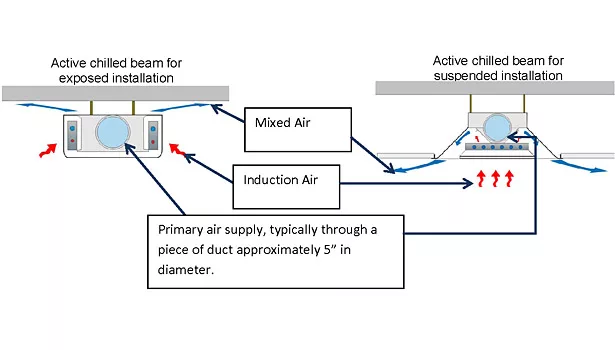
Figure 1: Active chilled beam.
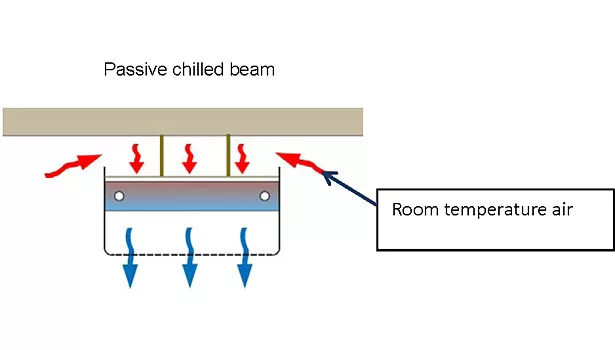
Figure 2: Passive chilled beam.
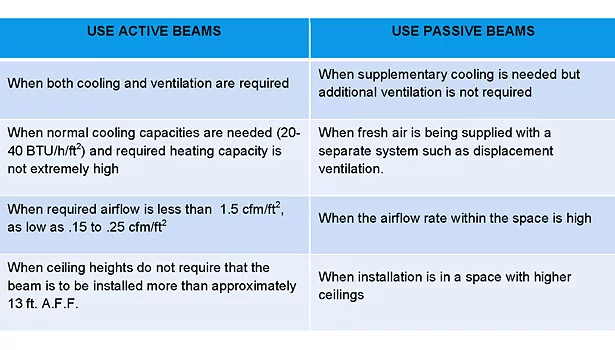
Table 1: When to use active or passive chilled beams.
Introduction to Chilled Beams
A chilled beam is an air distribution device with an integral coil that may be installed within a space in order to provide sensible cooling and heating.
There are two main types of chilled beams: active and passive.
Active chilled beams are those that have ductwork supplied to them providing a specific amount of primary air to the pressurized plenum within the device to be discharged through induction nozzles, mix with entrained air, and ventilate the room (Figure 1).
Active beams should be utilized when sensible cooling, heating, and ventilation air are required. If the design calls for supplementary cooling only, or the complete ventilation requirements of the building’s design are being met by some other means, passive beams may be used. Classrooms, private and public office buildings, meeting facilities, health care facilities, other environments that may have moderate to high sensible heat ratios, and building retrofits where space for new mechanical equipment may be limited are all good applications for active chilled beams.
A passive chilled beam is one that is not ducted, does not supply primary air, and does not utilize fan powered equipment for any portion of the air that crosses the coil; they rely on induction air being drawn across the coil by the natural gravitational forces and buoyancy of air. Warm air rising to the ceiling enters the beam from above as the chilled air that has passed through the coil drops down; the motion of the cool air dropping creates a pressure drop behind it that draws more warm air through the coil (Figure 2).
Passive chilled beams are a good solution to provide sensible cooling in labs or other spaces where processes and people generate high heat loads, especially those that are sensitive to changes in pressure or ventilation and require no additional airflow. Some applications may have a ventilation rate requirement or high enough latent load that a traditional HVAC system would be more appropriate for use than active chilled beams, but could benefit from the use of passive beams for supplementary cooling. Building retrofits where additional cooling is required but the original ventilation system will remain in place are also good passive beam applications.
Due to the tendency of warm air to rise to the ceiling, stratification is possible with all air distribution devices if the discharge air temperature is too high or discharge velocity is too low. With chilled beams, stratification is likely if the temperature of the water entering the coil is too high. Due to air velocity and the mixing required to distribute treated air to the occupied zone, passive beams should not be used for heating applications (Table 1).
Looking for quick answers on air conditioning, heating and refrigeration topics? Try Ask ACHR NEWS, our new smart AI search tool. Ask ACHR NEWS
Multiservice beams are another “type” of chilled beam. Ultimately, they would be considered either active or passive but a multi-service beam incorporates other building functions into its design, such as lighting, sound devices, fire sprinklers, motion detectors, and other various options. In order to properly select and implement multiservice beam designs, extensive integrated building design is necessary. Multiservice beams are well suited for applications such as retrofits where space for several high technology systems may not be readily available, applications that may benefit from off-site manufacturing of installed technical services, and designs where it is architecturally important to create aesthetic interior architecture, even in cases when floor height is low.
Designs where chilled beams would likely not be an appropriate technology to utilize would be natatoriums, saunas, bathrooms, locker rooms, kitchens, or other areas in which the beams may be exposed to high latent gains, buildings with poor envelopes, or those that may have operable windows with no method of control, where beams may be immediately exposed to outdoor temperature and humidity conditions.
History of Chilled Beams
Although designing with chilled beams is a relatively new technology here in the United States, chilled beam design as we understand it now has been in use in Europe for decades. The concepts behind this technology have been understood in America since the early 1900s with Willis Carrier’s introduction of HVAC induction units. Carrier’s induction units utilized the similar principle of high velocity jet air inducing space air across a coil, but were primarily provided as “under-window” units similar in construction to today’s fan coil units.
Utilizing mechanical equipment to heat and cool via ceiling radiation can be traced back to the 1940s, when Norwegian engineer Gunnar Frenger developed and patented a device configured of a pipe attached to an aluminum profile to provide radiant temperature control. The first radiant ceiling was installed in Gothenburg, Sweden, in the late 60s. Combining the concepts behind Carrier’s induction unit and Gunnar Frenger’s applications of radiant panel cooling within the ceiling, designs began to more closely model what we see in chilled beam technology today. The first radiant cooling device that incorporated supply air into its design was installed, also in Gothenburg, in 1972 as the first step toward today’s active chilled beams. What could be considered the predecessor to today’s passive chilled beams were first installed in Stockholm, Sweden, in 1986.
Today, chilled beams are one of the most common HVAC systems installed in Europe. It has only been within the last decade that the technology has begun to catch on in designs in North America, but the comfort, quiet, and efficiencies that a chilled beam system provides are making it a more popular and established technology.
Benefits of Chilled Beams
Various methods of design exist, each possessing their own set of risk and reward. Chilled beam systems can provide several benefits, including:
• Potential reductions in initial costs of equipment and construction material.
• Increase in occupant comfort beyond that which is achievable through traditional systems.
• Space adaptability.
• Energy efficiency.
• Simple operation and maintenance.
First cost discussions of chilled beam systems frequently involve assumptions that the first costs of providing chilled beams are higher than those associated with providing traditional air distribution products. That is correct, of course, when considering only the air distribution device itself. However, that assumption does not take into account the reduction in sizes and capacities of other equipment and construction material. Traditional systems involve mixing return air with outdoor air, thus handling the total supply air volume and sensible capacity at the air handling unit. Chilled beam systems handle return air and sensible load within the space, reducing the total volume of supply air and shifting partial loads from the unit to the space which results in a large decrease in the amount of ductwork (and associated handling and labor costs) required. Reducing space required for the ductwork can yield significant savings in floor-to-floor height space requirements, leaving more room for occupants, processes, and in some cases even reducing costs of structural components by decreasing overall building height. Handling the sensible load at the space and recirculating entrained air also allows for significant reduction in size and capacity of air handler components such as heating/cooling coils, filters, supply fans, etc., which frequently reduces the total overall size of the air handler.
An increase in overall comfort in a space conditioned with chilled beams is mostly a result of the decrease in noise, draft conditions, and temperature inconsistency. Where traditional overhead air distribution systems may produce sound levels in the range of NC 35-40, chilled beam systems typically operate with sound levels under 20 NC. Chilled beams are designed to deliver air at lower velocity than standard overhead systems, thus reducing the possibility of unpleasant draft conditions. Additionally, the design of chilled beams results in highly effective mixing of room air and primary air supply which results in comfortable and consistent room temperatures.
Designing a chilled beam system according to an “adaptable” strategy can allow flexibility in design that may produce optimum indoor climate conditions for the life of the building, regardless of changes of use or layout within the space. This adaptability is accomplished by utilizing chilled beams with options such as velocity controllers, air quality devices, and controls that allow for water flow and temperature regulation. For example, a velocity controller can be manually adjusted to any one of multiple positions, which change the size of the discharge slot, thereby increasing or decreasing the throw. The controller has a very slight impact on capacity, pressure, and sound.
An air quality device is part of an adaptable design that gives end users the ability to increase or decrease fresh-air cfm to change the chamber pressure to match the available duct pressure at the branch; the adjustable device can be manually or electronically moved to open or close the end of the plenum where primary air can be discharged into the space without crossing the coil or impacting the efficiency of the induction nozzles in the active portion of the beam.
Whether air is being supplied at the minimum ventilation rate or if mixed air is being supplied, a means to exhaust air from the space is required in order to maintain appropriate building pressure. An exhaust valve option acts as an additional way of relieving air from the room. The exhaust valve is integrated into the chilled beam on either the left or right side of the beam. In chilled beam applications, there are typically two lengths referenced: total length and active length. The active length indicates the length of the coil within the beam; total length is for the beam itself including the pressurized plenum and architectural casing. If an exhaust valve option is selected, the active length of the beam is reduced.
Energy efficiency in design is a major reason for recent increases in popularity of the use of chilled beam systems. The handling of return air and the sensible load within the space that occurs with the utilization of chilled beam technology yields several energy efficiency benefits. Removing all or part of the sensible load from the air handler decreases the energy consumption there, and the potential energy losses experienced while the air is delivered through the ductwork to the space. Separating sensible cooling loads from ventilation loads, airflow supply rates may be decreased to just satisfy minimum ventilation requirements. Utilizing chilled beams with a constant volume dedicated outdoor air supply (DOAS) unit that delivers required minimum ventilation rate airflow may decrease the overall amount of outdoor air being supplied and therefore decrease the energy output required to treat that air. Due to the fact that chilled beams utilize induced air from the space and air does not need to be returned to the unit to be reconditioned, fan energy consumption at the air handler is reduced.
In addition to energy savings as a result of changing air movement and capacity considerations, chilled beams offer energy savings related to chiller efficiencies as well. Chilled beam systems require that higher temperature chilled water be supplied to the beams. In traditional systems, the water utilized by traditional ancillary air handling devices such as terminal units and fan coil units may be supplied at anywhere from 40° to 45°F. With chilled beam systems, chilled water should be supplied at temperatures no lower than 55°. This difference in water temperature supply requirements may produce significant increases in chiller energy efficiency. The need to reheat cooled air is decreased by the provision of higher chilled water supply temperatures and by the mixing of the treated primary air supply with the large volume of entrained air from the room.
Operation and maintenance of chilled beam systems is very simple, reliable, and far less likely to require maintenance or replacement parts. Because air is supplied by fans upstream of the device, there are no moving parts in the chilled beam itself that may be prone to wear. In most designs filtration occurs upstream, so replacement filters are not required for individual beams. Service costs are minimal. Infrequent and/or as-necessary vacuuming of the coil, which can be accessed via a hinged front panel in most devices, is typically all the maintenance required for the beam itself.
Publication date: 5/20/2013
Want more HVAC industry news and information? Join The NEWS on Facebook, Twitter, and LinkedIn today!
Looking for a reprint of this article?
From high-res PDFs to custom plaques, order your copy today!


