Reduced Refrigerant Dehumidifiers Can Separate Contractors and Engineers from the Competition
While refrigerant reduction has been fairly common in conventional air conditioning, it’s only now emerging in the category of indoor pool (natatorium) dehumidification.
Since the Kyoto Protocol global environmental treaty in 1997 when chlorofluorocarbon (CFC) refrigerants, such as R-12 and R-11, were slated for phaseout, there has been an ongoing thrust, both politically and in public opinion, against refrigerants and their environmental impact. Regardless of the fact that today’s hydrofluorocarbon (HFC) refrigerants, such as R-410A and R-407C, are considered more environmentally-friendly, refrigerant is still considered an unpopular term among environmentally-conscious people. Therefore, an opportunity to reduce refrigerant is always welcomed by building owners and the general public.
Considering the current state of public opinion on refrigerants, consulting engineers or contractors who specify a reduced refrigerant natatorium dehumidifier for a new construction or retrofit project not only have an edge over their competitors’ conventional specifications, but they also portray a cutting-edge mindset.
One example of a natatorium dehumidifier accommodating this trend of reduced refrigerant is the Protocol (NP) Series by Seresco USA, Decatur, Ga. The design dramatically reduces by up to 85 percent the refrigerant onsite compared to conventional mechanical dehumidifiers. Instead of the large refrigerant charge/heavy outdoor air-cooled condenser approach, glycol/fluid cooled heat exchangers (also called dry-coolers) are used to reject heat.
While just now appearing in commercial dehumidification, all manufacturers should be able to offer heat rejection to dry-coolers today, because the technology has been available for decades in other HVAC categories such as precision cooling. The competitive difference depends on whether it’s a standard catalog product or it must be custom built, the latter of which is comparatively more expensive. Each manufacturer’s respective design innovations dictate how much refrigerant can be reduced while still remaining competitively-priced and equally efficient with conventional DX systems.
Reduced Refrigerant System Advantages
The contractor’s and engineer’s competitive advantages with a reduced refrigerant system consist of many factors:
• The refrigerant circuit of a dehumidifier that uses glycol as a heat rejection transfer fluid is compact and factory-charged and sealed, which eliminates onsite refrigeration work by EPA-certified technicians. In multiple compressor units, the fluid-cooled circuits are combined into a single manifold set of PVC pipes to the fluid cooler (dry-cooler).
Looking for quick answers on air conditioning, heating and refrigeration topics? Try Ask ACHR NEWS, our new smart AI search tool. Ask ACHR NEWS
• Glycol is 95 percent less expensive than refrigerants. With refrigerant prices and management costs perpetually rising, a system with hundreds of pounds of refrigerant carries considerably more risk management liability than a glycol-based system.
• Glycol systems can be piped to nearly infinite lengths and height levels that are only dependent on proper pump horsepower sizing and hydraulic design considerations. Conversely, onsite placement of a conventional DX system’s condenser and dehumidifier is extremely limited before refrigerant and oil management issues are encountered.
• Glycol system installation labor and material costs are considerably less since the required copper line sets needed for each DX circuit can be substituted with a single PVC or CPVC piping set on glycol systems.
• Glycol is an environmentally-preferred heat transfer liquid that can add to Leadership in Energy and Environmental Design (LEED®) credits.
• Eliminating exterior copper minimizes exposure to the recent trend of copper theft.
• Longer piping runs and more field-brazed joints increase the chance of refrigerant leaks. Today’s refrigerants, such as R-410A, are blends of refrigerants. Blend refrigerants with different molecular structures tend to leak out at different rates — thus skewing the original formula ratios — which is commonly called fractionation. This inadvertently creates a modified refrigerant blend for which the system was not designed. The resulting system performance degradation is often costly to diagnose in service labor and the replacement of hundreds of pounds of refrigerant is very expensive at an approximate price of $20/pound.
Reduced Refrigerant Systems Have Higher Efficiencies
The foremost concern most engineers and contractors have is whether a reduced refrigerant charge is a trade-off for efficiency. When designed properly, reduced refrigerant systems are overall more efficient. They are equally as efficient as their DX counterparts in the high cooling demand on summer design days and surprisingly 5 to 7 percent more efficient than conventional DX dehumidifiers throughout the rest of the year. In the Protocol’s case, it uses an active refrigeration head pressure monitor/control that ensures the lowest possible condensing pressures to boost system performance.
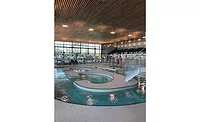
Using less refrigerant is what attracted city officials to use a reduced refrigerant dehumidifier for its Centre Aquatique, Côte Saint-Luc, Quebec, according to Stéphane Maccabée, ing., project director at mechanical contractor, Kolostat®, Laval, Quebec.
The natatorium’s competition and family pools use 30-ton, 13,000-cfm and 30-ton, 25,000-cfm dehumidifiers that substitute glycol for an 80 percent reduced refrigerant charge in both units. The result is a huge reduction of 480 pounds of refrigerant between the two systems. The plan to use a reduced refrigerant strategy along with heat recovery, geothermal, and other principles was part of a plan to construct one of Quebec’s most environmentally-friendly and energy efficient facilities.
The Firekeepers Casino, a Battle Creek, Mich.-based resort owned and operated by the Nottawaseppi Huron Band of Potawatomi, is completing its hotel expansion this year that uses a 30-ton reduced refrigerant dehumidifier for the hotel’s new pool. The 14,000-cfm unit also provides free pool water heating via heat recovery.
The Current Business Climate for Retrofits and New Construction
Since their introduction in the 1970s, DX dehumidifiers have dominated new construction indoor pool HVAC designs. Many of those installations from the 1970s, 1980s, and even the 1990s are reaching the end of their lifecycle and need retrofits. A reduced refrigerant design potentially gives a design/build contractor or consulting engineer a tremendous advantage over the competition on a retrofit project, especially when combined with today’s technological advances that offer efficiency far surpassing the original equipment.
Aggressive sales and marketing combined with energy audits should easily convince facility managers that energy efficiency advances and reduced refrigerant technology can produce short paybacks and lower operational and service costs versus older equipment. A majority of older units today operate with R-22, a hydrochlorofluorocarbon (HCFC) refrigerant outlawed from use in new products Dec. 31, 2009. A dwindling supply of R-22 combined with increasing service issue demands for the remaining millions of older R-22 (all HVAC systems) units still operating, has R-22 prices perpetually rising. The price will continue rising well beyond its total ban from manufacturing and importing in 2020. Therefore, an R-22 dehumidifier that loses any portion of its charge will be a costly service call and should be a prime candidate for replacement.
Although new construction has slowed the last few years, new projects also offer opportunities to present cutting edge equipment, such as reduced refrigerant units, to architects and engineers. Reduced refrigerant dehumidifiers offer a tremendous advantage for engineers and contractors trying to accumulate project LEED credits or simply accommodate green-minded building owners with state-of-the-art ideas.
Reducing refrigerants to help save the environment is a proven technology that has come of age. It’s now the contractors’ and engineers’ responsibility to think outside the box and introduce the technology to the end-user.
Publication date: 10/8/2012
Looking for a reprint of this article?
From high-res PDFs to custom plaques, order your copy today!