Fun With R-407A in Retail Refrigeration
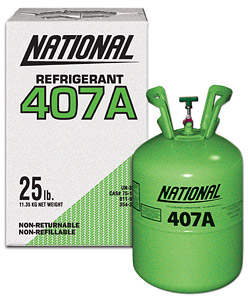 Have you worked with R-407A in refrigeration jobs? The mechanical design company Henderson Engineers Inc. (HEI) of Kansas City has in such a project where it was given the task by a major retailer to improve the carbon footprint of a supermarket refrigeration system; it included in its efforts one of the newest refrigerants that has been introduced into the industry, HFC-407A.
HEI’s Nick Shockley, associate and senior refrigeration design engineer, said, “In addition to the carbon footprint, we also had to consider energy efficiency, refrigeration capacity of the blend, system construction costs, refrigerant cost, and availability. R-407 (a blend of -32, -125, and -134a) provided the best overall solution for these parameters.”
Of the refrigerants considered for the application, only HFC-410A and HFC-407C had lower direct global warming potential than -407A. R-410A is common in air conditioning and several prototype refrigeration systems are in test using the refrigerant. But, according to a case study issued by National Refrigerants, “the lack of commercially available -410A refrigeration components has kept this option from being considered.”
It was then a matter for HEI to compare -407A and -407C for the specific application parameters. “It was decided that the increase in lower temperature capacity for -407A outweighed the small improvement in GWP for -407C,” said National in its case study.
Said Shockley, “One last consideration is that the refrigerant has to be readily available. It might be needed anywhere in the United States (the technology is earmarked for 250 sites), and we did not want to specify a proprietary blend.” R-407A is said to be available from all major distributors of refrigerant in the United States.
Challenges
Initially, there were not a lot of pieces of equipment directly specified for -407A. “Equipment selection was a challenge until more manufacturers added -407A choices to their selections,” said Shockley.
Also HEI had to overcome some initial misconceptions about blends with a temperature glide. Shockley said, “Manufacturers wanted to oversize their condensers, assuming that the glide would hurt performance and cause problems. We had to make allowances for the software to correct for using the midpoint of the glide and not the dew point.”
In addition, he noted that some technicians did not understand temperature glide and were not setting superheat values correctly.
Design Ownership
Shockley said, “The key to making this project successful was HEI getting ‘refrigeration design ownership.’ This means that we could get creative about making efficiency-related design changes as we changed to a new refrigerant. All aspects of the system design, and the impact on the carbon footprint, were coordinated through (HEI).”
Looking for quick answers on air conditioning, heating and refrigeration topics? Try Ask ACHR NEWS, our new smart AI search tool. Ask ACHR NEWS
As the equipment selection and sizing issues were resolved, HEI learned that the temperature glide of -407A allowed the floating of the suction pressure in the evaporators to gain additional efficiency. “We looked at pipe sizes,” said Shockley. “By changing to a loop piping design and reducing the pipe sizes, we were able to manage proper oil return and cut a considerable amount of copper and fittings out of the store.”
HEI also discovered that changing to -407A did not require the addition of liquid injection into the compressors, which was needed for some other blends that were tested. HEI said there was enough heat rejected by the compressors to make use of a heat reclaim system for the making of hot water during the winter.
Additional system modifications included variable-speed motors on the condenser fans and improved control schemes.
Looking Ahead
HEI said the design has improved the carbon footprint compared to previous store design and met the goals set by clients.
In addition, Shockley said HEI continues to evaluate new lower GWP fluids and alternative technologies. “We are always looking at design improvements that will provide the improved performance and environmental benefits that our clients demand. We will be ready as these new technologies become cost effective.”
Publication date: 10/31/2011
Looking for a reprint of this article?
From high-res PDFs to custom plaques, order your copy today!