ACHR News
search
Ask ACHR NEWS AI
cart
facebook twitter instagram linkedin youtube
  • Sign In
  • Subscribe
  • Sign Out
  • My Account
ACHR News
  • NEWS
    • Breaking News
    • New HVAC Products
    • Featured Products
    • Manufacturer Reports
    • HVAC Data
    • Legislation
    • ACHR NEWS Centennial
  • RESIDENTIAL
    • Air Conditioners
    • Furnaces
    • Residential Heat Pumps
    • Ductless
    • Residential IAQ
    • Testing, Monitoring, Tools
    • Components & Accessories
  • COMMERCIAL
    • Air Handlers
    • Rooftop Units
    • Chillers and Cooling Towers
    • Commercial Heat Pumps
    • Boilers and Hydronics
    • VRF/Ductless
    • Commercial IAQ
  • REFRIGERATION
    • Refrigerants
    • Refrigerant Regulations
    • Leak Management
  • CONTRACTOR PRO
    • Geothermal
    • Homeowner Study
    • VRF and VRV Ductless
    • Unitary Trends
  • EDUCATION
    • Training and Education
    • Business Management
    • Service and Maintenance
    • Continuing Education
    • Market Research >
      • HVAC Brand Awareness Report
      • VRV, VRF, VRVZ Report
      • Unitary Trends Report
      • Water Heat Professionals Report
    • Webinars
    • Sponsor Insights
    • eProducts Info
    • White Papers
  • EVENTS
    • HVAC Contractor Forum
    • Industry Events and Webinars
  • MEDIA
    • Videos
    • AHR Expo 2025 Videos
    • Podcasts >
      • ACHR News Podcast
      • HARDI Podcasts
      • AHR Expo Podcasts
      • ACCA Podcasts
    • Interactive Spotlights
    • Quizzes
    • eBooks
    • HVAC Talkback
  • HVAC GROUP
    • ACHR NEWS >
      • Current Issue
      • Digital Edition
      • Subscribe
    • Distribution Trends
    • SNIPS NEWS >
      • Join SNIPS NEWS
    • Engineered Systems News >
      • Join ES News
    • HVACR Directory
    • Contests
    • Newsletters
    • Contact
    • Advertise
    • My Account
NewsHVAC Residential MarketAir ConditionersService Market

The Moisture Epidemic
October 17, 2011
Moisture Epidemic
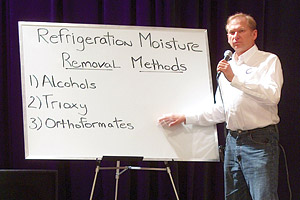
Paul Appler discusses moisture-related problems during a State of Alabama Continuing Education Program for HVACR contractors.

“An epidemic of moisture-related problems are causing more system failures today than ever before in the history of air conditioning and refrigeration,” said Paul Appler, a technical speaker at the state of Alabama’s mandated Continuing Education Program for HVACR Contractors.

Appler, director of research for Cliplight Manufacturing, presented the state-approved Repair and Servicing R-410A/POE and R-22/Mineral Oil-Related Systems last spring to classes of HVACR service techs at the Alabama Johnstone Supply branches of Birmingham and Huntsville.

“I think service techs are finally understanding that moisture is now public enemy No. 1 based on the many moisture-related questions they asked during the four-hour class,” said Larry Brudi, the program’s host and owner of five Johnstone branches in north central Alabama and middle Tennessee.

While HFC-410A/POE systems readily react with water or hydrolyze to form acids and alcohol that lead to accelerated system corrosion, Appler said HCFC-22/mineral oil systems can also develop similar problems such as waxing particulates that restrict thermostatic expansion valves (TXV). “Moisture is an old adversary regardless of the system, but now it’s even more threatening because of the efficiency advancements of today’s systems,” said Appler.

Appler said that chemical-based drying agent additives, triple evacuations, liquid line drier replacements, and other technology can help remove, prevent, and greatly reduce system moisture. When combined with industry-accepted repair fundamentals, moisture-related problems can be virtually eliminated or at least minimized, Appler said.

Shortening Triple Evacuation Time

Commercial refrigeration service contract customers typically can afford their service company’s lengthy full-fledged triple evacuation procedures that ASHRAE recommends to boil off moisture in a system, according to Appler. However, the average residential central air conditioning customer typically can’t afford two to four-hour service calls. “ACR associations recommend a pull-down between 500 to 1,000-microns with the ability to hold the vacuum for at least an hour, but residential techs don’t have that kind of time or don’t feel comfortable billing customers for it,” said Appler.

Looking for quick answers on air conditioning, heating and refrigeration topics? Try Ask ACHR NEWS, our new smart AI search tool. Ask ACHR NEWS →

Instead, Appler recommended a leaner five-step evacuation approach that reduces service time on residential air conditioners while still ensuring the greater amount of moisture is removed. The steps are:

1. Using a two-stage vacuum, pump and evacuate down to 1,000-microns.

2. Once 1,000 microns is reached, immediately break vacuum with 15-psi nitrogen and hold for 10 minutes.

3. Evacuate to the 500 to 700 micron level.

4. Immediately break vacuum again with 15-psi nitrogen and hold for 3 minutes.

5. Evacuate down to 500 microns and hold for 10 minutes.

On a typical residential unit, holding 500 microns for 10 minutes without any gauge movement indicates a relatively leak-free system, according to Appler. If the system moves up to 2,000 microns and holds there, it indicates moisture remains in the system and steps 1 through 5 must be repeated. If it surpasses 2,000-microns, the system is leaking and may also potentially have moisture.

Chemical-Based Drying Agent Additives

“Triple evacuations and liquid line driers, as critical and effective as they are, probably will never totally rid the system of all moisture, particularly in POE oil systems,” said Appler, who performed a live demonstration in the classes showing residual moisture. “Therefore, the right chemical drying agents will aid evacuations and driers in moisture removal and make a huge difference in your service success and billing time. But it’s important to know the different types of chemical drying agents and how they work scientifically.”

He noted that chemical driers fall under three main categories: 1) alcohols; 2) vinyltrimethoxySilanes; and 3) orthoformates. These chemicals are distributed in the HVACR industry under many brands, all which have material safety data sheets (MSDS) listing their contents, according to Appler.

Alcohols: Several industry drying agents use methanol, ethanol, isoproponol and other alcohol-based chemicals, according to Appler. They can either be poured from a bottle into an oil injector tool or a charging hose, or contained in syringe-type devices, as well as hydrocarbon-charged canisters. They don’t proactively remove the moisture, but in a reactionary strategy, they prevent it from forming ice crystals that can block TXV orifices or capillary tubes. The ice crystal prevention is the same strategy used in glycol systems. Alcohols are a quick temporary fix for a problem, such as frozen TXV’s in a walk-in cooler that can’t be shut down for moisture removal because there’s no alternative food storage.

Vinyltrimethoxysilanes: They have been used solely as a drying agent in the automobile air conditioning industry. They are sold in a syringe tool or canisters using HFC-134a or a hydrocarbon as a propellant. Vinyltrimethoxysilanes are a reactive compound that doesn’t remove water molecules, but instead reacts with the moisture to form globular, soft polymers that could collect particulates that could potentially cause flow resistance and orifice restrictions.

Orthoformates: They are a reactive chemical that actually breaks apart H2O molecularly into ethanol and menthol. “You might be asking yourself, what’s the difference because both the alcohol-based and orthoformates chemical driers end up as an alcohol in the system, but the difference is the orthoformate system has eliminated water while the alcohol-based driers only mask it,” said Appler. “Orthoformates, because of their high reactivity and aggressive nature toward water, eradicate H2O in a two-stage attack.”

He said orthoformates can only be packaged in a vacuum-packed can, or else they would start working before applying them to a system. Once connected to the low side of an off system, the vacuum-packed can allows the system’s refrigerant to charge the can, then inject it into the system when the system is switched back on. This transfer prevents the product from being exposed to atmosphere or a primary propellant, he said.

Publication date: 10/17/2011

KEYWORDS: air conditioning systems Moisture Control

Share This Story

Looking for a reprint of this article?
From high-res PDFs to custom plaques, order your copy today!


Recommended Content

JOIN TODAY
To unlock your recommendations.

Already have an account? Sign In

  • HVAC-enrollment

    The Trades Are Back: HVACR Programs See Nearly 30% Enrollment Spike

    A new wave of future technicians is entering the pipeline.  
    Training and Education
    By: Matt Jachman
  • 2025 Top 40 Under 40

    2025 Top 40 Under 40 HVACR Professionals List

    The 11th annual Top 40 Under 40 list highlights those...
    News
    By: Hannah Belloli-Oster
  • LG Ductless Mini-Split Systems

    The 9 Types of Heat Pumps

    As the U.S. moves toward electrification, heat pumps are...
    HVAC Commercial Market
    By: Joanna R. Turpin
Subscription Center
  • Create an Account
  • Start a Subscription
  • Manage My Account
  • Sign Up for Newsletters
  • Visit Customer Service
  • Update Preferences

More Videos

Sponsored Content

Sponsored Content is a special paid section where industry companies provide high quality, objective, non-commercial content around topics of interest to The News audience. All Sponsored Content is supplied by the advertising company and any opinions expressed in this article are those of the author and not necessarily reflect the views of The News or its parent company, BNP Media. Interested in participating in our Sponsored Content section? Contact your local rep!

close
  • Piggy Bank
    Sponsored byWatercress Financial

    Energy Prices, Inflation, and HVAC: What Today’s Homeowners Care About

  • Refrigerated Food
    Sponsored bySolstice Advanced Materials

    R-455A Refrigeration: A Cold Storage Solution for the Future

  • Airex Rooftop Units
    Sponsored byAirex Manufacturing Inc

    Consolidating Roof Penetrations: A Growing Trend in Multifamily HVAC Design

Popular Stories

HVAC-Price-Increase-graphic

HVAC Price Increase List: June 2026

Trump-Section-232.jpg

Trump Reduces Section 232 Tariffs on HVAC Equipment to 15%

R410A-Refrigerant-Cylinder.jpg

Refrigerant Recovery is a Revenue Opportunity

Heat-pump-cutaway.jpg

PFAS Rules and A2L Building Codes Continue to Evolve

Kroger.jpg

Kroger to Spend $100 Million to Reduce Refrigerant Leaks

View The ACHR NEWS
Centennial Anniversary Timeline

The ACHR News Timeline Chart
Submit a Letter
Submit a letter to our editors.

Events

November 6, 2025

Next-Gen Data Center Cooling: HVAC Innovation and Real-World Solutions

On Demand As AI workloads and high-density computing push traditional cooling methods to their limits, the data center industry is accelerating the adoption of next-generation HVAC technologies.

June 9, 2026

Before You Go All In on AI: Set Up Your Business to Actually Win

In this webinar, we'll walk you through exactly what to get in place before you add AI to your business. You'll leave with a clear picture of where you stand today and a practical action plan to set yourself up for real results.

View All Submit An Event

Poll

Summer Staff

Are you fully staffed for the summer season?
View Results Poll Archive

Products

BNI Mechanical/Electrical Square Foot Costbook, 2026 Edition

BNI Mechanical/Electrical Square Foot Costbook, 2026 Edition

See More Products
A2L Refrigerants - Free Webinar - May 21, 2026

Related Articles

  • Research: Solving The Moisture Load

    See More
  • The Effect Of Moisture On POEs

    See More
  • Troy Byers headshot

    The Blueprint: ASHRAE Epidemic Taskforce’s Troy Byers

    See More

Related Products

See More Products
  • Uncomplicating The Heat Pump: Refrigeration & Air Flow Systems DVD

See More Products

Related Directories

  • The Whalen Co.

    The Whalen Company is the pioneering manufacturer of HVAC vertical stack riser heat-exchanger fan coil units and water-source heat pumps for hotels, apartments and other multi-story buildings.
×

Sign Up. Stay Informed.

The #1 trusted source for the HVACR industry since 1926

SUBSCRIBE
  • RESOURCES
    • Advertise
    • Contact Us
    • Advisory Board
    • Classifieds
    • Submit a Letter
    • Directories
    • Store
  • ACCOUNT CENTER
    • Create an Account
    • Start a Subscription
    • Manage My Account
    • Sign Up for Newsletters
    • Visit Customer Service
    • Update Preferences
  • SERVICES
    • Marketing Services
    • Reprints
    • Market Research
    • List Rental
    • Survey/Respondent Access
  • STAY CONNECTED
    • LinkedIn
    • Facebook
    • Instagram
    • YouTube
    • X (Twitter)
  • PRIVACY
    • PRIVACY POLICY
    • TERMS & CONDITIONS
    • DO NOT SELL MY PERSONAL INFORMATION
    • PRIVACY REQUEST
    • ACCESSIBILITY

Copyright ©2026. All Rights Reserved BNP Media, Inc. and BNP Media II, LLC.

Design, CMS, Hosting & Web Development :: ePublishing