The Professor: The Scroll Compressor

Figure 1: Tip seals for axial sealing. (Photo courtesy of Ferris State University.)
[Editor’s note: This is the second of three columns covering the scroll compressor. The first article, “The Scroll Compressor - A History,” Sept. 1, covered the history of the scroll compressor along with the scroll compressor’s operation. This article will cover the scroll compressor’s advantages and the modulating scroll compressor. The third article will cover digital capacity control for scroll compressors and scroll compressor protection.]
The methods in which the two scroll members of a scroll compressor interact and operate have several advantages. When liquid refrigerant, oil, or small solid particles enter between the two scrolls, the mating scroll parts can actually move apart in a sideways direction. This is referred to as “radial” movement. This radial movement eliminates high-stress situations and allows for just the right amount of contact force between mating scroll surfaces.
This action allows the compressor to handle some liquid. When a liquid slug is experienced, the scroll’s mating parts will separate slightly and allow for the pressurized gas to vent to suction pressure. This allows the liquid slug to be swept from the mating scroll surfaces to suction pressure and vaporize. A gurgling noise may be heard during this process. The compressor may even stall briefly and then restart as the excess liquid is purged out of the scrolls. Scroll compressors handle liquid better than other compressors, but still can require additional accessories like crankcase heaters and suction line accumulators for added protection.
As the orbiting scroll orbits, centrifugal forces on the sides of the mating scrolls, along with some lubricating oil, form a seal that prevents gas pocket leakage. This is often referred to as “flank sealing,” a major contributor to the scroll’s high efficiency. A small amount of lubricating oil is usually entrained in the suction gases, and along with the centrifugal forces, provides the flank sealing.
Tight up-and-down mating or sealing of each scroll’s tips prevents any compressed gas pocket leakage and adds to the efficiency. This up-and-down sealing is often referred to as “axial” sealing. Some scroll manufacturers use tip seals for the axial seal (Fig. 1).
Scroll tip seals act the same as piston rings in a reciprocating piston-type compressor. These tip seals ride on the surface of the opposite scroll and provide a seal so gases cannot escape between mating scroll parts and the tips of the scrolls.
The scroll compressor requires no valves, so it does not have valve losses that contribute to inefficiencies as piston-type compressors do. As mentioned earlier, the scroll compressor has no re-expansion of discharge gases, which can be trapped in a clearance volume and cause low volumetric efficiencies. This is why the scroll compressor has a very high capacity in high- compression ratio applications.
A considerable distance separates the scroll compressor’s suction and discharge ports or locations. This greatly reduces the transfer of heat between the suction and discharge gases. Because of this, the suction gases will see less heat transferred into them and will have a higher density. This will increase the mass flow rate of refrigerant through the scroll compressor.
Because of the scroll’s continuous compression process, and the fact that it has no valves to create valve noise, the scroll compressor produces very low gas-pulsation noises and very little vibration when compared to piston-type compressors.
Finally, the scroll compressor’s simplicity requires only the stationary and the orbiting scroll to compress gas. Piston-type compressors require about 15 parts to do the same task.
In summary, the main reasons scroll compressors are gaining popularity over piston-type compressors in energy efficiency, reliability, and quieter operation are:
• No volumetric losses through gas re-expansion as with piston-type compressors.
• The scroll compressor requires no valves, so it does not have valve losses that contribute to inefficiencies as piston-type compressors do.
• Separation of suction and discharge gases reduces heat transfer losses.
• Centrifugal forces within the mating scrolls maintain nearly continuous compression and constant leak-free contact.
• Radial movement eliminates high-stress situations and allows for just the right amount of contact force between mating scroll surfaces. This action allows the compressor to handle some liquid.
• Scroll compressors have a continuous compression process and have no valves to create valve noise. This creates very low gas-pulsation noises and very little vibration when compared to piston-type compressors.
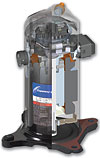
Figure 2: Two-step modulating scroll compressor. (Photo courtesy of Emerson Climate Technologies.)
MODULATING SCROLL COMPRESSORS
When dealing with an air conditioning system, a compressor with modulating capacity along with a variable-speed blower motor for the conditioned air will deliver much tighter temperature control with a reduced humidity level within the conditioned space than a standard cooling system without these features. The overall comfort level for the occupants will be much higher because the compressor will run longer at part load to reduce humidity levels and maintain very precise temperature levels.A new technology in scroll compressor design allows the compressor to have a two-step modulating capacity of either 67 percent or 100 percent. In a modern, two-step modulating scroll compressor (Fig. 2), the addition of an internal unloading mechanism in the scroll compressor opens a bypass port or vent at the end of the first compression pocket. This internal unloading mechanism is a direct current (dc) solenoid controlled by the second stage of a conditioned space thermostat in either the heating or cooling modes.
The dc solenoid, which is controlled by a rectified external 24-V alternating current (vac) signal initiated by the conditioned space thermostat, moves a slider or modulating ring that covers and uncovers the bypass ports or vents. The compressed gas is then vented into the beginning of a suction pocket within the scroll.
When the bypass or vent port is opened by de-energizing the dc solenoid, the effective displacement of the scroll is reduced to 67 percent. When the dc solenoid is energized by the second stage of the conditioned space thermostat, the bypass ports are blocked or closed and the scroll is at 100 percent capacity. Again, this opening and closing of the bypass ports or vents are controlled by an internal electrically operated dc solenoid. The unloading and loading of the two-step scroll compressor is done while the compressor’s motor is running without cycling the motor on and off.
The compressor motor is a single-speed high-efficiency motor that will continue to run while the scroll modulates between the two capacity steps. Whether in the high (100 percent) or low capacity (67 percent) capacity mode, the two-step modulating scroll operates like a standard scroll compressor.
As mentioned earlier, the internal dc solenoid in the compressor that operates the internal unloading mechanism is energized by the second stage of a conditioned space thermostat. It is expected that the majority of run hours will be at low capacity (unloaded at 67 percent). It is in this mode that the solenoid is de-energized. This allows the two-stage thermostat to control capacity through the second stage of the thermostat in both cooling and heating. An extra external electrical connection is made with a molded plug assembly that contains a full wave rectifier to supply direct current to the solenoid-unloaded coil (Fig. 2). The rectifier is actually located in the external power plug on the compressor.
Publication Date: 10/06/2008
Looking for a reprint of this article?
From high-res PDFs to custom plaques, order your copy today!