Seeing Problems More Clearly Now
While attendees put the tool through its paces, company representatives made sure to ask what applications the testers thought TestoView could be used for. According to Bill Spohn, hvac product manager, the list of applications seems to be growing. Chief among those are looking for blocked or dirty coils. The instrument is also waterproof and can be used to inspect drain pans.
“Another area is duct cleaning,” said Spohn. “A contractor can use the TestoView to check the ducts and then let the customer use it to verify.”
One application is really grabbing the attention of some contractors. The instrument is helping service technicians find cracks in heat exchangers.

CRACKING UP
Ellis Prach has been in the hvacr industry for more than 40 years. In that time, he has acquired a lot of knowledge about furnaces and the cracks that can occur in heat exchangers.Prach has run his own heating-cooling business and is the developer of Heat Exchanger Experts, Inc., Fort Collins, CO. The company educates contractors and technicians on how to locate problems within residential heat exchangers. Prach has traveled all over the country presenting these seminars, and puts out a residential furnace inspection manual that offers case studies on numerous manufacturers’ furnaces.
Sitting in on one of his sessions was Eric Kjelshus, owner of Erik Kjelshus Energy. Kjelshus told Spohn about Prach and his work. He also told Spohn that the TestoView would work well for Prach’s applications.
Spohn approached Prach with the tool and says that Prach “had reservations. He had seen products like this before.”
But Prach started to use the TestoView and is now using it to help instruct his classes. Kjelshus, who also does seminars on cracked heat exchangers, has adopted the TestoView into his training as well.
Looking for quick answers on air conditioning, heating and refrigeration topics? Try Ask ACHR NEWS, our new smart AI search tool. Ask ACHR NEWS

A PASSION FOR HEAT EXCHANGERS
When it comes to heat exchangers, Prach knows his stuff. When there are cracks or other problems in a heat exchanger, Prach knows where to look and what to do. He also has a good idea why these complications occur.According to Prach, cracks develop in heat exchangers due to lack of airflow, failure to derate the furnace, improper temperature rises, and dirty air filters. Prach says that more than 50% of all 80% and 90% furnaces will develop cracks or holes in the heat exchanger. These cracks, he says, occur within a year of installation.
“It doesn’t matter to me why they crack,” says Prach. “It is important where they crack.”
And this is the focus of Prach’s training. He says many service technicians are not familiar with procedures for checking for cracks. He says technicians will overlook a five-year-old furnace because of its age. But once you know where to look, finding cracks is simple.
The key to the use of the TestoView is to know how and where to use it. Prach’s manual can guide technicians on the area of the heat exchanger they need to view.
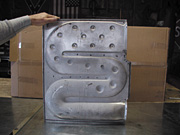
The types of heat exchangers Prach covers include clamshell, serpentine, and drum type; all can be inspected using the TestoView, he says.
According to Prach, the clamshell style will usually fail in the back of the chamber, where it narrows. He explains that inspecting the clamshell would be easy if the sheet metal at the back of the furnace were removed, but this is against regulations and a lot of times it’s just impossible.
Prach states, “The TestoView is sometimes the only tool that gets you into places that a mirror and light will not go. For instance, it is now so much easier to see up the rear side of a chamber after removing the blower. I would recommend that every shop have at least one.”
A number of applications must be run through before placing the TestoView into the system. After performing these tasks, the test instrument can be used for inspecting the opposite side of the metal for cracks. It is important to note the discolorations in the chambers, especially towards the back of the furnace where the chambers narrow. Prach also suggests looking for rust lines in the metal of an aluminized steel chamber. Cracks can usually have the appearance of such rust lines.
Clues like these are important; Prach says that almost 90% of all cracks cannot be seen in heat exchangers.
The process for the serpentine style is much like the clamshell model. Prach says one of the important things to inspect with the serpentine models are the eyelets that hold the chamber together.
NECESSARY TRAINING
The TestoView heat exchanger test kit debuted at the Air Conditioning Contractors of America’s (ACCA’s) annual conference in Kissimmee, FL.Prach strongly believes in training technicians on heat exchangers and their proper inspection. The most important reason is safety. The cracks have the potential to leak out carbon monoxide (CO), and this gets worse over time.
Testo will continue to find new ways to use its TestoView. Spohn says a model is in development that would incorporate a digital camera to capture images of holes in heat exchangers.
For more information on Prach’s contractor/technician training, visit www.heatexchangerexperts.com (website). For information about Testo, visit www.testo.com (website).
Publication date: 03/11/2002
Looking for a reprint of this article?
From high-res PDFs to custom plaques, order your copy today!