Reducing the First Cost of Heat Pumps
The length of the ground heat exchanger piping for a given building is affected by the building’s heating and cooling loads, wrote John Shonder and Jeffrey D. Spitler; “minimizing those loads minimizes the heat exchanger length, which in turn minimizes installation costs.”
Consumers are showing more and more interest in ground-source heat pump (GSHP) systems, due in part to consumer efficiency research and the availability of federal and local efficiency rebates. However, their first cost can still deter consumers’ best intentions.
According to a paper by John Shonder and Jeffrey D. Spitler (both of Oak Ridge National Laboratory [ORNL], and published in IEA Heat Pump Centre Newsletter Vol. 27, Issue 1, 2009), “the use of ground source heat pumps in residential applications is limited by the cost of installing ground heat exchangers.” However, they found some solutions that could help the technology become more palatable by lowering those first costs.
According to the authors, a collaborative research project between ORNL, Oklahoma State University, and De Montfort University is examining potential solutions and developing design tools.
MINIMIZED LOADS, MINIMIZED LENGTHS
A major factor in the high first cost of GSHP is due to the cost of the drilling/excavation needed to install ground heat exchanger piping, they pointed out.“In general, the length of the ground heat exchanger piping required for a given building is a function of the building’s heating and cooling loads,” they wrote; “minimizing those loads minimizes the heat exchanger length, which in turn minimizes installation costs.”
Zero energy homes, for instance, have space conditioning loads that are so low, “the excavations made for the basement/foundation - along with other excavations such as those required for water and sewer lines - may be sufficient to contain all of the ground heat exchanger piping necessary,” said Shonder and Spitler.
“Where existing excavations are insufficient” - in other words, where the home’s air conditioning loads are much higher - “auxiliary heat sources and/or sinks, such as mechanical ventilation, could satisfy the remainder of the requirement.”
In either case, they wrote, “foundation heat exchangers can eliminate the need for separate drilling or trenching for ground heat exchangers, thereby significantly reducing or eliminating the cost premium associated with ground source heat pumps.”

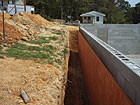
This image shows the foundation heat exchanger for a house during construction, before it was backfilled.
EXPERIMENTAL WORK
According to Shonder and Spitler, ORNL has already demonstrated the feasibility of foundation heat exchangers. This was in a 2,600-square-foot residence in Lenoir City, Tenn.They cautioned that more study is needed before the technology can be applied on a large scale. For instance, they need to study interactions between the basement/foundation, soil, ground loops, and ambient conditions at the ground surface.
At that point, design tools could be developed. Right now, however, “there are no design tools available to size foundation heat exchangers or the supplemental heat sources/sinks that may be required.”
The research is underway. It involves four research homes built around Oak Ridge, Tenn., and an alliance between ORNL, the U.S. Department of Energy, Tennessee Valley Authority, a construction company, and various equipment and building material manufacturers.
The houses, which will incorporate a number of energy-efficient technologies, will be monitored to assess their performance - monitored to a very high degree. As we might expect, one of the technologies is the foundation heat exchanger.
The mass of soil around the foundation is subject to heat transfer from the foundation itself, and from the heat exchanger pipes by way of conduction within the soil. Moisture flow also takes place within the soil. At the surface, heat is transferred through convection, radiation, and evapo-transpiration.
The bottom image above shows the foundation heat exchanger for one of the houses during construction, before it was backfilled. Three parallel loops are located in the basement/foundation overcut. The installation also applies trenching for water and sewer connections.
According to the authors, “ORNL is collecting data on water inlet and outlet temperatures, pipe surface temperatures at various points along the length, soil temperatures both within the trenches and at undisturbed locations, heat flux across the foundation walls, and other variables of interest.”
At the same time, the team from Oklahoma State University and De Montfort University is developing a series of two- and three-dimensional heat transfer models. These are expected to be the basis for both a stand-alone design tool and a simulation model (to be incorporated into building energy analysis programs such as EnergyPlus). This shows preliminary results of temperature distribution in the ground surrounding a foundation heat exchanger, calculated with an analytical model.
Shonder and Spitler said the stand-alone design tool can help system designers figure out whether or not a foundation heat exchanger will sufficiently meet the heat rejection/extraction needs of the GSHP system over the life of the system. “If it will not be sufficient, the design tool will support the sizing of an alternative supplementary heat source or sink,” they said. The simulation model will be able to predict entering fluid temperature to the heat pump, from the foundation heat exchanger, in hourly or shorter time steps.
CONCLUSIONS
The authors summed it up: “Foundation heat exchangers have the potential to reduce the cost of using ground-source heat pumps in zero-energy homes and other low-energy buildings.“With calibrated design tools and simulation models available, engineers and architects will be able to specify the use of foundation heat exchangers in buildings, leading to reductions in energy consumption and carbon emissions.”
For more information, contact John Shonder, Oak Ridge National Laboratory; shonderja@ornl.gov; 865-574-2015.
Publication date: 08/31/2009
Looking for a reprint of this article?
From high-res PDFs to custom plaques, order your copy today!