Humid Climate Schools Find Solutions

The second-floor graduate office space in Patton Hall was in need of renovation. The University office of Planning, Design and Construction wanted to support this project by offering design services; however, limited funding for the renovation required additional contributions of products, materials, and services.
According to a recent survey of educational facilities, including K-12 and colleges and universities, when researching HVAC systems, the most important factor taken into consideration is the energy savings that a specific product will help them realize. This factor outweighed quality/reliability, operating efficiency, and both equipment and maintenance costs.
Other markets surveyed by Clear Seas Research, Troy, Mich., included assisted living, government/military, hospitality, multifamily residential, and office and utility facilities. The survey participants work in buildings of various sizes; the majority were buildings with fewer than four floors and around 20,250 square feet, with an average of 77 rooms.
When asked about their cooling and heating preferences and challenges, both the K-12 schools and the colleges/universities noted that one of their major challenges was not only delivering conditioned, ventilated air at comfortable temperatures to a diverse group of people located in adjacent spaces, but also maintaining temperatures that were generally agreeable. Another challenge cited that educational facilities face - a lack of proper maintenance staff should an outage occur.
The following case studies demonstrate the variety of challenges faced by educational facilities, and how ductless systems are said to help resolve them.
VA. TECH MEMORIAL
At Virginia Tech’s Patton Hall, Blacksburg, Va., a ductless cooling system was donated for a memorial space, following the April 16, 2007, shooting incident at Norris Hall - an uncommon problem, thankfully, but one that demonstrates the use of the technology in renovated spaces. (A professor and eight students died in the incident.)The university’s Department of Civil and Environmental Engineering (CEE) approached the University office of Planning, Design and Construction (UPDC) with an idea to create a memorial space on the second floor of Patton Hall (home to the CEE Department) as a tribute to those fallen students and their teacher. A CEE committee decided to create a commemorative space as a home for the professor’s collection of technical publications, reports, and journals.
The second-floor graduate office space in Patton Hall was in need of renovation. The UPDC wanted to support this project by offering design services; however, limited funding for the renovation required additional contributions of products, materials, and services.
Built in 1929, Patton Hall had never had any cooling systems other than window units, so for this memorial space, an advanced HVAC system became a priority. The solution came via Mitsubishi Electric HVAC’s Advanced Product Division, which already had a number of HVAC systems on campus. The manufacturer volunteered to donate equipment, technology, and expertise.
The memorial project was placed under the leadership of Shane Larkin, manager of renovation projects for the UPDC office. City Multi® VRFZ (variable refrigerant flow zoning) technology was a good match for this renovation, Larkin said. He described the Patton Hall space as “large, ugly, ductwork was everywhere, and there was an air handler in the corridor that was extremely noisy.”
With the ductless system “we didn’t have to lower the ceilings for ductwork, and the installation was simplified since it is a two-pipe simultaneous cooling and heating system. … We simply placed the outdoor unit in an out-of-site rooftop location and ran the pipes and wiring down through an existing chase wall.”
The renovation was completed in February 2009. The team included Varney Inc. as the HVAC engineer and contractor and distributor Aireco Supply, Inc., all of Roanoke, Va.
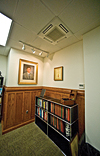
At Virginia Tech’s Patton Hall, Blacksburg, Va., a ductless cooling system was donated for a memorial space, following the April 16, 2007 shooting incident at Norris Hall. (A professor and eight students died in the incident.) The renovation was completed in February 2009. The team included HVAC engineer Varney, Inc.; contractor Varney, Inc.; and distributor Aireco Supply, Inc., all of Roanoke, Va. The memorial project was placed under the leadership of Shane Larkin, manager of renovation projects for the UPDC office. City Multi® VRFZ technology was a good match for this renovation, Larkin said.
HUMID CLIMATE CONTROL
Florida’s Admiral Farragut Academy presented a different set of challenges; the renovation had to follow a very tight timetable.This 75-year-old college preparatory environment promotes academic excellence, leadership skills, and social development within a diverse community of young men and women. In the fall of 2008, as the academy was in the midst of continued preparations for its 75-year anniversary in February of the following year, it realized a strong need for a more modern and efficient climate control system for the on-campus museum.
The 3,200-square-foot museum houses the history of the college preparatory academy. Named after Admiral David Glasgow Farragut, the first U.S. Naval officer to rise to that rank, the academy’s museum houses his memoirs and the school’s resources, and for a long time, three dilapidated window unit air conditioners kept the museum cool in the humid Florida climate.
As we mentioned, timing was crucial. The installation had to be completed in time for the week-long anniversary celebration in February of 2009. After reviewing several cooling alternatives, the academy ultimately went with three of LG Electronics’ Commercial Air Conditioning Art Cool Picture and Inverter Mirror products.
For the entryway, the academy chose two Art Cool Picture units because they combine air conditioning and climate control that is stylish as well as functional. A three-dimensional airflow system combines the look and feel of a photo frame. A photograph of Admiral Farragut now hangs in an Art Cool Picture frame in the entryway. For the administrative office area, an Art Cool Inverter Mirror features a matte white, slim, rectangular, wall-mounted interior evaporator with a one-way airflow system.
The picture and mirror models did not require dropped ceilings for ductwork. The installers were able to go through the wall to connect to an outdoor Multi-V system. This system uses VRF technology, so it controls the amount of refrigerant flowing to each evaporator of the indoor unit. Indoor evaporators are available for different capacity, configuration, and individualized comfort control, as well as simultaneous heating-cooling in different zones. The museum now can control temperature zoning and prevent spending unnecessarily on cooling unoccupied rooms.
With the installation of the three units, the academy has been able to save on its energy bills. What’s more, during the anniversary celebration, attendees commented on how stunning the framed photograph of Admiral Farragut was. When academy staff pointed out that the frame doubles as an air conditioner, attendees were amazed.
Since then, the academy has engaged in a two-year phased rollout to incorporate almost 100 Art Cool Picture models across the campus in the living quarters, to replace older window units.
For more information, visit www.lg.com, and www.mehvac.com.
Publication date: 08/03/2009
Looking for a reprint of this article?
From high-res PDFs to custom plaques, order your copy today!