HDPE Cooling Tower from the Early ’80s Still 'Chillin’ to the Max'
A four-decade-old HDPE cooling tower still powers critical RF heating operations at a Massachusetts manufacturer
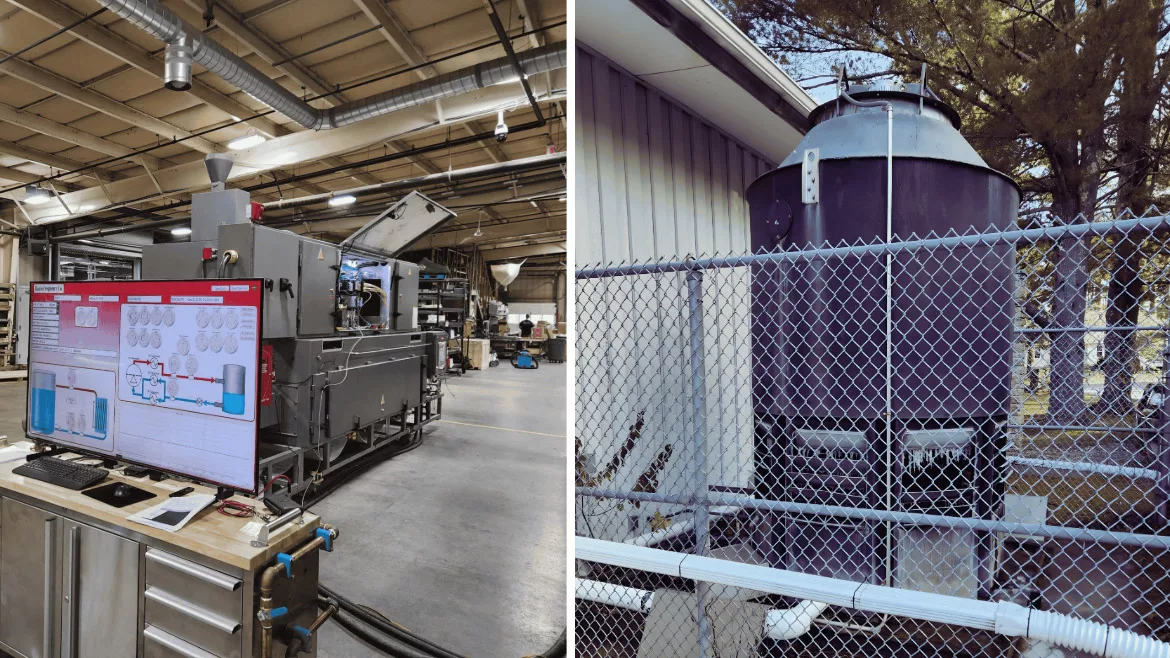
HUM: To the left, the RF Company’s manufacturing facility hums with activity. To the right, the original HDPE cooling tower – still in service after more than 40 years – stands as a testament to durability and innovation.
Installed in 1981, the HDPE cooling tower supports an industrial RF dielectric ‘microwave’ oven equipment manufacturer that services the food industry.
Cooling towers support a wide range of commercial HVAC systems and industrial operations. Their job is straightforward: remove waste heat from the process. As warm water moves through the tower, it encounters cooler air, causing some water to evaporate, carrying heat away and leaving cooler water to be recirculated. It is a simple mechanism, but essential for everything from food-processing lines to large commercial chillers.
What limits cooling tower performance in most facilities is not efficiency, but durability – both in maintaining uptime and in how long the structure can realistically last. Traditional metal-clad towers tend to hold up for only 10 to 15 years, depending on where they are installed and what they are cooling. Harsh climates, airborne chemicals, or heavy industrial loads usually push them toward the lower end of that range.
So you can imagine the surprise of Thomas Maio, senior program manager at Radio Frequency Company (RFC), when he learned the cooling tower behind their Millis, Massachusetts, plant was not “about 20 years old,” as he first assumed. The engineered-plastic, high-density polyethylene (HDPE) tower had been in continual operation since 1981.
“I just turned 43, so that thing’s older than me,” Maio said. “But it still works great and serves our needs.”
A Dual-Purpose Cooling System for ‘Radical’ RF Heating
RFC is a longtime manufacturer of industrial RF dielectric heating systems used in food processing, ceramic production, and numerous other heating and drying applications. Their systems rely on tightly controlled RF energy at 40 MHz to deliver uniform heating across the product bed—a level of precision not possible with a standard microwave’s random energy distribution. Achieving that consistency requires steady water-side cooling, both during system operation and during full-power acceptance testing.
That is where their 45-year-old cooling tower comes in.
RFC uses their cooling tower in two ways. The first is simple: cooling the components inside their RF systems. An internal closed loop circulates distilled water, while a secondary loop removes heat before it can damage sensitive equipment.
“What we don’t want to do is use city water on the primary side,” Maio explained. “The cooling tower lets us recirculate water safely, cool it down, and bring it back without causing damage.”
The second use is more unique. The tower enables full-power acceptance testing. Because RFC can’t always run each customer’s materials through their machines at their New England plant before shipment, their engineering team developed a water-cell method.
Tall water cylinders are positioned inside the RF applicator, and the system drives kilowatt-level power into them. The temperature change between inlet and outlet tells the team exactly how much energy the machine is delivering.
On a 120-kW output system, they push 12–13 amps through these test loads. Through all of it, the cooling tower maintains supply water between 60 and 75°F, even though return temperatures can climb close to 120°F during peak testing.
“The cooling tower is really integral for us,” Maio added. “It lets us power the units up and test them to their full potential before they ever reach a customer’s site.”
A “Tubular” Tower from the 1980s
The engineered-plastic cooling tower at RFC is a Paragon model from Delta Cooling, featuring a one-piece, tube-shaped design pioneered by the company in the 1970s. The 100-ton cooling tower carries a 20-year warranty, which Maio said is a good indicator of how confident the manufacturer is in the tower’s longevity.
According to service and installation records at RFC, the tower has not undergone major repairs, component replacements, or unplanned downtime. More than four decades later, the louvers, shell, and structure all appear original. However, verifying that is impossible because the tower has now outlasted everyone who was around when it was first installed.
“When I checked the install documents, I could not believe it,” said Mike Adams, an expert in fluid, air, and thermal management who supports industrial cooling projects across New England through BA Associates. “At 45 years old, it has to be the oldest engineered-plastic tower I’ve come across that’s still in service.”
For RFC, longevity is only part of the story. What matters most is reliability. They run the tower year-round, in temperatures ranging from midsummer heat to freezing New England winters. Even on the hottest days, the tower remains part of the manufacturing and testing workflow.
While approaching nearly half a century of continuous operation, one might assume that the cooling tower is nearing its end of life. But that does not appear to be the case.
“We have no plans to replace it anytime soon,” Maio stated. “It still does exactly what we need.”
Why Engineered-Plastic “Totally” Outlasts Metal
Adams said corrosion is the number one issue he encountered with traditional metal cooling towers in the region. The combination of coastal salt air, winter road salt, and constant freeze–thaw cycles is unforgiving.
“I’ve seen metal towers with basins rusted all the way through,” Adams said. “One had a hole in the side big enough that I could crawl through it.”
Even stainless steel, often assumed to be the more durable alternative, can struggle.
“We’ve had stainless steel towers develop leaks,” Adams added. “Here in New England, the typical lifespan of a metal tower is really only about 10 years.”
To keep leaking metal towers running, many facilities coat the basins with layer after layer of rubberized sealant. Some accumulate more than two inches of it before failure finally forces replacement.
Engineered-plastic cooling towers avoid these problems entirely. HDPE does not corrode, does not require protective coatings, and does not crack under temperature swings. Its material flexibility and molded, one-piece construction prevent the structural issues common in multi-panel metal shells.
Adams noted that RFC’s tower is not an outlier. Another New Hampshire manufacturer he visited regularly operates two engineered-plastic towers: one installed in 1989 and another added more recently. Both run five days a week, year-round.
“They’re fulfilling and exceeding the lifespan expectations,” Adams explained. “I have not heard about nor seen a warranty claim on one.”
Total Cost of Ownership: “Bodacious” Savings
Across a 40-year span, the economics become obvious. Facilities that rely on metal cooling towers typically face multiple full replacements. Each one requires additional expenses not only for the new unit, but also for the installation, which often requires crane rentals to get the tower into position.
Adams noted that many customers “laugh” when they hear about a 20-year warranty on some engineered-plastic cooling towers, because metal units rarely make it that far without developing significant problems.
Without ever intending to, RFC has demonstrated the clearest possible cost-of-ownership profile: one tower, installed in 1981, still supporting the needs of a modern manufacturing environment.
Although RFC’s application is specialized, its cooling requirements mirror those found across numerous industrial sectors. Process cooling for food production, ceramic drying, chemical manufacturing, plastics extrusion, and countless other operations depend on stable water temperatures and reliable heat rejection. HVAC systems and industrial chillers also rely on cooling towers to maintain efficiency.
The durability of engineered-plastic cooling towers makes them well suited to any environment where corrosion, climate, or airborne contaminants shorten the lifespan of metal equipment.
“Out of the 15 years that I have been here, it’s probably been the easiest piece of equipment we’ve had to maintain,” Maio concluded.
Looking for a reprint of this article?
From high-res PDFs to custom plaques, order your copy today!