Understanding Real-World Performance of Additive Air Cleaners in HVAC Design
The rise of 'additive' indoor air cleaners
The use of in-space as well as centralized in-duct air cleaning technologies has been increasing in building systems, a trend accelerated by the COVID-19 pandemic and heightened focus on indoor air quality. An accurate understanding of their effectiveness in real indoor environments is critical to sound HVAC system design and equipment selection.
Air cleaners may be classified by distinguishing between subtractive and additive technologies. Subtractive devices are physical barriers in the air stream that remove contaminants. Closely packed fiber filters that remove particles are common examples. More specialized ones can also be found, like activated carbon filters for scrubbing the air of certain chemicals. Additive devices release substances directly into the air that are meant to react with and neutralize microbes and certain chemicals. This distinction is important because these two approaches behave very differently once integrated into HVAC systems and occupied spaces.
Additive air cleaners encompass ozone generators and modern UL-certified low/no-ozone-emitting devices, like bipolar ionizers and photocatalytic oxidizers. Ionizers rapidly grew in use and popularity early in the COVID-19 pandemic for air disinfection, especially in restaurants and schools. Today, they remain popular in system designs for some large commercial applications, like airports. They are often used as part of an energy-saving strategy to reduce outside air ventilation rates in accordance with the indoor air quality procedure (IAQP) of ASHRAE Standard 62.1.
Adoption of additive devices has been largely driven by the fact that they can be easily installed into existing systems with little impact. They are relatively low cost, take up little space, cause no appreciable airflow disruption, and are essentially silent. Many studies have observed nearly complete pathogen removal in controlled experiments. This evidence has undoubtedly contributed to their popularity. Yet, many experts still urge caution in their application.
Inconsistent Effectiveness Metrics
Much of the confusion surrounding additive air cleaners stems from how their effectiveness is commonly measured and reported. Claims of almost complete disinfection are misleading, not because they are based on flawed experiments, but because such statements are provided without specific context. Devices are often advertised with slogans like "killed over 99% of pathogens in less than an hour" in third-party testing. Yet, these experiments are typically done in small, sealed laboratory chambers. Rooms are very different environments: they are larger and continually exchange air with the outdoors and other spaces. With a sufficiently long experimental duration and/or a sufficiently small, sealed chamber, an arbitrarily large percent reduction can be produced by a device that negligibly affects real indoor environments.
A more robust method for describing the inherent performance of an air cleaner unaffected by the space that it serves is the volumetric flow rate of pathogen-free air. This flow rate metric is conceptually equivalent to the clean air delivery rate (CADR) that the Association of Home Appliance Manufacturers (AHAM) has used for decades to characterize air cleaners. A 2022 article in ASHRAE Journal used hypothetical test data to demonstrate a simple CADR calculation procedure. This procedure was formalized in Normative Appendix A of ASHRAE Standard 241, first released in 2023. Standard 241 uses equivalent clean airflow (ECA) to describe the provision rate of pathogen-free air and requires that devices have a measured ECA for compliance.
A Comprehensive Study: Logging Equivalent Clean Airflow Rates
Despite these clarifying resources and ongoing expert analyses, there has been little guidance or clarification of performance. One reason for this might be the relative lack of ECA data compared to the quantity of large percent reduction data. To address this gap and to give our engineering team in Harris’ Design Studio a clearer understanding, an in-house review study was done where ECAs of additive devices were calculated from publicly available experimental data.
Forty-five individual experiments were analyzed from 14 studies and reports, encompassing many kinds of technologies, models, and microbes. Aside from one outlier, calculated ECAs ranged from 0.6 to 94 CFM, with the median device providing just 27 CFM of ECA. This corresponds to between little and negligible disinfection. For comparison, off-the-shelf HEPA filter devices for residential applications can have ECAs up to 250 CFM. Models for larger residential or light commercial purposes can reach 500 CFM. Low-cost DIY air cleaners (e.g., Corsi-Rosenthal boxes) can have ECAs reaching 800 CFM. The wide variability in additive device performance from one study to another is most likely because different devices release different molecules at different rates.
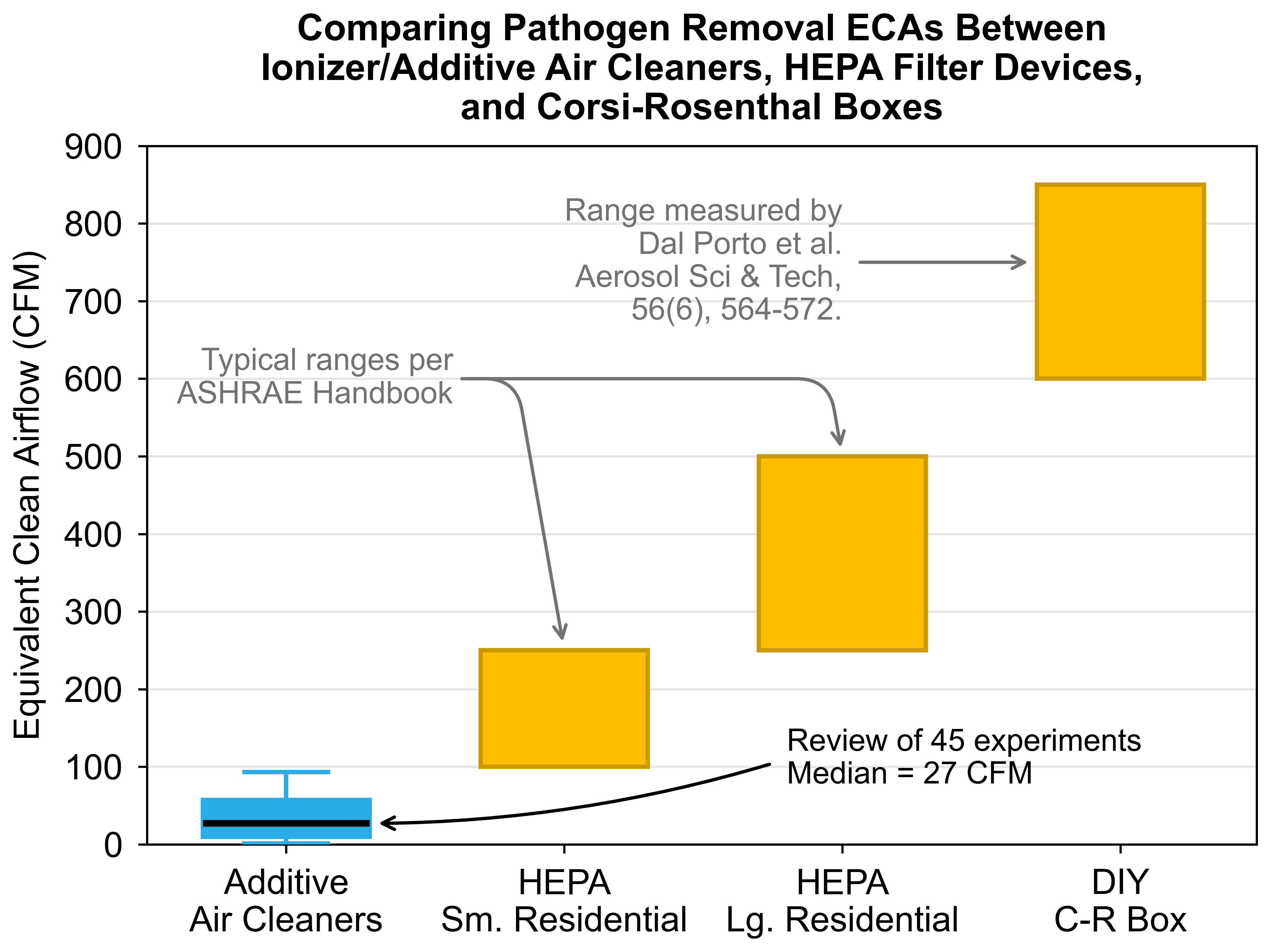
ADDITIVE: Boxplot of additive air cleaner ECAs calculated from 45 experiments, compared to typical ECA ranges for small residential HEPA filters, large residential or light commercial HEPA filters, and DIY Corsi-Rosenthal boxes. (Courtesy of Harris)
Implications
It is important to realize that added molecules follow no program and cannot be controlled. They may react with all sorts of organic chemicals instead of inactivating pathogens, resulting in two possible implications. First, and most ironically, an ionizer may become a less effective disinfectant as it interacts with organic materials, which increase as a space becomes more crowded. Second, chemical reactions will produce chemical byproducts. Manufacturers often claim that this provides a co-benefit, where harmful contaminants are broken down into non-toxic carbon dioxide and water vapor. But in real indoor environments, a complex chain of reactions ensues that may produce chemicals that are less safe than the original contaminants. This raises the possibility of a worst-case scenario where additive devices worsen the overall indoor air quality. For HVAC system designers, these behaviors are critical to understand because their assumed effectiveness can influence ventilation strategies and compliance decisions.
When a device’s advertising relies solely upon impressive-sounding percent reductions, it is not only misleading but also potentially dangerous. It instills a false sense of security and causes a divergence between actual and perceived risks.
Progress must build upon Standard 241. Not only must ECA reporting be required, but additive air cleaner specifications must also disclose which molecules they release and at what rate. HVAC engineers and facilities professionals must also ensure they are proficient in air cleaner specifications. While certain applications undoubtedly exist for additive air cleaners, there should be a shift in the industry from current practices. Technologies like particle and sorbent filtration or ultraviolet disinfection align more directly with established HVAC design practices and predictable system performance, and will be safer for occupied spaces and, in most cases, more cost-effective.
References
Underlying study: Contextualizing Equivalent Clean Airflow Rates for Airborne Pathogens of Ionizers and Other Electronic Indoor Air Cleaners: https://doi.org/10.1021/acs.estlett.5c01201
Acknowledgements
Michael Waring and Charles Haas - Study collaborators at Drexel University
Looking for a reprint of this article?
From high-res PDFs to custom plaques, order your copy today!