Construction Job Growth Driven by Nonresidential Trades as Unions Expand Workforce
Nonresidential hiring and union apprenticeship growth drive strong job gains, but long-term outlook depends on federal infrastructure clarity

OPTIMISM: Ken Simonson of Associated General Contractors of America weighs in with North America’s Building Trades Unions President Sean McGarvey.
After months of mixed signals in the construction industry, new jobs data from January is giving contractors and skilled trades a moment of optimism.
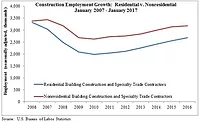
Nonresidential construction, powered by specialty trades like sheet metal, mechanical, electrical, and plumbing, led the way as the U.S. added 33,000 construction jobs last month, according to figures released by the Associated General Contractors of America. The bulk of those gains came from nonresidential specialty contractors, a segment that has weathered recent industry disruptions better than most.
But industry leaders warn the good news may be short-lived. “Those gains will fade later this year unless policymakers provide greater clarity and stability for infrastructure and energy investment,” said Ken Simonson, AGC’s chief economist, in a statement. With the federal-aid surface transportation program set to expire in September, contractors are already weighing whether to expand their payrolls or hold off on new hires.
At the same time, union-backed apprenticeship programs continue to grow. North America’s Building Trades Unions reported a record 88,000 new apprentices in 2025, and union membership rose by over 47,000 last year. In a statement, NABTU President Sean McGarvey credits these results to long-term investments in training and supportive federal policies – factors that make union shops especially resilient when demand for skilled labor spikes.
Yet beneath the headline numbers, challenges persist. The unemployment rate for experienced construction workers jumped to 6.9 percent in January, outpacing the national average. And while average hourly earnings climbed to $38.26, job opportunities remain uneven, especially in residential construction.
Private-sector union membership in the U.S. remains at a historic low, with just 5.9 percent of workers belonging to a union in 2025, according to new data from the Bureau of Labor Statistics. This comes despite aggressive organizing and major spending from unions such as the SEIU and UAW, who have targeted universities, restaurants, and the hospitality sector in hopes of reversing long-term declines outside of the construction trades.
“Despite years of heavy spending and aggressive organizing campaigns, the union effort to organize the private-sector continues to fall flat,” said Charlyce Bozzello, communications director at the Center for Union Facts. “This data suggests that no amount of positive news headlines has changed the fact that workers simply don’t see unions as a relevant tool in today’s rapidly modernizing workforce.”
While many sectors have seen union influence wane, construction trades have managed to buck the national trend – with union apprenticeship programs and workforce numbers growing even as other industries struggle to organize.
For the sheet metal and multi-trade workforce, this moment highlights both opportunity and risk. Continued growth will depend not just on market demand, but on Washington’s ability to deliver stable, long-term infrastructure funding – a point union leaders and industry groups agree on.
As Congress debates the future of transportation and energy investment, the construction trades are reminding policymakers: the nation’s economic security depends on a steady pipeline of projects – and the skilled professionals ready to build them.
Looking for a reprint of this article?
From high-res PDFs to custom plaques, order your copy today!