Boston’s Otis Elementary Now Meets ASHRAE 241 Benchmark – But Who Pays for the Next 1,000 Upgrades?
Boston’s bold air quality experiment could set a new national standard – if districts find funding for healthier classrooms
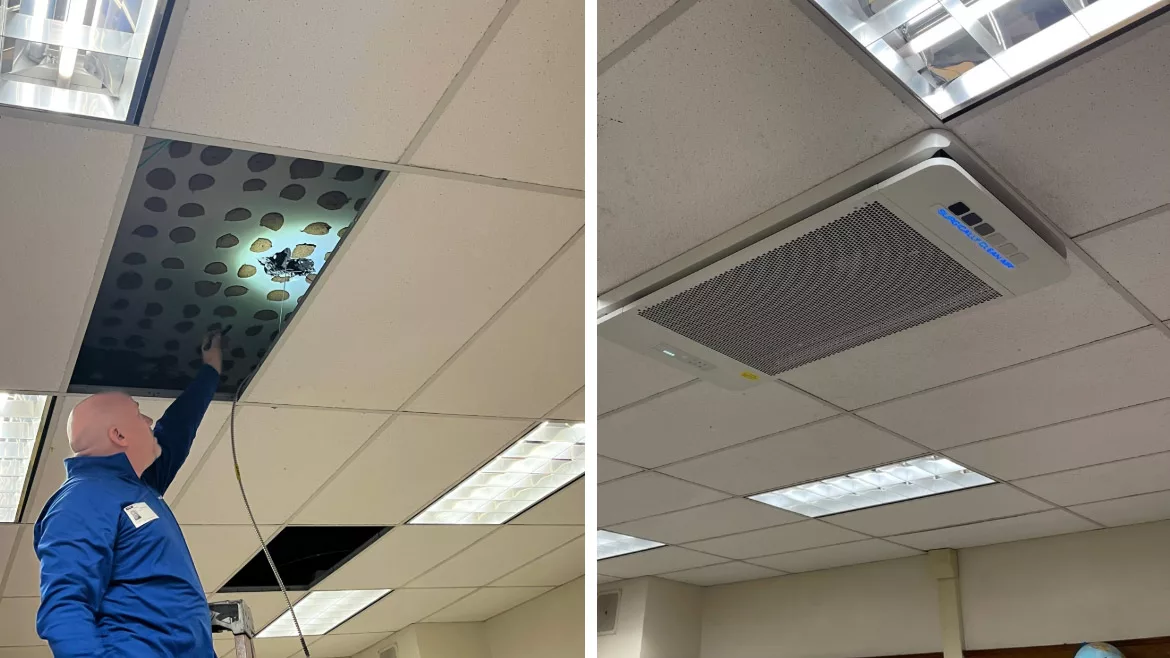
FRESH AIR: Energy recovery ventilators (ERVs) at James Otis Elementary bring in a steady supply of outdoor air while saving energy.
For many school districts, indoor air quality is a quietly urgent problem – one rarely discussed when budgets are tight. “School leaders are often terrified to even find out what’s really in the air their kids are breathing,” said Peter Cantone of Smart Air Defense. “Unless you come to the table with a way to fund the solution, you’re just opening yourself up to blame.”
Yet the urgency is rising. As Cantone bluntly puts it, “Public schools are falling apart and we need to do something different.” The American Society of Civil Engineers gave US public schools a D+ in both 2021 and 2025. COVID-19 accelerated demands for better indoor air, and now, with the introduction of ASHRAE 241 – a science-driven voluntary standard for air quality – the bar for “healthy air” in schools has never been higher.
Developed by an expert committee chaired by Penn State’s William Bahnfleth, ASHRAE 241 sets a new threshold for “equivalent clean air” per person, focusing on reducing the risk of disease transmission. To be “241 compliant”, in a K12 classroom, means providing at least 40 CFM (cubic feet per minute) of equivalent clean air per occupant during infectious disease risk management mode (IRMM) – a dramatic increase over previous expectations.
But how can cash-strapped districts achieve this? Cantone saw that before anyone would measure or discuss air quality, there had to be a credible way to pay for improvements. That’s why his company, Smart Air Defense, offers Energy Savings as-a-Service (ESaaS): a model that funds air quality retrofits by leveraging future energy savings, bundling upgrades into a monthly operating cost and reducing overall expenses. “By taking a holistic approach – investing in solutions that lower energy use and cut maintenance – districts can get capital improvements with zero debt,” Cantone said.
The more deferred maintenance a district has, the more Cantone’s approach can help. His funding partner, Onsite Utility Services (a subsidiary of Origyn International), has decades of experience structuring these deals for private companies, but only recently have such models gained traction in public schools. Cantone’s ESaaS is akin to familiar Energy Service Companies (ESCO) and Energy Performance Contracts (EPC), but with key differences: “With ESCOs, since they must guarantee savings, they cherry-pick energy efficient measures but leave other much-needed retrofit upgrades to be done by the school. Cantone explained. “What good are solar panels if the school still needs its HVAC, boilers, and roof to be upgraded? With ESaaS, we bundle energy efficiency measures with maintenance and repair reductions to incorporate a wider scope, helping to elevate a wider range of school infrastructure. In addition, all maintenance and repairs are the provider’s responsibility.”
As Cantone puts it, “School leaders won’t spend money to investigate air quality if they can’t possibly afford to fix it. But if you bring a package that solves funding fairly, you break the logjam.”
A Public Display – and a National First
Boston Public Schools made headlines by publicly displaying data from more than 4,000 indoor air quality sensors – an act of transparency that Cantone said demonstrates the kind of leadership every district will need as new air health standards take hold.
Otis Elementary, designed with help from Cantone’s firm, is now the first in the country to officially meet and exceed ASHRAE 241’s benchmarks. The design is simple but effective: when a teacher enters a classroom, a proximity sensor activates a ceiling-mounted HEPA filtration unit with a clean air delivery rate of 1091 CFM. This, combined with energy recovery ventilators (ERVs) supplying 15 CFM of fresh, tempered air per occupant, quickly pushes the classroom above the 241 threshold. “This isn’t just about pandemics – it’s about protecting students from everyday threats like flu, RSV, even long-term complications from repeated infections,” Cantone said.
ASHRAE 241: Changing the Game
ASHRAE 241’s science-driven approach shifts away from merely swapping air a set number of times per hour. Instead, it sets specific targets for equivalent clean air, based on occupancy and risk. As Bahnfleth notes, “Better indoor air quality does have quantifiable or monetizable benefits, although they may not be as obvious as energy savings.”
Cantone’s funding strategy – drawing on private capital through an Energy Savings as-a-Service funding model, which is a simple funding model that falls under the Public-Private Partnership umbrella– is new to most school districts but is gaining interest. “There is precedent for P3s in performance contracting and design-build-operate schemes,” Bahnfleth said. For underfunded districts, blending operational savings from HVAC, energy, and solar upgrades into a P3 can make IAQ improvements feasible.
The Otis Example – and the Path for Others
For facility managers staring down ASHRAE 241, the main question is how to provide 40 CFM per occupant, especially in old buildings with poor ventilation. Cantone’s solution at Otis avoided costly “rip-and-replace” retrofit. Instead, by layering ERVs (for fresh air) and ceiling-mounted HEPA units (for clean air), the project achieved and exceeded the new standard – often at a fraction of traditional costs.
In many cases, this hybrid approach can cut retrofit costs by up to 80 – 90% compared to replacing all HVAC systems and ductwork. “It’s about using what you have and adding the right layers – ERV for fresh air, HEPA for clean air, both easily installed and sized for classrooms,” Cantone said.
Boston, though, chose to go even further. As part of its electrification push, Otis Elementary added VRF (Variable Refrigerant Flow) heat pump systems for efficient heating and cooling without fossil fuels. While VRF is “way better” than traditional HVAC for decarbonization and compliance, it does increase upfront costs. “With VRF, you might reduce costs by 50 – 60% versus a full overhaul – not the 80 – 90% possible with ERVs and HEPA alone,” Cantone said. But the upside is clear: Otis stands as proof that schools can electrify, decarbonize, and deliver top-tier indoor air quality all at once.
Cantone is quick to caution: “It’s not one-size-fits-all. The best solution matches your school’s realities and future ambitions.”
Will Codes and Engineers Catch Up?
Despite clear health benefits and new funding options, one challenge lingers: engineering inertia. “Most engineers only design to ‘the code,’ not emerging best practices,” Cantone notes. That leaves districts with a choice – retrofit now to the best available standard, or risk having to redo work later when codes catch up.
Bahnfleth acknowledges the slow pace of regulatory change. “I don’t see a rapid shift yet from recommended practices like 241 to hard requirements,” he said. The solution, he argues, is thoughtful, phased improvements – optimizing costs and performance over time, not scrambling to hit every new standard as it appears. “Cost optimization of phased improvements is an important technical problem, distinct from funding models.”
As for ASHRAE’s role, Bahnfleth said the 241 committee is focused on technical content and ANSI certification, not P3 roadmaps, though other ASHRAE groups are updating school IAQ guidance to be more consistent with 241.
For superintendents facing resistance from engineers used to incremental upgrades, Bahnfleth has simple advice: “Caveat emptor.” Districts need clear, recurring performance evaluations and requirements for remediation if systems fail – and should consult with peers who have already tried these novel strategies.
Otis Elementary is a national first, but advocates see a scalable blueprint. As Cantone concluded: “Net Zero matters. Net Healthy matters just as much. The future is both.”
Looking for a reprint of this article?
From high-res PDFs to custom plaques, order your copy today!