Fed Rate Cut and End of Tightening Signal New Era for HVAC Contractors and Sheet Metal Fabricators
Central bank pivots as economy slows; Tariffs, labor, and volatile materials leave HVAC and sheet metal firms bracing for uncertainty
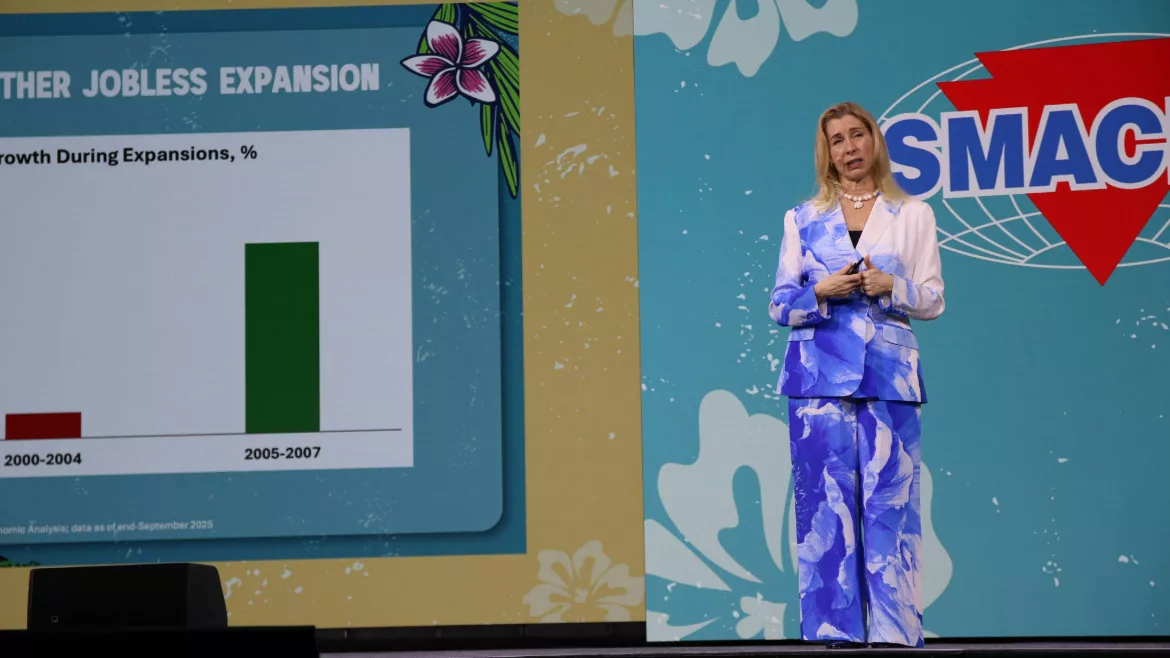
INSIGHT: Rebecca Patterson, global macroeconomic researcher, shares insights on Federal Reserve policy and industry risks with the HVAC industry at SMACNA's annual conference.
In a decision sending ripples through the construction and manufacturing sectors, the Federal Reserve announced a widely-anticipated interest rate cut on Wednesday and declared it will halt quantitative tightening starting December 1. For HVAC contractors and sheet metal fabricators, the move could mean a shift in borrowing costs, project financing, and overall industry momentum heading into 2026.
The move comes as signals of a cooling economy mount across multiple sectors, according to Rebecca Patterson, a globally recognized investor and macroeconomic researcher who studies the intersection of policy and market trends.
Evidence of the slowdown is already stark: Leading manufacturers like Carrier are projecting third-quarter residential volumes down more than 40% year-over-year – the sharpest decline in over a decade, according to The ACHR News. Plummeting shipments and falling HVAC unit sales are reverberating through the supply chain, forcing contractors and fabricators to adjust forecasts and brace for more uncertainty in the months ahead.
“The Federal Reserve acted out of concern that the underlying economy is losing steam, even as headline GDP numbers remain firm,” Patterson told attendees at the Sheet Metal and Air Conditioning Contractors' National Association’s annual conference held in Maui, Hawaii on Wednesday.
Falling interest rates tend to boost mergers and acquisitions by making it less expensive for companies and private equity groups to borrow money and fund their purchases. And while lower interest rates may provide some relief for project borrowing and capital investment, fresh uncertainty looms in the form of shifting tariffs, commodity price swings, and ongoing labor market challenges.
Tariff Volatility Keeps Pressure on Steel and Copper Costs
Among Patterson’s top concerns: persistent and unpredictable tariffs that have made budgeting for steel, aluminum, and copper – a core issue for HVAC and fabrication companies – more challenging than ever. Even as the Supreme Court weighs the fate of certain international tariffs, the broader landscape isn’t expected to ease soon.
“Tariffs are now structurally embedded in U.S. fiscal policy,” Patterson noted. “Regardless of which administration is in power, the need for government revenue means contractors should expect some level of tariffs to remain.”
For sheet metal shops and contractors, that translates into ongoing price pressure on raw materials. Steel and aluminum tariffs, currently reaching as high as 50%, and volatility in copper prices continue to squeeze margins, while complicated customs and compliance paperwork create risk for projects with imported components.
Shifting demand from the booming AI-driven data center sector has made things even more unpredictable. Surging capital expenditure on tech infrastructure is bidding up prices for certain metals and equipment, even as other construction markets take a breather. Patterson warned, “Commodity markets are now especially reactive – global supply constraints, tariff battles, and financial policy all interact to move prices more quickly than many businesses are used to. Steel and copper are at the heart of this new volatility."
The stampede into AI-fueled data center infrastructure has begun drawing flashbacks to the dot-com era, when easy money fueled a massive fiber optic buildout that quickly imploded – leaving half-finished projects and excess capacity across the country. Fed watcher and award-winning financial journalist Bethany McLean and University of Chicago Booth School Economist Luigi Zingales debated the prospect on Thursday. “The wisdom of cutting rates into a bubble the likes of which we may never have seen before, it just seems insane to me,” McLean said. Zingales countered that cuts might soften a hard landing, arguing, “You want to create demand in other sectors once all the data centers will be left unfinished.” Federal Reserve Chairman Jerome Powell himself has poured cold water on expectations for more rate cuts, echoing McLean’s warning – suggesting the central bank is watching these risks as closely as the contractors on the ground.
Commercial, Industrial Slow Down
According to Aaron Hilger, CEO of SMACNA, the commercial and industrial markets are likely to feel “a little bit of slow down ... over the next four to six months,” with much of that lag traced back to the current blows landed on residential HVAC. But Hilger and SMACNA economic advisors are not forecasting a collapse. “I don't expect that to be a particularly dramatic slowdown,” he said, explaining that the industry is used to cycles where activity may be “down five or ten percent and up five or ten percent in any given period.” He remains optimistic that as legal decisions around tariffs and visa issues resolve in coming months, uncertainty will ease and more project backlogs will move forward.
“There’s a huge backlog in the industry of projects that will occur, just like the data center work is still going to be ongoing,” Hilger told industry members, highlighting that infrastructure tied to AI and manufacturing growth remains robust. “As we build more power, you get more manufacturing because you have power to do manufacturing. So I’m actually very optimistic on this ... our customers will have more confidence, and then those projects will move forward,” he added. But Hilger did caution that surprises are always possible, encouraging contractors and fabricators to plan for volatility, even as the overall sector energy remains strong.
Meanwhile, Patterson echoed the need for careful scenario planning and flexible business strategy, especially as labor markets tighten under new immigration limits and as global headwinds – from a slowing Chinese economy to a weakening U.S. dollar – add new layers of complexity to supply chains and input costs.
Patterson also pointed to potential relief from ongoing efforts to cut regulatory red tape – a move expected to eventually reduce project costs and permitting delays, even if its impact may take time to materialize. On the labor front, she warned that tightening immigration policy is already constraining the pool of skilled workers available to the trades, a factor that could drag on productivity and growth if not addressed.
Other structural forces remain in play: mounting public debt may steadily increase the cost of borrowing for long-term projects, and global trends like China’s slowdown and a weaker U.S. dollar could further drive up import and input costs for the sector.
With the Federal Reserve charting a new course, HVAC contractors and sheet metal fabricators are advised to reinforce scenario planning and monitor inputs closely. As Patterson told the room, “We’re entering an era where planning for volatility is a survival skill. Smart businesses will keep a steady eye on commodity sourcing, labor availability, and the evolving policy landscape to stay competitive.”
Looking for a reprint of this article?
From high-res PDFs to custom plaques, order your copy today!