Advancing Heat Exchanger Design with Small-Diameter Copper Tubes
Exploring efficiency, refrigerant reduction, and performance outcomes in modern HVAC/R systems

Market demand and global sustainability goals are encouraging HVAC/R manufacturers to innovate with more energy-efficient and environmentally responsible systems. To meet these evolving standards, engineers are rethinking heat exchanger design from the inside out, starting with the tubes that manage heat transfer and refrigerant flow.
Reducing refrigerant use is a growing goal in modern HVAC/R design since this lowers emissions and improves overall system safety. A proven-effective approach is the use of small-diameter copper tubes. Their reduced internal volume allows for a substantial decrease in refrigerant charge while still delivering strong thermal performance. Combined with copper’s high conductivity, mechanical strength, and long-term reliability, these smaller tubes support the development of efficient and durable HVAC/R systems.
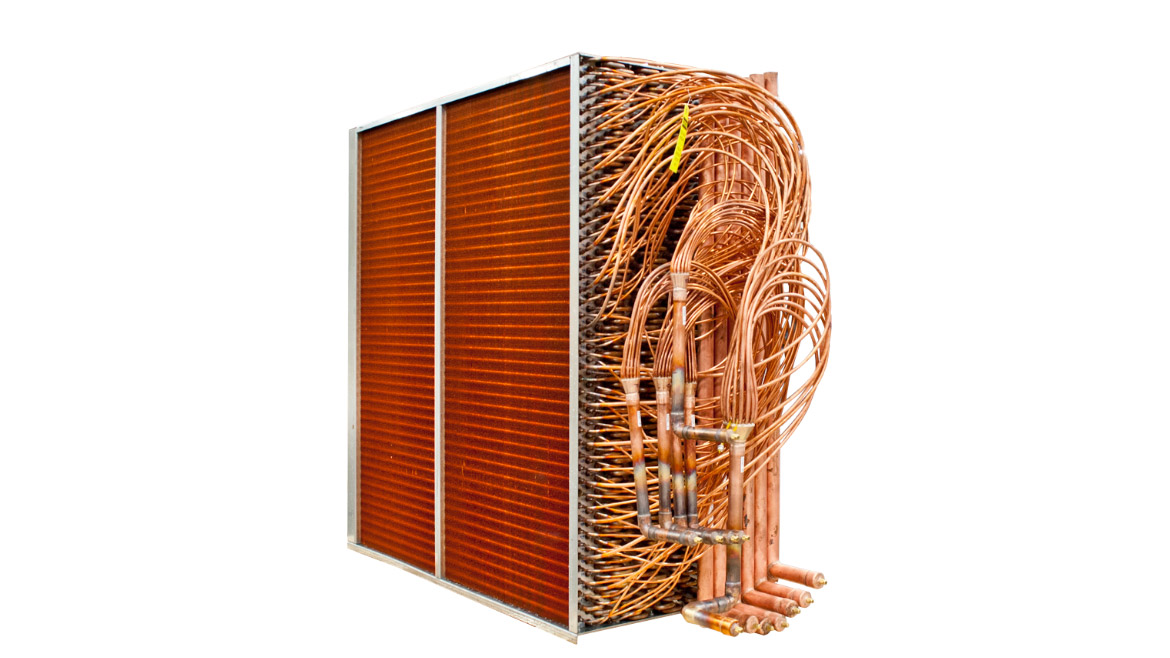
COPPER: Small-diameter copper tubes enable significant refrigerant reduction and improved heat transfer. (Image Courtesy of Super Radiator Coils)
System Efficiency Through Thermal Performance
Copper combines thermal performance, durability, and sustainability, supporting modern heat exchanger design. Its high thermal conductivity, among the top engineering metals, enables efficient heat transfer even at reduced refrigerant charge levels.
Based on performance comparisons, 5 mm inner-grooved small-diameter copper tubes consistently outperform larger 9.52 mm tubes (see Figure 1). These tubes can increase local heat transfer coefficients by 15 to 20 percent compared to traditional 9.52mm tubes across a range of flow conditions. The inner micro-grooves promote refrigerant mixing and boiling initiation, improving internal heat transfer while reducing the thickness of thermal boundary layers. The result is improved system efficiency in a smaller footprint, achieving optimal performance with less refrigerant.
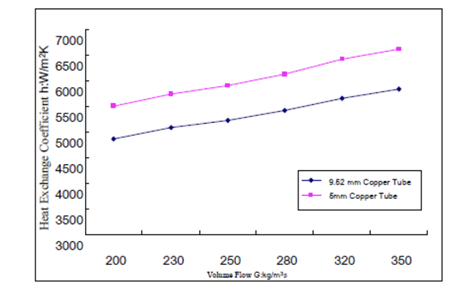
FIGURE 1: Local heat exchange coefficients for 9.52mm and 5mm inner-grooved copper tubes for different mass flow, indicating 15 – 20 percent improvement with 5mm tube.
Additionally, 5mm copper tubes contribute to lower system pressure drop, improving flow characteristics and reducing compressor load. Their compact size also enables lighter, more flexible system designs with less airside resistance, improving airflow efficiency and supporting lower-energy fans, thus improving overall system COP (Coefficient of Performance).
Mechanical Performance and Design Adaptability
Beyond its thermal benefits, copper’s mechanical strength and inherent resistance to corrosion support long-term durability. These characteristics help lower the risk of leaks, reduce maintenance needs, and extend the service life of equipment. Its ability to withstand fatigue and degradation is especially important in systems that use low-GWP refrigerants, which often operate under higher pressures or demand tighter tolerances.
This size and surface enhancement also directly support sustainability goals. Reducing internal volume leads to lower refrigerant charge requirements of up to 50 to 60 percent compared to standard configurations without forfeiting capacity. This is most valuable when using low-GWP refrigerants, many of which are A2L (mildly flammable) or A3 (flammable). Smaller tubes help limit total refrigerant volume, which improves safety and simplifies compliance with flammability and toxicity thresholds under emerging regulations.
Copper can be recycled repeatedly without losing quality, supporting sustainable material use and contributing to circular economy practices. Its established supply chain and material stability further enhance its long-term viability for manufacturers and end users.
Beyond its material properties, copper offers notable design flexibility. It can be manufactured in precise, small-diameter tubes while maintaining structural integrity, making it possible to build smaller, lighter coils that can fit into tight spaces without reducing performance. Unlike aluminum microchannel heat exchangers, which typically require large batch fabrication, copper tube systems provide greater adaptability for customized designs and varying production volumes.

COPPER: Innovative small-diameter copper tubes from Super Radiator Coils drive efficiency and sustainability.
Case Studies
The Copper Development Association collaborates with OEMs to prototype and refine copper-based solutions by offering access to technical consultants, simulation software, and performance testing facilities. Working alongside research organizations such as Optimized Thermal Solutions (OTS), CDA supports evaluating heat exchanger configurations, advancing manufacturability, and fine-tuning copper tube designs to achieve defined performance objectives.
LU-VE
In collaboration with Optimized Thermal Systems (OTS R&D), LU-VE conducted a comprehensive analysis comparing traditional ⅜ inch small-diameter copper tubes, 5 mm copper tubes, and aluminum microchannel configurations. The goal was to maintain performance while maintaining refrigerant charge. The 5 mm small-diameter tube configuration stood out by reducing internal volume by approximately 50% compared to the baseline and outperforming microchannel alternatives (when factoring in the required larger headers for aluminum designs. This design improved refrigerant efficiency, system weight, and environmental impact, offering a holistic improvement in heat exchanger design.
Whirlpool
In response to refrigerant transition challenges, Whirlpool partnered with OTS R&D and the Copper Development Association to reevaluate and redesign evaporator and condenser coils. Evaluating of more than 55,000 design variations resulted in selecting small-diameter copper tubes, which showed superior heat transfer performance across all key metrics. The optimized copper coils improved efficiency and overall system performance while remaining consistent with evolving environmental standards and refrigerant regulations. These findings highlighted copper’s adaptability and strong performance potential in HVAC applications.
GE Appliances
In another study, GE Appliances partnered with OTS R&D and explored using small-diameter copper tube heat exchangers in their packaged terminal air conditioner (PTAC) systems. Using CoilDesigner® simulation software, the team aimed to reduce material costs and airside pressure drop while maintaining thermal performance within strict geometric constraints. The redesigned copper coils demonstrated up to 47% material cost savings, 15% reduction in airside pressure drop, and an outstanding 58% decrease in internal volume compared to the baseline designs. A second optimization phase, exploring new fin geometries, achieved up to 50% cost savings and 62% internal volume reduction. These improvements were achieved without compromising refrigerant pressure drop, and even validated that high-performance designs could be implemented using existing manufacturing equipment.
Moving Forward with Proven Benefits
Progress in HVAC/R design emphasizes materials that combine efficiency, safety, and sustainability, positioning small-diameter copper tubes as an outstanding option for high-performance, regulation-compliant heat exchanger solutions. Case studies continue to confirm their advantages in practical applications, and copper stands out as a reliable and adaptable choice for engineers and manufacturers working under tight regulations and increasing performance demands.
CDA is helping OEMs, engineers, and product teams navigate this shift with technical support, material expertise, and real-world data on 5mm and 7mm copper coil performance.
CDA also offers tailored support for your projects. To learn more about what it means to partner with CDA, visit https://info.copper.org/how-to-partner-with-cda
Looking for a reprint of this article?
From high-res PDFs to custom plaques, order your copy today!