Building Automation Graphics: How Symbol Standards Improve Quality and Reduce Rework
Graphics are more than aesthetics: they help operators quickly interpret complex building automation data and respond effectively

In building automation, the user interface often determines how quickly an operator can understand system performance or respond to an alarm. While controllers, networks, and protocols get most of the attention, the value of clear and consistent graphics is frequently overlooked.
Across thousands of projects, one trend continues to stand out: the companies that standardize their building automation graphics – through structured symbol libraries and templates – complete projects faster, reduce rework, and deliver a noticeably better experience for end users.
This article explores how symbol standards improve project quality, what goes into building them, and why the effort pays off in day-to-day operations.
The Role of Graphics in System Performance
The purpose of a building automation graphic isn’t simply to look good – it’s to communicate complex information quickly. A well-designed interface shows operators exactly what matters: temperatures, pressures, setpoints, alarms, and trends, all presented in a way that’s intuitive at a glance.
When symbols are inconsistent, mislabeled, or visually cluttered, the system becomes harder to use. In large facilities or campus environments, operators may have to jump between systems built by different teams or contractors, each with its own conventions. The result is confusion, errors, and longer response times.
Symbol standardization solves this problem by creating a visual “language” for mechanical and electrical systems – one that is predictable, legible, and scalable from one project to the next.
Why Symbol Libraries Matter
A symbol library is a curated set of equipment and component graphics – air handlers, pumps, valves, dampers, sensors, and more – built to uniform standards. These symbols maintain consistent proportions, line weights, colors, and labeling conventions, making it easy to identify components regardless of the project or control platform.
Beyond aesthetics, a good symbol library ensures:
- Faster project setup – Designers and programmers can drag and drop verified symbols instead of rebuilding from scratch.
- Reduced errors – Consistent visual cues minimize mix-ups between similar components.
- Shorter learning curve – Operators recognize familiar layouts across different facilities.
- Simpler updates – Revising a single symbol updates hundreds of graphics across projects.
In essence, symbol libraries bring the same efficiency to BAS graphics that templates bring to programming or documentation. They enable quality control and scalability – critical when managing hundreds or thousands of points across multiple buildings.
Building a Usable Symbol Standard
Creating a symbol standard doesn’t require starting from zero. Most integrators can begin by identifying recurring components in their past projects and standardizing how those elements look and behave.

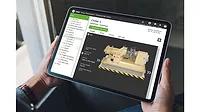
3D: A 3D-rendered Air Handling Unit (AHU) model, showing the detail achievable with standardized building automation graphics. (Courtesy of QA Graphics)
Here are a few best practices:
- Define visual rules early. Establish consistent color schemes (for air, water, or electrical systems), labeling formats, and animation conventions.
- Prioritize clarity over style. The goal is readability and functionality, not ornate design.
- Document your system. Keep a simple guide describing what each symbol represents and how it should be used.
- Review annually. As projects evolve, revisit your standards to accommodate new equipment types or client preferences.
The best symbol libraries evolve gradually. Over time, they become the visual identity of a company’s BAS work—an internal brand standard that customers come to recognize.
The Connection Between Graphics and Commissioning
Clear, consistent graphics don’t just help the end user; they help commissioning teams. When equipment symbols and naming conventions match the mechanical drawings and point lists, verification goes faster and troubleshooting becomes easier.
For example, if every pump graphic includes consistent indicators for status, speed, and failure, technicians know exactly what to check and where to click. That consistency eliminates confusion between jobs and reduces callbacks after turnover.
The same logic applies to graphics updates. With standardized symbols, an upgrade from one platform to another – say, from an older BAS interface to a modern HTML5 or vector-based system – can be done with less manual work and fewer opportunities for mismatch.
Bringing It All Together
Symbol libraries are no longer just “nice to have.” They are a practical, measurable way to improve project delivery in the HVACR and building automation industry.
Whether developed in-house or using a prebuilt library, the principle is the same: standardization leads to quality. Teams that invest in consistent, well-documented visuals report fewer errors, faster project completion, and better operator satisfaction.
The most successful integrators treat their symbol library like a living product – reviewed, maintained, and refined with every project. Over time, this investment builds a reputation for clarity and professionalism that sets them apart in a crowded market.
Looking for a reprint of this article?
From high-res PDFs to custom plaques, order your copy today!