High Efficiency Closed Loop Steam System Achieves an Overall Boiler Efficiency of 95+%
Learn how we can eliminate virtually all flash losses and reduce makeup to almost nothing

EFFICIENT: High efficiency closed loop steam systems save on energy, and can be done in stages. (All images courtesy of BoilerSource)
Steam is a marvelous way to transport large amounts of energy effectively and economically. That is why Steam has been the cornerstone of campus, district heating, and process systems for the past two-plus centuries. With the current need to decarbonize to reduce global warming, many have relegated steam systems to the trash heap. Heat pumps and hot water systems are the current focus for many folks when looking to decarbonize.
This trend would entail abandoning the steam system infrastructure at many sites and replacing it with a pumped hot water loop and/or decentralized heat pump systems, which is costly. Electrification is also a trend that is misunderstood and applied improperly, or at least installed prematurely. In most localities in the U.S. today, substituting electricity for fossil fuels like natural gas will increase your Scope 1 and 2 carbon emissions and increase your cost of energy significantly. With the approach outlined below, we will show how upgrading your steam system to a "High Efficiency Closed Loop Design" can put you on the path to achieving your decarbonization goals in an effective way that can be implemented over time and, best of all, save energy and lower your operating costs.
In April 2024, the DOE published "DECARBONIZING THE U.S. ECONOMY BY 2050: A National Blueprint for the Buildings Sector," outlining five categories of technical solutions for building decarbonization. Ironically, category No. 1 was energy efficiency. If we burn less fuel, we emit less carbon.
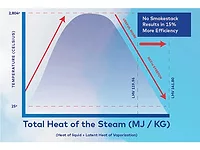
Conventional steam systems historically have had many requirements that limit overall efficiency, with flash steam losses being one of the worst. When we vent flash steam, we need makeup water to replace it. The more we lose, the more we make up. Makeup requires more energy than condensate to turn back into steam and increases the need for chemical treatment. More chemical and oxygen scavenger is needed to treat the makeup, which then leads to more blowdown to remove the precipitants. This is a vicious cycle that has soured the taste of steam systems for many people. Let's look at how we can eliminate virtually all flash losses and reduce makeup to almost nothing.
Introducing the patented High Efficiency Closed Loop Steam System that achieves an overall steam boiler efficiency of 95+% using components and technologies familiar to steam system operators and designers. In fact, all the components we will discuss are recommended by the DOE as Energy Tips.
I am sure you are wondering what makes this concept different from what we have all done in the past. We jokingly say, "all the same ingredients but a different recipe." I hope you like our carrot cake.
Typically, when using a condensing economizer on a boiler, the heat sink water is from the low-temperature hydronic heating system, and the boiler is typically a hot water boiler. We are applying some of the same concepts but using low-temperature condensate as our heat sink, and we are condensing the flue gas in a high-pressure steam boiler!
Below is an example drawing showing a simplified campus or district steam system where the Powerhouse is remote from the buildings using steam. The only pipes leaving and returning to the Powerhouse are the steam supply and the condensate return. The key element that makes this possible is the departure from conventional steam-to-water heat exchangers and using Maxi-Therm Vertical Flooded Heat Exchangers.

Simplified campus or district steam system.
The Maxi-Therm Vertical Flooded Heat Exchangers will subcool the condensate with a very close approach to the hydronic return water temperature. Since the condensate is at a much lower temperature than conventional systems, we gain efficiency by eliminating the flash steam losses common to these older-style systems. There are many other benefits to using vertical flooded heat exchangers.

High efficiency closed-loop steam system diagram.
These include:
-
Eliminating condensate transfer pump stations and flash tanks.
-
Using high-pressure steam directly in the heat exchanger, eliminating pressure-reducing stations.
-
Controlling the water temperature with a small condensate control valve and delivering steam uncontrolled to the heat exchanger.
-
No vacuum breaker = no air injection = less makeup and less chemical treatment
-
Fewer high-maintenance components than a conventional system.
-
Lower installed cost and lower total cost of ownership.
This photo is from a project on the East Coast. It shows a heat exchanger running at 43% of capacity with 129 psi steam entering and 110°F condensate leaving. It also shows the hydronic water loop entering at 107°F and leaving at 120°F. That is a 3°F difference between the condensate outlet and hydronic return. This is not possible using conventional heat exchanger systems.

Example of a heat exchanger working at 43% capacity.
Along with the vertical flooded heat exchanger(s), we employ various other heat recovery methods to reduce the condensate temperature even further before it enters the condensing section of the economizer. Combustion air preheating is one of the key methods to reduce the condensate temperature and use the recovered heat to reduce the load on the boiler, thus increasing the overall efficiency. A 2-3% efficiency increase using conventional burners with air preheat is typical. As stated earlier, we are using some very familiar additional ingredients to reduce the condensate temperature and reduce other energy losses like deaerator flash loss and blowdown heat recovery.
The main photo of this story is one of our proof-of-concept projects. This is a 500-horsepower steam boiler running at 120 psi. The HeatSponge two-stage, three-section economizer is condensing the flue gas, and the overall boiler efficiency was raised from 83% to 95+%! This was a retrofit project to an existing boiler, and we were able to fit the economizer above the boiler and maintain the same flue outlet location.
Every project is unique, and energy savings will vary, so a detailed analysis of potential savings is important to evaluate if this concept makes sense for the owner and whether utility rebates and incentives are available to help offset the cost of implementation. Once the project is surveyed, we can run a simple model to look at the potential savings and determine the ROI. Below is an example of the report we generate to determine project feasibility. This was for a 600-horsepower steam boiler operating at 100 psi. The condensate returns from multiple vertical flooded heat exchangers that provide building heat and domestic hot water for a medical center.
I hope you will agree that using this concept along with other proven technologies keeps steam relevant in today's push for better efficiency and lower emissions. Decarbonization will take many years to implement. The High Efficiency Closed Loop Steam System design is a way to save energy now that is cost-effective, and you can implement it in stages to work within your budget.

Example project feasibility report.
Looking for a reprint of this article?
From high-res PDFs to custom plaques, order your copy today!