Copeland CTO Talks Innovation, Company’s Future
Aggressive R&D is leading the way
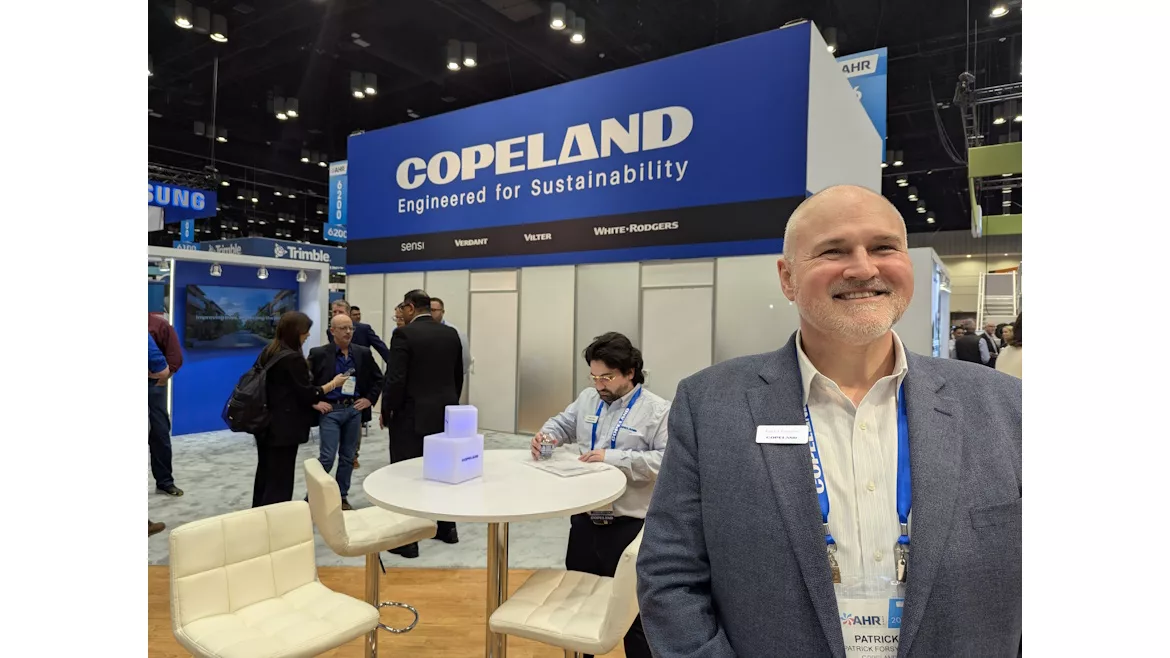
THE PATH FORWARD: Copeland CTO Patrick Forsythe discusses the company’s strategy, and what he thinks the future holds. (Staff photo)
Joining the company in June of 2024, Patrick Forsythe has not only settled into his position as Chief Technology Officer at Copeland, but is already taking steps to accelerate technological innovation.
“While we have a legacy of innovation, I’d say we’re ramping it up,” Forsythe said. “We’re driving it more aggressively and certainly, that’s my goal — innovation and the delivery of new products.”
When Forsythe thinks about Copeland’s history of innovation, he said there’s a lot to be proud of — touting a patent portfolio of 3,400, he said some may try to explain away that impressive number by just saying that’s what Copeland has produced over the last 21 years. But, upon closer inspection, he said that north of 700 of those are relatively new applications, with 126 of them submitted in the last year.
It’s this drive that Forsythe said makes Copeland different.
Forsythe served as CTO and executive vice president of global engineering at Generac Power Systems, vice president of technology at Hayward Industries, vice president global engineering at Doosan, and vice president of global engineering at Ingersoll Rand, and despite all of his time spent in the development space, he said what he’s seeing at Copeland in terms of investment is unique.
“None of those very, very successful companies had the same investment that we have in engineering, research, and development,” Forsythe noted. “We’re investing at like 4% of revenue, which is quite significant, and the biggest portion of that pays for 2,300 engineers and researchers. That’s a big army of people.”
What’s Getting Copeland Excited
With a substantial team of engineers at its disposal, Forsythe said they’re working diligently to meet the demands of their customer base, and striving toward continuously improving energy efficiency.
One thing that Forsythe said he’s excited about is a technology that has traditionally been used in things like semiconductors, aerospace and defense, and even biotech equipment.
The air bearing, which typically utilizes a thin film of pressurized air to create low-friction, load-bearing interfaces allowing non-contact operation, certainly isn’t a new invention, but Forsythe said it is new to the HVAC scene.
Magnetic bearings have been more popular in high-efficiency compressors, but Copeland is shaking that up with its Aero-lift bearing.
“We’ve come up with what I’d say is a different, and in many ways, better solution to a problem,” he said.
The Aero-lift bearing can stand up to intense conditions, such as sudden power interruptions or rapid restarts, which is perfect in an application like oil-free centrifugal compressors.
Copeland is also putting emphasis on model-based digital engineering (MBDE), which is a data-driven approach for not only R&D, but also lifecycle management. Basically, instead of using just physical prototypes to test, develop, and improve designs, they leverage virtual models to test these systems before they’re even built.
Working with a digital twin, Copeland can simulate more performance scenarios in a fraction of the time it would take with a physical model, speeding up development.
Without having to reiterate hardware umpteen times, there is less waste, less expended energy, and improved speed-to-market metrics.
Right now, the next step is getting data from the systems of different customers. That way, performance and real-world application can be even more enhanced.
“In order for all of this to work, everyone has to collaborate,” Forsythe said.
During his conversations with key players at AHR, he said some were still a little nervous about sharing their models.
“But I think everybody’s starting to realize there are ways and means to share the interfaces, which is all you need,” Forsythe said.
New Political Climate
Aside from being the industry’s go-to convention for all things innovation, AHR also serves as an excellent arena to check the political pulse.
With news of policy shifts coming at break-neck speeds, Forsythe said Copeland is keeping its footing firm, as well as its focus for the future.
When asked about the impact of potential Inflation Reduction Act (IRA) rollbacks, he said that doesn’t change Copeland’s approach.
“We’re not going to change our strategy because of the administration change — we’ve built our strategy based on our vision and mission and all the good things we know need to be done for the industry,” Forsythe said.
Forsythe also noted that they are a global organization, so adapting to new climates is nothing new and wouldn’t cause any seismic shifts within the company.
“I do recognize that it may alter priorities in terms of resourcing, but it’s not going to shift the things that we do,” Forsythe said. “There might be customer shifts that might be more drive-by (potential IRA rollbacks) and we need to support our customers.
He added, “We have a very deep relationship and understanding of what our customer wants.”
Looking Forward
As for what future trends the industry will follow, Forsythe said AI and machine learning are grabbing a lot of headlines, but he’s not sure that’s going to be a thumb on the scale for Copeland.
“I believe in those things, I really do, but I’m not sure if those will be the game-changers for us,” Forsythe said. “I think they will certainly help, particularly in the aftermarket, but for me, when I look at more near-term stuff, the move toward variable speed is really, really important.”
The acceleration toward variable speed will sharpen Copeland’s focus on its electronics and, longer term, he thinks natural or low-GWP refrigerants will be a major player in determining the direction of the market.
At the Helix Innovation Center, a massive 40,000-square-foot research facility in Ohio, he said that’s one of the biggest focuses right now.
“A very, very high percentage of the efforts at The Helix has gone into natural and low GWP,” Forsythe said. “It's variable speed driving energy efficiency and natural or low GWP. That's driven by regulatory, of course, but it's also the right thing.”
Looking for a reprint of this article?
From high-res PDFs to custom plaques, order your copy today!