Industry Associations Pivot to State-Level Advocacy
From fire-life safety to building codes, here's how various HVAC industry organizations are moving past federal gridlock
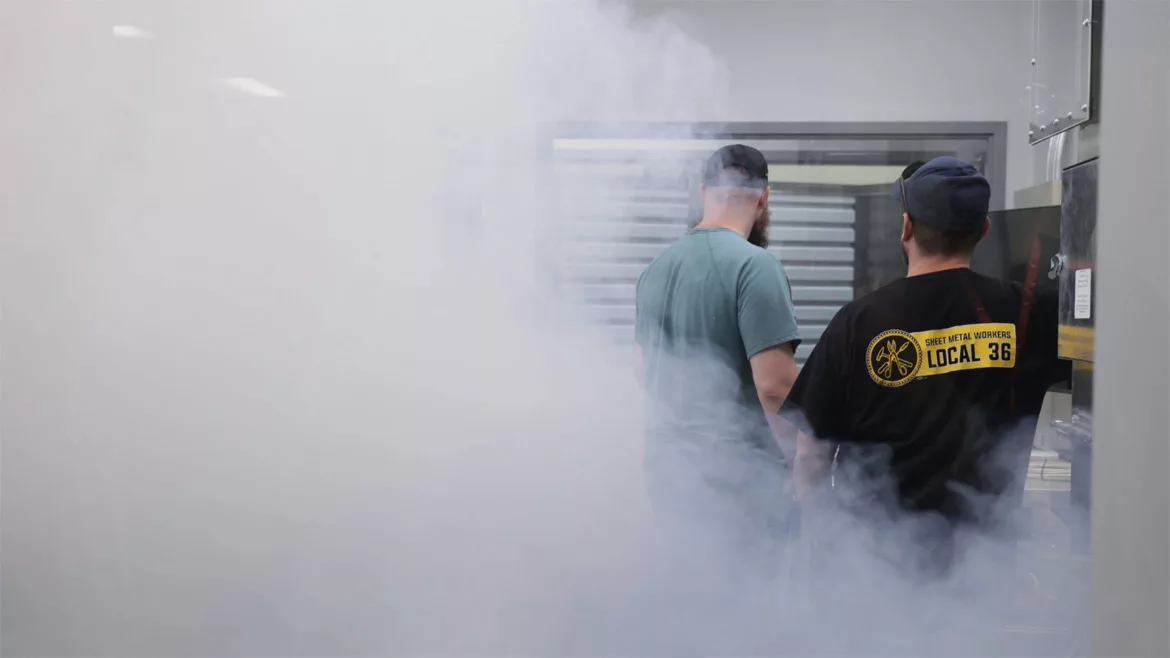
LOCAL: SMART Local 36 successfully lobbied for amendments to the St. Louis fire code, requiring ANSI-certified inspectors for fire and smoke dampers. (Courtesy of National Energy Management Institute)
In a climate of increasing regulatory complexity, HVAC industry associations are pivoting their advocacy efforts toward state and local governments, marking a significant shift in their traditional federal-centric approach. This strategic realignment comes as industry leaders recognize the growing influence of state and municipal regulations on everything from refrigerant standards to building codes.
"With one-party control in Washington D.C., union and environmental advocates know that the best opportunities to advance their legislative and regulatory agendas will be at the state and local levels," explained Sean Robertson, VP of Membership, Advocacy, and Events at Air Conditioning Contractors of America (ACCA). Robertson pointed to New York State's recent Part 494 regulation as a prime example, which accelerates the phase-out of certain refrigerants and pushes for a transition to new equipment types by 2034.
The impact of local initiatives from the union side is best illustrated by St. Louis, where the International Association of Sheet Metal, Air, Rail and Transportation (SMART) workers Local 36 successfully lobbied for amendments to the city's fire code, requiring ANSI-certified inspections for fire and smoke dampers.
The shift toward state and local level advocacy has become so pronounced that major industry players are restructuring their operations. Heating, Air-conditioning & Refrigeration Distributors International (HARDI) created its first-ever state affairs department in February 2024.
"The industry has always been heavily regulated at the federal level," explained Todd Titus, Director of State and Public Affairs at HARDI. "But in recent years, there's been a dramatic increase in state-level policymaking, with environmental NGOs and municipalities putting out aggressive climate policies."
These municipal changes often serve as catalysts for state-wide reforms.
"Even in red states, some left-leaning municipalities have advanced regulations that restrict access to or incentives for efficient gas equipment," Robertson noted, emphasizing the need for vigilance at all levels of government. This interplay between city and state regulations has created a complex web of compliance requirements that industry professionals must navigate.
State Engagement
In Washington state, despite its reputation as a predominantly Democratic stronghold, the Washington Air Conditioning Contractors Association (WAACCA) supported a ballot initiative to stop the state’s ban on gas appliances, a significant victory for consumer choice.
"When you look at Washington's ballot initiative 2066," HARDI’s Titus explained, "the majority of citizens chose that they don't want prohibitions or incentives pushing natural gas out of their state. People want the option to choose between electric and gas for themselves."
Similar successes have emerged through building code advocacy. When Massachusetts contractors faced challenges with GFCI protection requirements causing unnecessary service calls, ACCA helped spread awareness nationwide. This led to the Texas Air Conditioning Contractors Association securing a state exemption, which ultimately paved the way for a national exemption.
The industry is also grappling with emerging challenges like Per- and polyfluoroalkyl substances (PFAS) regulations.
"Over 30 states have passed PFAS legislation," Titus said, noting that following engagement by HARDI and other stakeholders, SNAP approved refrigerants have secured exemptions in all but one state: Minnesota. “The others have either purposely excluded or exempted our industry from being affected by their prohibitions."
This success in securing exemptions demonstrates the growing sophistication of industry advocacy at the state level. The complexity of state-level advocacy is further illustrated on the labor side by recent developments around Project Labor Agreements (PLAs). While a federal court recently struck down PLA requirements for some federal projects, and the DoD and Veterans Affairs are removing PLA mandates from solicitations, state and local mandates continue to proliferate. Republican-controlled states have largely moved to restrict government-mandated PLAs, while Democrat-led states like New York, Illinois, and New Jersey are increasingly requiring them.
The trend toward state-level PLA requirements has accelerated, with Pennsylvania, Massachusetts, Hawaii, Washington D.C., Maryland, and Delaware all enacting pro-PLA policies in 2023 and 2024. In Oregon, for instance, PLAs are now required for public improvement projects where labor costs constitute 15% or more of the total construction costs, a major concern for state-level contracting organizations like ORACCA.
Code Advocacy
The industry has also scored significant victories in code advocacy. HARDI, working alongside Air-Conditioning, Heating, and Refrigeration Institute (AHRI), successfully pushed back implementation of new American Society of Mechanical Engineers (ASME) pressure vessel code requirements from 2025 to the next code cycle.
"What was going on with ASME was they were going to remove exemptions in their pressure vessel code for anything with under a six-inch pressure valve, which would have affected compressors, air coils and other HVAC components," Titus explained. "Being exempt allowed us to fall under the UL code, which was actually made for HVAC. The ASME code is more of an industrial standard - there's even a section for nuclear reactors."
The delay prevents what Titus described as a potential "logistical nightmare" that would have required extensive contractor retraining and equipment redesigns. "We would have probably had a similar COVID year for contractors retiring because they don't want to change their licensing and go back and get trained over for something they're already capable of doing," he noted. The successful intervention demonstrates how industry associations can work together to prevent unintended consequences of code changes.
Looking ahead to the rest of 2025, Robertson identified several priority areas for state-level advocacy, including managing the patchwork of state refrigerant regulations, addressing workforce development through licensing requirements, and tackling liability reform related to PFAS chemicals. The organization is actively seeking contractor feedback on these priorities through both in-person events and online platforms.
"We need contractors everywhere to be on the lookout for opportunities for ACCA and its Allied Contracting Organizations to fight for consumer choice," Robertson emphasized, highlighting the growing importance of grassroots involvement in shaping industry policy.
"Policy can't drive technology. Technology needs to drive the policy," Titus concluded, emphasizing the importance of finding win-win solutions that balance environmental goals with industry capabilities and consumer needs. This principle increasingly guides industry advocacy efforts at all levels of government, from city councils to state legislatures.
Looking for a reprint of this article?
From high-res PDFs to custom plaques, order your copy today!