TODAYS BOILER 2024
Primary Safety Controller Versus Programmable Logic Controller Systems
With inbuilt BACnet or Modbus software, primary safety controllers are as easily integrable to a site’s BMS as a PLC.
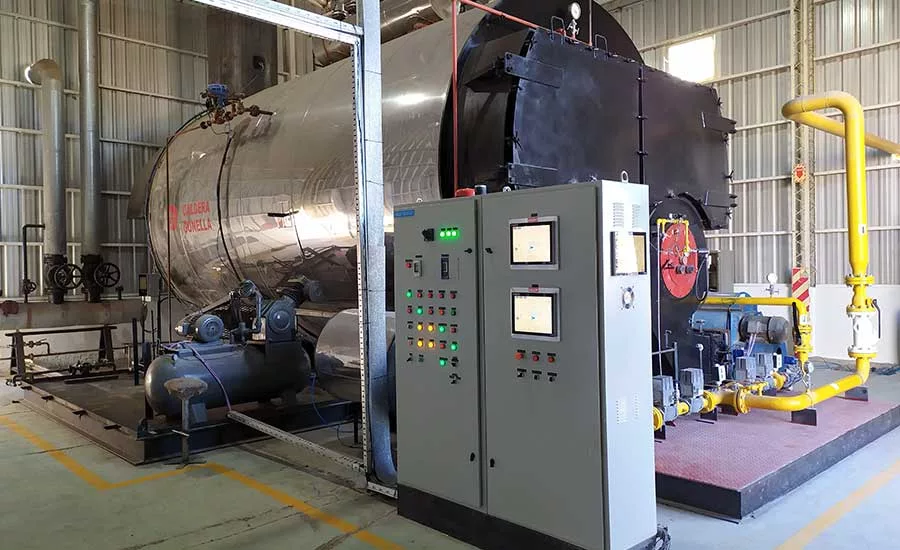
Primary safety controls installed at a Vineyard in Mendoza, Argentina.
All images courtesy of Autoflame Engineering
The world has faced many geopolitical, environmental, economic, and technological changes over the past several years, and with these have come new learnings and opportunities to refine our practices to achieve environmental, economic, and technological goals. A commonality that continues to be found is the drive for efficiency in fuel usage, performance, and reduction of emissions.
The boiler plant is at the heart of a building, providing heat and steam for domestic, commercial, and industrial requirements. To build and maintain successful operational capability, certain controls need to be in place. Decisions need to be taken to ensure plant rooms not only fulfil demand, but also comply with environmental regulations and meet their own emission reduction goals – all whilst operating securely, effectively, and efficiently. When selecting a control system for your plant, there are a range of systems to choose from and many factors to consider. Some of the most discussed in recent years within the industrial automation sphere, are programmable logic controller (PLC) systems.
Many PLCs you will come across in the boiler plant are part of the building management system (BMS), providing an overview of an entire plant, receiving values, flowrates, and the status of devices. The main advantage that PLCs provide is an undeniably high level of configuration: their flexibility, ease of programming and scalability, has made them increasingly popular for use amongst manufacturing processes and industrial automation. Not only can they be quickly altered via their open operating system, they also can be applied to just about any process - from industrial-scale automation within factory processes, to the automation of light switches within your home. In addition, they can be integrated with other equipment to provide ease of scalability.
When discussing boiler plant control, which includes the control of the burner, listed and approved systems or primary safety controls, are inherently safer than PLCs due to their functional safety approvals. PLC software can be written on-site, by an engineer, however change at this stage is not approved by safety testing bodies, such as UL and CE. These types of approvals provide assurance that your plant equipment is fully safe and fit for purpose. A primary safety control system cannot be field approved, with its embedded architecture. It must be approved by a test house, such as UL or CE, who carry out a thorough, independent test of the controller in their own laboratory. The inherently protected nature of the embedded software is arguably safer and more reliable overall when compared to the flexibility of PLCs. Most importantly, this means that the approved primary safety controller cannot be changed on-site, which could pose a safety threat if carried out by unqualified individuals. As we know, ensuring that safety processes are followed is innate to boiler operators. With these same safety rules written into the software of a primary safety control, the coded sequence must follow every time an operator wishes to start the burner. This limits the possibility of human error and reduces the risk of safety breaches in a plant.
The fact that a primary safety controller is not available on an open network increases the security of the system. PLCs operate on an open network, which — although it creates flexibility for those re-mapping a PLC’s requirements — instantly brings a higher level of risk from a cyber-security perspective. A primary safety controller has the capability of locking down its actions to a single closed network within the boiler plant, so it operates entirely on its very own secure network connection, independent from the rest of the building or production line. This feature enables workflows to stay compartmentalised, which reduces potential contamination risks from hacks or malware. From our experience, clients and their company’s policies aren’t comfortable with having certain devices on their network that can be accessed or edited remotely. They demand a high level of security on these components.


When discussing the connectivity of a PLC vs. a primary safety controller, it has been said that a PLC is more collaborative than a PSC. However, this is not true. With inbuilt BACnet or Modbus software, primary safety controllers are as easily integrable to a site’s BMS as a PLC and integrate with various types of input/output signals. An extra layer of security comes by allocating the read addresses or write addresses, meaning that the controller can decide if a BMS can read or write to its functions, rather than providing an open access to all, as seen typically in PLC controllers.
It’s compelling for manufacturers and engineers alike to witness and be part of the necessary developments that are occurring within our industry. The innovation that will lead us to meet the technological and environmental requirements of a boiler plant is encouraging and inspirational — of course it is imperative that, whilst we innovate and evolve, we also meet the demands efficiently and economically. Above everything else, we must do this without compromise to the integrity of the boiler/burner operation.
Looking for a reprint of this article?
From high-res PDFs to custom plaques, order your copy today!