Researchers discover 'zero energy' flow control
Researchers used the powerful Leonardo supercomputer at CINECA, a supercomputing center in Italy, to learn from a highly realistic 3D replica of a sponge
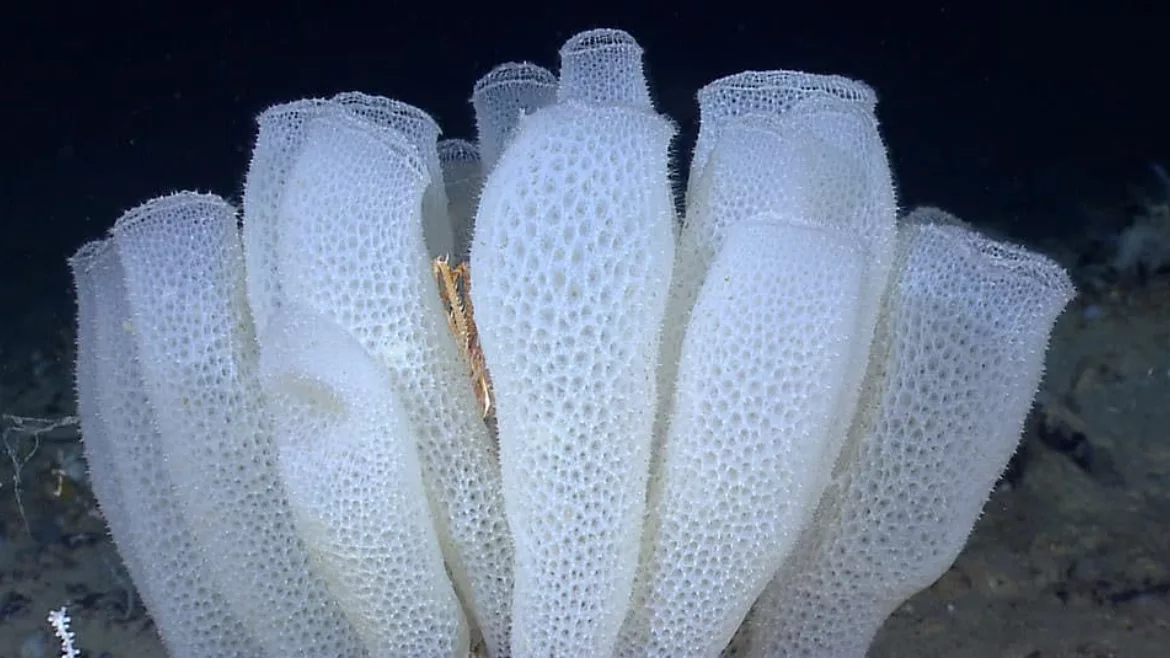
Glass sponge image courtesy of the National Oceanic and Atmospheric Administration
The Venus flower basket sponge, with its delicate glass-like lattice outer skeleton, has long intrigued researchers seeking to explain how this fragile-seeming creature's body can withstand the harsh conditions of the deep sea where it lives.
Now, new research reveals yet another engineering feat of this ancient animal's structure: its ability to filter feed using only the faint ambient currents of the ocean depths, no pumping required.
This discovery of natural '"zero energy" flow control by an international research team co-led by University of Rome Tor Vergata and NYU Tandon School of Engineering could help engineers design more efficient chemical reactors, air purification systems, heat exchangers, hydraulic systems, and aerodynamic surfaces.
In a study published in Physical Review Letters, the team found through extremely high-resolution computer simulations how the skeletal structure of the Venus flower basket sponge (Euplectella aspergillum) diverts very slow deep sea currents to flow upwards into its central body cavity, so it can feed on plankton and other marine detritus it filters out of the water.
The sponge pulls this off via its spiral, ridged outer surface that functions like a spiral staircase. This allows it to passively draw water upwards through its porous, lattice-like frame, all without the energy demands of pumping.
"Our research settles a debate that has emerged in recent years: the Venus flower basket sponge may be able to draw in nutrients passively, without any active pumping mechanism," said Maurizio Porfiri, NYU Tandon Institute Professor and director of its Center for Urban Science + Progress (CUSP), who co-led the study and co-supervised the research. "It's an incredible adaptation allowing this filter feeder to thrive in currents normally unsuitable for suspension feeding."
At higher flow speeds, the lattice structure helps reduce drag on the organism. But it is in the near-stillness of the deep ocean floors that this natural ventilation system is most remarkable, and demonstrates just how well the sponge accommodates its harsh environment. The study found that the sponge's ability to passively draw in food works only at the very slow current speeds -- just centimeters per second -- of its habitat.
"From an engineering perspective, the skeletal system of the sponge shows remarkable adaptations to its environment, not only from the structural point of view, but also for what concerns its fluid dynamic performance," said Giacomo Falcucci of Tor Vergata University of Rome and Harvard University, the paper's first author. Along with Porfiri, Falcucci co-led the study, co-supervised the research and designed the computer simulations. "The sponge has arrived at an elegant solution for maximizing nutrient supply while operating entirely through passive mechanisms."
Researchers used the powerful Leonardo supercomputer at CINECA, a supercomputing center in Italy, to create a highly realistic 3D replica of the sponge, containing around 100 billion individual points that recreate the sponge's complex helical ridge structure. This "digital twin" allows experimentation that is impossible on live sponges, which cannot survive outside their deep-sea environment.
The team performed highly detailed simulations of water flow around and inside the computer model of the skeleton of the Venus flower basket sponge. With Leonardo's massive computing power, allowing quadrillions of calculations per second, they could simulate a wide range of water flow speeds and conditions.
The researchers say the biomimetic engineering insights they uncovered could help guide the design of more efficient reactors by optimizing flow patterns inside while minimizing drag outside. Similar ridged, porous surfaces could enhance air filtration and ventilation systems in skyscrapers and other structures. The asymmetric, helical ridges may even inspire low-drag hulls or fuselages that stay streamlined while promoting interior air flows.
The study builds upon the team's prior Venus flower basket sponge research published in Nature in 2021, in which it revealed it had created a first-ever simulation of the deep-sea sponge and how it responds to and influences the flow of nearby water.
In addition to Porfiri and Falcucci, the current study's authors are Giorgio Amati of CINECA; Gino Bella of Niccolò Cusano University; Andrea Luigi Facci of University of Tuscia; Vesselin K. Krastev of University of Rome Tor Vergata; Giovanni Polverino of University of Tuscia, Monash University, and University of Western Australia; and Sauro Succi of the Italian Institute of Technology.
A grant from the National Science Foundation supported the research. Other funding came from CINECA, Next Generation EU, European Research Council, Monash University and University of Tuscia.
Looking for a reprint of this article?
From high-res PDFs to custom plaques, order your copy today!