Why are electric PRVs replacing self-piloting steam regulators?
Greater visibility and control aren’t the only reasons
Image by Michal Jarmoluk from Pixabay
A trend has been gaining steam: Electric, modulating, pressure-reducing valves (PRVs) are increasingly replacing traditional self-piloted regulators in steam systems.
The adoption of this “smart” technology is part of the overall trend of digitally connecting all components to building automation systems (BASs) for greater visibility and control and for lower energy consumption.
Sometimes, the shift to electric PRVs is driven by more basic considerations. For example, PRVs with electric actuators can be more compact, allowing them to fit in spaces too confined to install — and maintain — a pilot-operated steam regulator.
Moreover, an electric PRV can be set up to automatically calculate the downstream steam flow rate, without the need to install a traditional flow meter. This is an important benefit in locations that lack a sufficient straight run of pipe to accommodate a traditional flow meter.
Pressure reduction increases efficiency
Steam is usually produced at high pressure by a steam boiler to avoid the production of wet steam, among other reasons, and then distributed to one or more points of use that require lower pressure for safe and efficient operation. Steam pressure-reducing stations perform the critical function of reducing the pressure to a desired set point. The control of pressure can also be an effective means of controlling temperature because the temperature of saturated steam is closely related to its pressure.
A single facility may have several pressure-reducing stations. Hospitals, for example, require PRVs to deliver steam for many different uses, including heating, humidification, hot water, sterilization, kitchen, and laundry functions, with varying steam usage requirements based upon the process, time of day, weather, etc.
Pressure-reducing stations also facilitate cost-effective distribution. Significantly smaller pipe diameter can be used where the steam is under high pressure. Therefore, on university campuses where the steam plant serves many buildings spread over a large area, the pressure-reducing stations may be located close to the points of use to save on the installation cost of piping and fittings. This benefit needs to be weighed against the energy savings achieved from reducing radiant heat loss when distributing steam at lower temperatures.
The goal is not only to deliver steam below the maximum allowable working pressure (MAWP) of each piece of equipment, but to maximize energy efficiency for financial saving and environmental sustainability. The most significant energy savings from pressure reduction comes from delivering the optimal pressure at the point of use. Lower pressure results in increased enthalpy of steam and the availability of more latent heat. In other words, more Btus can be delivered per pound of steam when the pressure is reduced.
Traditional pilot-operated regulators
Originally invented in the 1880s, pilot-operated steam regulators are a tried-and-true method of reducing steam pressure and flow. The main advantage is that they operate as self-contained devices that do not require electrical power or a pneumatic air supply. The operating principle is relatively straightforward: The valve operates by continuously balancing the downstream pressure (via a pressure-sensing pipe) against a mechanical spring that operates in conjunction with a bellows or diaphragm. The pressure set point is adjusted by tightening or loosening bolts to increase or decrease the spring force.
Pilot-operated PRVs have several disadvantages inherent in their design. They provide a limited turndown ratio, typically 10:1. Therefore, it’s quite common that multiple pilot-operated valves are installed in series, often in a 1/3 2/3 configuration, to produce the net pressure reduction required.
These devices are also prone to failure due to clogging by moisture and dirt in the small-diameter, pressure-sensing pipe and in the valve itself. Steam is used both as the sensing mechanism and as the force for moving the diaphragm.
The greatest advantage of pilot-operated valves — operation as a self-contained, isolated device — also serves as an important disadvantage. The “set it and forget it” adjustments provide stable downstream pressure, but the pressure cannot be modulated based on changing load, weather, and other conditions.
Pilot-operated valves not only lack the ability to be intelligently controlled but are also unable to remotely communicate alerts of problem conditions or data on usage. In fact, a pilot-operated valve provides no visibility of its internal settings and operating condition even when you are standing in front of it.
Electric, modulating PRVs
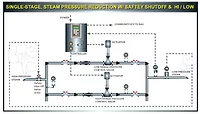
Electric, modulating PRVs employ an electric actuator to open and close the valve. Instead of the steam in a pressure-sensing pipe used by a pilot-operated system, electronic PRVs utilize electrical signals. A controller continuously reads the downstream pressure and temperature from a sensor and uses this information to control the valve’s electric actuator.
Globe valves with electric actuators provide more precise control than pilot-operated valves. They have a turndown ratio of 50:1 that supports low loads without the need for 1/3 2/3 configurations. The systems are reliable and require minimal maintenance because the electrical connections eliminate the clogging problems of pilot-sensing pipes. Globe valves are also compact, making them suitable for confined spaces.
A smarter solution
As a connected system, electric modulating PRVs are fundamentally different from standalone pilot-operated valves. In conjunction with sensors, controllers, and BASs, they offer new capabilities of visibility and control.
Visibility —The controller has constant visibility of the exact position of the valve. This information is useful in several ways. The pressure-reduction station can be monitored remotely, generating alerts of fault conditions. Steam usage data can be captured. The downstream flow rate can be calculated, using the orifice plate method, without installing a flow meter.
Control — The PRV can be precisely modulated and automatically controlled by logic programmed into the local controller or the BAS to optimize the system for energy efficiency or performance, and, in emergencies, the PRVs can be controlled by personnel accessing the BAS remotely.
The ability to remotely monitor and control PRVs is especially useful when pressure-reducing stations are widely distributed at points of use throughout a large campus or facility and when the steam is used for several different processes.
Bringing steam in line with other systems
As BASs become more commonplace, steam pressure-reducing stations are sometimes one of the last components to be integrated, long after chillers and boilers have been connected.
Electric modulating PRVs have proven to be highly reliable and easy to maintain while providing improved visibility and control that enables significant energy savings.


Real-life example
A college in New England installed a turnkey digital modulating PRV solution. The facility had a seasonal reduction of steam pressure from 60 PSIG in the fall/winter to 15 PSIG in the spring.
A globe valve with electric actuator was installed as a PRV after it was determined that a pilot-operated, pressure-reducing valve would suffer poor downstream pressure control and potentially choke steam flow to the heating hot water set in the late spring/early summer. Also, there wasn’t enough space for a pilot-operated PRV and insufficient straight run to accommodate a traditional flow meter.
Looking for a reprint of this article?
From high-res PDFs to custom plaques, order your copy today!