IAQ and Emerging Infectious Diseases
What is the influence of IAQ on human immune defenses.
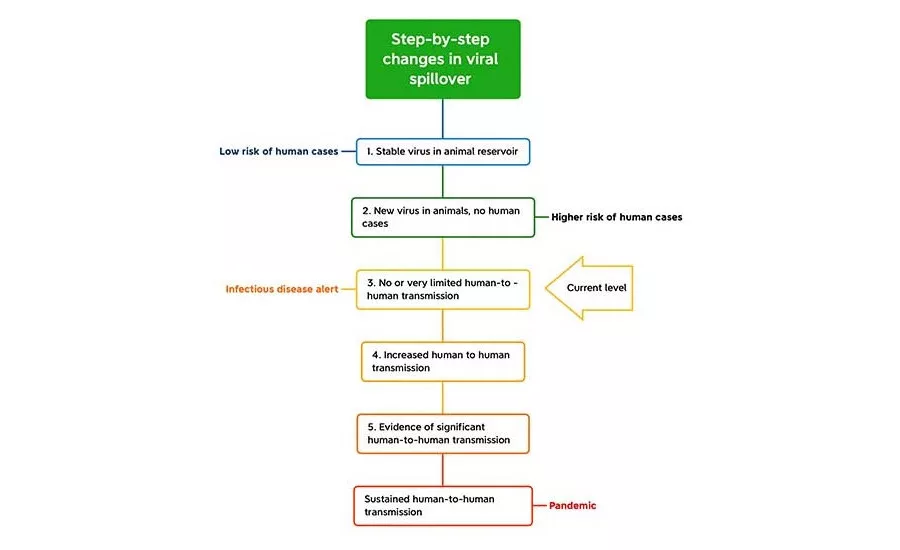
FIGURE 1: Progression of viral hosts from a zoonotic source to a human pandemic.
Barely three years after a pandemic disrupted life around the globe, reports of avian influenza infections moving from birds into mammals are surfacing. While it may be understandable that we were caught off guard by COVID–19, we must thoughtfully implement everything we learned about SARS-CoV-2 to try to prevent another pandemic from a much deadlier virus. In fact, the H5N1 avian influenza virus, which has already spilled beyond the avian population, is sending warning signals that we must take seriously right now.
COVID-19 clarified several key points regarding infectious diseases:
- When conditions are right, a virus can expand its host pool by jumping from one species to another;
- Sars-CoV-2 virus transmission is primarily through airborne bioaerosols that can travel over significant distances, remaining infectious if inhaled by a secondary human host;
- Most human-to-human outbreaks occur indoors;
- Vaccines, testing and mask wearing reduce disease spread, but there are additional preventive steps we can take immediately.
Avian influenza H5N1, highly contagious and with a greater than 50% mortality rate, is now hovering as a concerning virus. Infections have already jumped hosts, starting with birds and recently spilling over into minks and sea lions, mammals that are closely related to humans. In addition, a girl recently died from a respiratory disease caused by H5N1 and her father subsequently tested positive. While there are unknowns about the source of the infecting virus in these two family members, we cannot be naive about the possibility of ongoing human-to-human transmission.
An increase in spillover infections from one host to another, called “viral chatter,” indicates the emergence of viral mutants that could possibly result in widespread human-to-human transmission. The viruses most frequently involved in spillovers have single-stranded RNA (ssRNA) genomes, which are known to frequently mutate during replication, resulting in offspring strains that could allow survival in a new host. Coronavirus and influenza are two such ssRNA viruses.
Prior to the eruption of COVID-19 cases around the world, the coronavirus SARS-CoV-2 exhibited increasing viral chatter. We are once again seeing this trend as H5N1 avian influenza infections jump host species from poultry to mammals, such as minks. In addition, there have been a handful of human infections in people who have had direct contact with infected chickens. Clearly, the viral shift we do not want to witness is ongoing human-to-human transmission. What have we learned from SARS-CoV-2, and how can this knowledge guide us in what may be a pivotal moment?
“Environmental pollutants affect how we are infected,”said Linda Burnbaum, director of the US National Institute of Environmental Health Sciences.

Once an airborne infectious disease outbreak occurs, decreasing the number of viruses in the breathing zone of occupants through “air cleaning,” mid-range humidification, filtration and ventilation is one arm of our defense. The other critical component, and one which is severely neglected, is managing IAQ to optimize the immune systems and overall health of human occupants.
IAQ and Respiratory Health
Particulate matter, sulfur dioxide, nitrogen oxides, ozone, carbon monoxide, volatile organic compounds (VOCs) and polycyclic aromatic hydrocarbons (PAHs) are air pollutants that are notorious for causing respiratory diseases in humans. A less well-known effect, and one that is essential to manage in order to contain airborne infectious diseases, is that even short-term exposure to pollutant levels frequently found indoors impairs the resistance of our airways to viral and bacterial infections. Even less well known is that relative humidity (RH) below 40% also significantly weakens both skin and respiratory immune defenses. This means that in occupied buildings, dry air is an indoor pollutant.
To better understand the effect of short-term exposure to air pollutants on our immune system’s ability to resist infections, air pollution exposure and blood markers for immune function were studied in patients hospitalized for viral and bacterial respiratory infections.
Patients with severe respiratory viral infections had immune system changes impaired by air pollutant exposure within the prior seven days. Specifically, an average increase of 1 μg/m3 of particulate matter exposure affected the regulation of interferon signaling necessary for innate immunity and inflammation control by log2-fold. A deficiency in the type 1 interferon response has been hypothesized to be a risk factor for a severe clinical course of COVID-19.
All pollutants impaired several pathways needed for innate immunity in the lung. Other research found connections between PM exposure and loosening of epithelial cell junctions, respiratory microbiome, and cytokine response – all factors increasing pathogenic virulence of COVID-19.
Another indoor condition, one that unfortunately has become the norm during the heating season in cold climates– yet harms the occupant immune system, is low indoor relative humidity (RH). Seasonal influenza virus outbreaks are closely correlated with the heating season and low indoor RH. Low ambient humidity is known to shrink exhaled droplets, which increases transmission of exhaled infectious bioaerosols. The harm from low RH extends even further. A study in 2019 revealed that genetically engineered mice challenged with influenza A virus died from respiratory disease more quickly at RH 20% compared to RH 50%. The study showed that inhalation of dry air impaired host immune defense against influenza infection and reduced tissue repair.
What should we do?
- Optimize IAQ for occupant health by monitoring the important indoor and outdoor pollutants;
- Try to maintain RH between 40%–60%.;
- Blindly increasing ventilation without first understanding what is in the outdoor air through building specific monitoring is a bad idea.
Looking for a reprint of this article?
From high-res PDFs to custom plaques, order your copy today!