TODAY’S BOILER | NOVEMBER 2022
Seeking the Holy Grail of Hydronics: Total System Integration
Thanks to steady advancements in technology, hydronics has improved the art and mechanics of water flow.
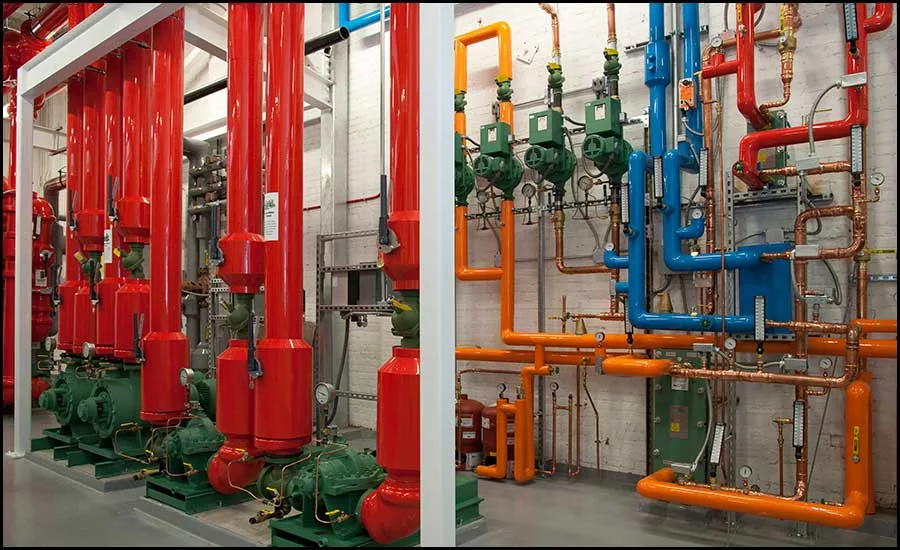
Image courtesy of Taco Comfort Solutions
Using and maintaining the water-level instrumentation on your boiler is of vital importance for the safety of your plant personnel and the longevity of the equipment in your plant.
The most exciting shift in the science of building-system design is the ability for all parts of the system to interact, combining as one to optimize system performance, comfort, IAQ, and energy efficiency.
Today, achieving that is all within reach.
Arguably, hydronics remains at the top of the list — where it’s been for decades — when building owners and designers consider the types of systems that deliver optimally across a broad spectrum of performance variables.
Thanks to steady advancements in technology, hydronics has improved the art and mechanics of water flow.
Taco Comfort Solutions’ engineers see a future that opens itself entirely to exploration and unprecedented energy efficiency, sustainability, ease of operation, and interior comfort.
Total System Integration
Design engineers responsible for hydronic heating and cooling systems are increasingly constructing their designs not on the basis of the type and efficiency of the boilers, chillers, or other key components, or even the building envelope but, rather, employing a new approach based on total system integration.
In this expanded realm, the performance and efficiency of individual components are less important than the combined efficiency of all components operating together as an integrated system.
This new dimension for commercial hydronics system design relies on the merging of all system equipment, components, terminal units, and the piping network. Also, high-efficiency, system-reacting pumps are playing an ever greater role as they integrate with building automation systems (BASs) and predictive controls based on current and future indoor and outdoor conditions.
Technology has enabled this new “holistic” approach to system design. These technology enhancements include the expanding reach of self-sensing pumps, the introduction of variable frequency pump drives (VFDs) and electronically commutated motors (ECMs), and their integration with BASs.
With self-sensing pumping, there are no holes in pipes for tubes or taps connecting remote differential sensors together with the pump. Self-sensing pump system design offers the advantages of greater accuracy for variable flow, attainment of higher energy efficiency, lower install costs, and improved system stability.
Versatility and Control with VFDs
Before the emergence of variable-speed pumps, fixed-speed pumps coupled with control valves were used to regulate system flow. VFD pump technology has now matured, and the cost of low-voltage VFDs continues to drop while reliability and functionality continue to increase. The most commonly used VFD is a voltage-source, pulse-width, modulated-frequency converter. In its simplest form, the converter develops a voltage directly proportional to the frequency controlling motor speed and torque.
Controlling delta T (∆T) and matching capacity with the load are critical for making a system’s primary equipment more efficient, and that’s where variable-speed pumping makes its contribution. When equilibrium is established between a system’s capacity, load, and optimal ∆T, maximum efficiency is attained.
With new and responsive pump technology, designers can now strive for optimal system balance.
Variable-speed pumps are designed to track the load closely — an ability that constant-speed pumps don’t have. VFDs reduce pump speed if the load varies.
By reducing pump speed to match the load, energy is saved and equipment longevity is greatly improved. With variable speed, power is gradually increased as needed: Soft starts benefit the motor, pump, and allied system components.
With pumps performing optimally with VFD technology applied, system designers can configure systems with precisely prescribed ∆Ts to take advantage of the work a boiler or chiller can accomplish.
The result: Chillers operating at optimal temperatures with smoother, longer run times, while boilers avoid short-cycling by firing at the lowest possible temperatures based on demand. This means higher ∆Ts and terminal devices with more surface area, ensuring a lifetime of operating savings.
Variable-speed technology has evolved to the point that drives and their cousins — ECMs — offer cost-effective solutions for every type of HVAC system and control strategy. Manufacturers today offer a wide range of pumps with onboard VFDs and ECMs.
Both technologies offer the intelligence for optimal operation, communication between smart devices, process control systems, and diagnostics.
Smart Pumps
New efficiency standards established by the U.S. Department of Energy (DOE) in conjunction with the Hydraulic Institute’s working group, have set the stage for ECM technology’s dominance of the commercial pump market in the years immediately ahead.
ECM pump technology has built-in control strategies, and proportional pressure control is prevalent in sensorless ECM pumps. Energy savings and noise reduction are achieved with proportional head regulation that also compensates for varying pressure drops as the demand for water changes, reducing as water demand declines and increasing as it rises.
In the commercial market, ECM pump technology is emerging rapidly with good results thus far, at least into the 30-hp size. Of course, because larger pumps with ECM technology offer the greatest energy-savings potential, market interest is high. Research and development efforts are moving apace worldwide.
The Stage Is Set
To complete the system integration approach, designers today look to specification of a control system that will ensure correct system temperatures and flow rates to maintain optimal performance under all conditions.
With the right BAS in place, all facets of the system are established to make system components function in unity. Terminal devices with sufficient surface areas ensure high ∆Ts, and this translates to healthy advantages back at the central plant. Matching the variation in system loads is an issue of maintaining proper flow — there’s no better, more fitting challenge for today’s intelligent pumps combined with BAS controls.
The final component is a system “barometer” or diagnostic window closely tied to the control system that allows operators to observe energy use (and savings) in real time. Advanced BASs permit this as they combine management of all system operation and diagnostics with predictive controls based on current and future indoor-outdoor conditions.
The Crusade for Total System Efficiency
System designers have pursued total system integration for decades, but it took technology advancements in pumps, controls, and diagnostics to make their quest a reality, even as individual components improved their efficiency ratings.
Systems experts are now moving the HVAC industry toward greater recognition of loftier goals, pushing toward “total system integration.”
This approach has been compared to holistic medicine. Rather than treating a single symptom with little or no consideration for the whole body, doctors are now increasingly treating the whole person (or system) — body, mind, and spirit.
Similarly, we can design, rebuild, and repair hydronic systems for optimal performance because we now have the means to achieve proper balance and extreme energy efficiency through advanced technology.
By Richard Medairos, P.E., senior systems engineer and director of commercial training, Taco Comfort Solutions
Looking for a reprint of this article?
From high-res PDFs to custom plaques, order your copy today!