100% Outside Air VRF Systems: A Sustainable, Hybrid Approach for Superior IEQ
Increasing the amount of outside air to the occupied space and increasing ventilation air change rates are effective solutions for reducing concentrations of contaminants and the risk of infection.
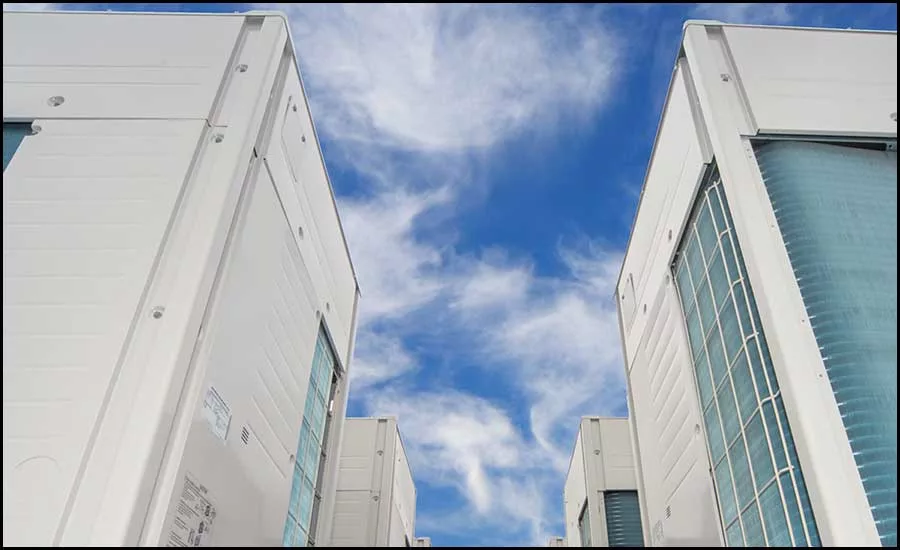
Image courtesy of Daikin
On April 5, 2021, ASHRAE’s Epidemic Task Force released an updated letter on airborne transmission guidance for SARS-CoV-2. The letter stated, “Airborne transmission of SARS-CoV-2 is significant and should be controlled. Changes to building operations, including the operation of HVAC systems, can reduce airborne exposures.”
On May 7, 2021, the U.S. Centers for Disease Control and Prevention (CDC) posted the following update on SARS-CoV-2 transmission: “SARS-CoV-2 is transmitted by exposure to infectious respiratory fluids.” The same posting goes on to state, “Infectious exposures to respiratory fluids carrying SARS-CoV-2 occur in three principle ways… deposition, touching, and inhalation of air carrying very small droplets and aerosol particles that contain infectious virus.”
The CDC website went on to say that factors increasing the risk of SARS-CoV-2 infection are “… increased exhalation, prolonged exposure, and enclosed spaces with inadequate ventilation.”
Since inadequate ventilation has been linked to aerosolized transmission of the virus within buildings, the following statements have been made by leading national authorities:
ASHRAE Epidemic Task Force:
- “…Evaluate recirculation or increase outside air fraction from design levels up to 100%;” and
- “Increase outdoor air ventilation and open outdoor air dampers to 100% as indoor and outdoor air conditions permit.”
CDC:
- “When indoors, ventilation mitigation strategies can help reduce viral particle concentration;” and
- “... Open outdoor air damper beyond minimum settings to reduce or eliminate HVAC air recirculation.”
U.S. Environmental Protection Agency (EPA):
- “Ensuring proper ventilation with outside air can help reduce the concentration of airborne contaminants, including viruses, indoors.”
Increasing the amount of outside air to the occupied space and increasing ventilation air change rates (ACR) are effective solutions for reducing concentrations of contaminants and the risk of infection.
However, increasing a building’s outdoor air, especially if heat recovery is not an option, requires more energy. Global public awareness regarding carbon’s impact on climate has resulted in numerous environmental initiatives to reduce energy usage and its respective carbon footprint. The AIA has advocated for net-zero building designs since the inception of its 2030 Commitment. The 2030 Commitment home page states, “The built environment creates a staggering 40% of the world’s (CO2) emissions, architects, engineers, and owners play a key role.” Consequently, the 2030 Commitment goes on to state, “We must all commit to net-zero emissions by 2030.” The Carbon Leadership Forum’s MEP 2040 Challenge posts on its home page: “All systems engineers shall advocate for and achieve net-zero carbon in their projects — operational carbon by 2030 and embodied carbon by 2040.”
ASHRAE has, for years, embraced the nation’s growing national imperative to increase building energy efficiency by continuing to develop and expand Standard 90.1’s performance requirements. The ASHRAE Journal publishes articles regularly on HVAC designs to optimize system performance; e.g., the September 2021 issue included the article, “How Building Decarbonization Can Transform HVAC.” The article leads with the following comment, “Buildings in the U.S. account for 40% of carbon emissions.” The article goes on to express, “Many of the U.S.’s largest corporations, including Apple, Microsoft, Kohl’s, Walmart, and Bank of America, have made commitments to achieve carbon neutrality or to get their electricity from carbon-free sources, namely solar and wind energy. An all-electric building coupled with a renewable or carbon-free source of electricity is considered to be decarbonized in its operation.” In fact, in July 2021, the U.S. Department of Energy (DOE) announced it has “reviewed ANSI/ASHRAE/IES Standard 90.1-2019, 'Energy Standard for Buildings, Except Low-Rise Residential Buildings,' and determined the updated edition would improve energy efficiency in commercial buildings subject to code.”

The DOE’s Standard 90.1 statement also expresses the following building efficiency directive: “Upon publication of this affirmative determination, each state is required to review the provisions of the commercial building code regarding energy efficiency and, as necessary, update their codes to meet or exceed Standard 90.1-2019.”
Public and governmental pressure is growing to increase building efficiency and to convert energy consumption from fossil fuels to renewable resources. These carbon neutrality initiatives, at first glance, appear to be at odds with ASHRAE’s HVAC recommendations for reducing the risk of infection. HVAC system and product strategies need to be evaluated and adopted to achieve both system efficiency and superior indoor environmental quality (IEQ).
The purpose of this article is to evaluate the use of 100% outside air (OSA) high efficiency heat pump technology in hot, dry climate zones, i.e., the Southwestern desert and to understand if such a system concept might meet the objectives of both national initiatives outlined above. High-efficiency heat pumps, or variable refrigerant volume (VRV)* systems, are all-electric solutions for heating and cooling a building that have been used in the Sonoran desert for a number of years. However, these systems are frequently laid out with untempered outdoor air ducted directly to fan coil plenums and/or ceiling and wall cassettes. Unfortunately, in extreme climate zones, such an approach is not conducive for optimizing VRV performance. Elevated mixed-air conditions result at fan coil evaporator coils and cassettes, resulting in higher peak loads and greater condenser block loads. Condensers are oversized and efficiency compromised when operating at part load. This article will examine performance data generated from three variable refrigerant systems designed for the Sonoran Desert. One VRV design will use a conventional, untempered outside air approach, and two other VRV system layouts will apply dedicated, 100% outside air (DOAS) units — one supplying OSA at a conventional dew point and the other at low dew point.

To run the evaluation, a suitable project of small to medium square footage, such as a small commercial or medical office building, was chosen. Working with SmithGroup’s Phoenix MEP team (Eric Martin, P.E., and Huiyuan Zhang, P.E.), the floor plan for a 28,000-square-foot medical office building, called under the pseudonym Southwest MOB, was provided. The referenced project plan included Trane Trace total and sensible load calculations, outside air requirements, and fan coil designations for each zone. Zack Niemeyer, sales engineer, and Austin Vedder, support engineer, both of Varitec, generated the Daikin VRV layouts and Rebel DOAS selections. For system review and energy analysis, Chris Soh, VRV product engineer, and Judith Peters, P.E., energy modeling engineer, Daikin, respectively, graciously supported the effort with system optimization strategies and performance analysis. For peak summer design, Arizona’s monsoon design ambient was chosen; i.e., 97° DB/78° WB, a condition representative of Phoenix’s peak enthalpy load. A winter design condition of 38° was applied. Hourly, typical meteorological year (TMY)-3 weather data for Phoenix was used in the energy model calculations. More current weather data reveals a trend of rising temperatures since TMY-3’s last referenced year, 2005. Applying TMY-3 data will generate more conservative evaluation results.

To run the evaluation, a suitable project of small to medium square footage, such as a small commercial or medical office building, was chosen. Working with SmithGroup’s Phoenix MEP team (Eric Martin, P.E., and Huiyuan Zhang, P.E.), the floor plan for a 28,000-square-foot medical office building, called under the pseudonym Southwest MOB, was provided. The referenced project plan included Trane Trace total and sensible load calculations, outside air requirements, and fan coil designations for each zone. Zack Niemeyer, sales engineer, and Austin Vedder, support engineer, both of Varitec, generated the Daikin VRV layouts and Rebel DOAS selections. For system review and energy analysis, Chris Soh, VRV product engineer, and Judith Peters, P.E., energy modeling engineer, Daikin, respectively, graciously supported the effort with system optimization strategies and performance analysis. For peak summer design, Arizona’s monsoon design ambient was chosen; i.e., 97° DB/78° WB, a condition representative of Phoenix’s peak enthalpy load. A winter design condition of 38° was applied. Hourly, typical meteorological year (TMY)-3 weather data for Phoenix was used in the energy model calculations. More current weather data reveals a trend of rising temperatures since TMY-3’s last referenced year, 2005. Applying TMY-3 data will generate more conservative evaluation results.

The electrical room used VRV cassettes mounted directly in the space without outside air connections. Three design concepts were assigned, each with the same room air condition: 75° DB/50% RH.
Variable Refrigerant Systems Design Options:
- Design No. 1: VRV system mixing untempered outside at 97° DB/78° WB summer and 38° winter with return air at fan coil return air plenums.
- Design No. 2: VRV system designed parallel to 100% DOAS with enthalpy wheel supplying 55.13° dew point LAT.
- Design No. 3: VRV system designed parallel to 100% DOAS with enthalpy wheel supplying 48.8° dew point LAT.
- 100% Outside Air (DOAS) Performance:
- Daikin Rebel DOAS units with enthalpy wheels, DX coils served by variable speed scroll compressors, and hot gas reheat provided for designs Nos. 2 and 3.
- Design No. 2:
- Cooling Coil: Leaving Air Conditions (LAT)
- 55° DB / 54° WB LAT
- Hot Gas Reheat Coil:
- 70° DB/59.58° WB or 53.13° DP LAT (heating, part-load cooling)
- 55° DB/ 53.89° WB or 53.13° DP LAT (100% cooling) VRV credit taken.
- DOAS to dynamically reset supply air dew point and temperature based for enhanced efficiency.
- VRV system fan coils to maintain room temperature set point for cooling and heating modes.
- Design No. 3:
- Cooling Coil: Leaving Air Conditions (LAT)
- 52° DB/50.2° WB or 48.8° DP LAT
- Hot Gas Reheat Coil:
- 70° DB/57.42° WB or 48.8° DP LAT (heating, part-load cooling) VRV credit taken.
- 55° DB/50.2° WB or 48.8° DP LAT (100% cooling) VRV credit taken.
- DOAS to dynamically reset supply air temperature for enhanced efficiency.
- VRV system fan coils to maintain room temperature set point for cooling and heating modes.
The modeled VRV system applied Daikin’s older Series IV condenser technology. (Daikin’s new condenser series, Emerion, was not used, as performance curves are still being generated. Evidence shows Emerion condensers are 30% more efficient than the Series IV model.) Since building room layouts and peak loads were identical for each of the three designs, fan coil sizing and layouts were also identical. Condenser capacity and sizing did change per design as space latent loads varied, resulting from the supply of OSA at moderate or depressed dew points for design numbers 2 and 3. The Rebel unit for design no. 3 increased in size and cost by supplying depressed 48.8° dew point. Both systems took advantage of another layer of efficiency when in full cooling. When all fan coils are in cooling mode, the DOAS hot gas reheat coil will auto reset discharge air temperature to a cooling minimum value, allowing for the VRV component to take an energy credit for designs 2 and 3.
100% OSA: Conceptual Advantages
Applying DOAS units operating parallel to a VRV system allows for enhanced space humidity control while ensuring the correct amount of OSA is supplied directly to the space. Buildings challenged by inadequate humidity control often experience this due to inadequate supply air dew point depression. Be aware, a room design set point of 75° DB/50% RH has, in Phoenix, at 1,100 feet in elevation, a 55.13° dew point. Supply air delivered at 55° DB/54° WB has a dew point of 53.32°. Consequently, to control space humidity at 50% RH with a dew point depression of 1.81° will require more air. When outside air is supplied with a higher dew point depression, 48.8°, for example, in design no. 3, VRV fan coils essentially become sensible cooling AHUs, limiting, if not eliminating, water buildup in condensate pans, a questionable practice for medical office buildings. Increased VRV efficiency also results from the lower inlet air condition at the VRV fan coils. Entering air will be very close to the room space condition, allowing for reduced coil loads. DOAS compressors can be disabled when the outside air condition is 70°DB/48.8° dew point or lower, depending on the type of building and usage. “Free” cooling annualized hours in Phoenix can double in comparison to those hours usually calculated from conventional, mixed-air, package rooftops in our dry climate region.


Comparative Energy Review
Figure 7 reviews the energy savings related to condenser sizing. The energy modeling results illustated below outline data for each design option.
Design No. 1: A VRV system using untampered outside air mixing with return air at VRV fan coils required 105.6 nominal tons of condenser capacity to meet the building’s total peak load, which was 3.92 tons greater than the total system peak load. Three condensers, tagged CU-1A, CU-1B, and CU-2, were selected for a total nominal tonnage capacity of 105.5 tons.
Design No. 2: VRV systems using a 100% OSA unit providing load-neutral 53.32° dew point air supplied directly into the space resulted in a reduced fan coil mixed air condition at the evaporator coils. The OSA latent component is not applied to the FCUs. Two condensers, tagged CU-1 and CU-2, were selected for a total nominal tonnage capacity of 74.4 tons, a downsizing of 31.2 tons. Design No. 2 shows an estimated 19% energy reduction to Design No. 1.
Design No. 3: VRV systems using a 100% OSA unit providing load-neutral 53.32° dew point air supplied directly into the space resulted in a reduced fan coil mixed air condition at the evaporator coils. The OSA and percentage of room latent energy is not applied to the FCUs. Two condensers, tagged CU-1 and CU-2, were selected for a total nominal tonnage capacity of 64.8 tons, a downsizing of 40.8 tons. Design No. 3 shows an estimated 26% energy reduction to Design No. 1.
First Cost and Savings Payback
When design teams propose to owners more “unconventional” energy-efficient HVAC designs, it is inevitable the following questions ensue: “How much does the system cost? What payback, if any, might the owner benefit from?” Below is a budgetary breakdown of the relative costs of design numbers 1, 2, and 3. What is important is the percentage of savings and projected payback a more efficient system offers for a smaller, 28,000-square-foot building.
Design No. 1:
- Daikin VRV Series IV Condenser layout with untempered outside air. Total budget cost: $239,875; and
- Daikin Rebel DOAS budget cost: $0.
- Total system equipment cost: $239,875.
Design No. 2:
- Daikin VRV Series IV Condenser layout with untempered outside air. Total budget cost: $184,090; and
- Daikin Rebel DOAS budget cost: $73,055.
- Total system equipment cost: $257,145;
- Total Premium: $17,270; and
- Projected payback: five to 10 years** (based on $0.10/kWh power).
**Payback would vary between local utility rates, climate zone, regional market values, contractor installation costs, etc.
Design No. 3:
- Daikin VRV Series IV Condenser layout with untempered outside air: Total budget cost: $173,051; and
- Daikin Rebel DOAS budget cost: $93,280.
- Total system equipment cost: $266,331;
- Total premium: $26,456; and
- Projected payback: six to 11 years ** (based on $0.10/kWh power).
**Payback would vary between local utility rates, climate zone, regional market values, contractor installation costs, etc.
When analyzing pricing, the values above are for the VRV and DOAS equipment only. Installation, controls, ductwork, copper piping, and wiring are not included. However, one should keep in mind that complete life cycle costs compared to standard package rooftop units have not been taken into account. Variable refrigerant systems are more robust than standard rooftop DX units. When compared to single-phase split DX solutions, a reduction in electrical load infrastructure could be available as well as the potential for architectural savings. VRV systems are more resilient and are made to last 20 years.
Arguably the most important point: Creating an environment with superior IAQ while reducing contaminant concentrations are two compelling reasons why 100% OSA VRV systems, especially with depressed dew points, should be considered for design solutions.
Concluding Remarks
This article opened with a listing of existential pressures influencing future HVAC designs. However, paying higher energy costs to create environments that reduce the risk of pathogenic infection will not be a foregone conclusion. Designing for HVAC systems that offer superior IEQ and more energy efficiency is not only possible, the technology is already available. 100% OSA variable refrigerant systems supplying low dew point supply air offer one such compelling design strategy.
This hybrid VRV concept aligns with the AIA’s 2030 Commitment and the Carbon Leadership Forum in meeting its carbon neutrality targets by providing an all-electric HVAC solution that can be powered by renewable energy sources. Future analysis should be considered to arrive at tighter performance results more closely aligned with building types and a range of other geographical regions. More research should be conducted to determine what optimal room ACH rates more effectively reduce airborne contaminant concentrations. Regardless, a 100% outside air VRV system is one compelling option for creating more efficient buildings and healthier environments conducive to maintaining personal health and well-being while reducing the impact of our carbon legacy on future generations,
*VRV refers to Daikin’s name brand of Variable Refrigerant Volume. Daikin introduced the variable refrigerant concept in 1982.
Looking for a reprint of this article?
From high-res PDFs to custom plaques, order your copy today!