Think You Need a Building Management System? Start Small Instead
In the U.S., it’s estimated only 11% of commercial buildings under 50,000 square feet have a building management system.
Building management systems (BMSs), sometimes called building automation systems (BASs), are pretty cool. They’re also pretty rare.
In the U.S., for instance, it’s estimated only 11% of commercial buildings under 50,000 square feet have one. With 94% of commercial buildings in that size range, it’s easy to see how few businesses are taking advantage of automation-driven benefits and smart systems.
A BMS is like a computer program that runs all of your critical systems, including HVAC, lighting, and security. These are broad categories encompassing a number of products and processes, and the operating logic — also called automation — can be robust or as simple as setting a schedule for things to turn on and off.
It seems obvious you’d want alarm systems to be activated automatically or ventilation systems to activate when the temperature outside reaches a certain point, so why doesn’t every business have one?
For starters, the price tag can bring on sticker shock. By one estimate, the average cost to deploy a basic system is at least $2.50 per square foot and can be as high as $7 per square foot, equivalent to at least $125,000 for a 50,000-square-foot building — and that’s on the low end. The installation can be costly and time-consuming, possibly even forcing a temporary closure. On top of all that, these systems usually need to be upgraded every five to 10 years.
For a small- or medium-sized business, the return on investment just isn’t always there.
While the thought of having all systems integrated on one platform sounds nice, this approach lacks the economy and flexibility smaller businesses value. Fortunately, thanks to a flood of innovation in the building control space, you can find individual solutions that are affordable and easy to set up without professionals.
For all of the hypotheticals and techno-dreams, smart building and energy management can often be simplified. For instance, use occupancy sensors to control lighting. Also, scheduling your HVAC systems to turn off an hour or two before the final shift ends is an easy way to cut costs without impacting comfort. Optimize air exchange by scheduling ventilation fans to run based on outside temperatures. Let’s take a look at some of these alternatives to building management systems.
Lighting
A wide range of lighting control and automation systems exist independent of BMSs. For example, daylight sensors can adjust the lighting output based on ambient lighting conditions. Known as daylight harvesting, the automatic adjustments help your facility be more energy-efficient. Other options include timers and scene control with some systems even tracking energy use in real-time and providing alerts to building managers. And, of course, there’s always the humble and low-cost occupancy sensor, turning off lights automatically if a space is not occupied — and vice versa, so you don’t walk directly into that forklift.
Security
Security can mean a lot of things: access control, fire or water monitoring, alarm systems, surveillance, and more. These are just some of the considerations a business may have when researching or implementing security systems.
Thanks to a combination of reliable wireless technology and low-cost sensors, many of these security objectives can be achieved without a fully integrated BMS. Protecting what’s valuable is always a good investment, and you can even get insurance breaks for implementing some of this technology.
HVAC
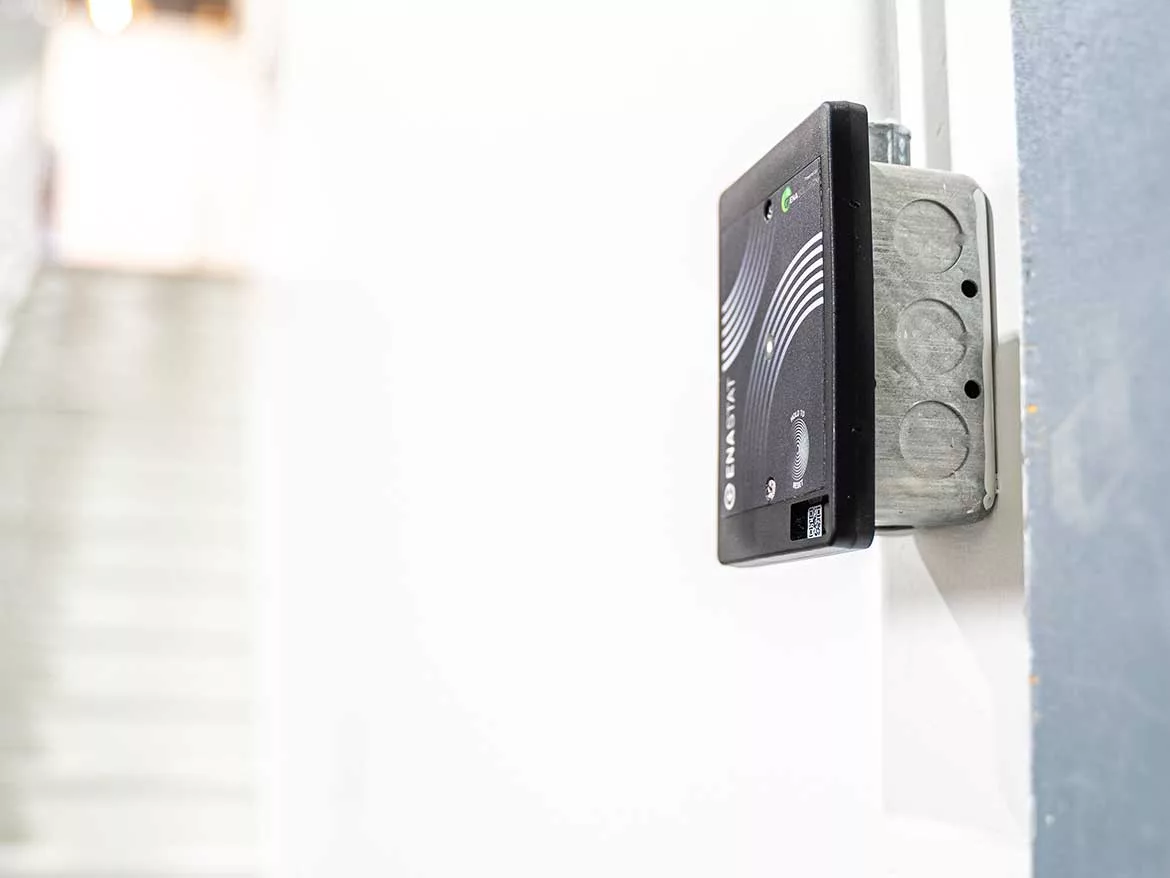
The category of HVAC is inherently broad, so think about it as a thermal comfort system. There are numerous ways to achieve thermal comfort, with strategies ranging both in complexity and cost, but forced-air heating systems are fairly common in commercial environments (and expensive to operate). One of the simplest ways to ensure comfort and efficiency is through a smart commercial or industrial thermostat. Use the smart thermostat’s scheduling feature, and a heating and air system can run when you want it to and stop when you don’t. Beyond scheduling, smart thermostats, such as ENA Solution’s ENASTAT, offer zone control, recognizing that just as each company is unique, so, too, is how users use each facility. Since different sections have different working shifts and comfort requirements, companies benefit from the flexibility offered.
Ventilation control systems can bring in fresh air at optimal times of day, and circulator fans can be equipped with timers, schedules, and occupancy sensors to help mix the hot air in winter or cool building occupants in summer. All of this can be done without the help of a BMS, so you can stay cozy without breaking the bank.
Promising potential
What’s driving the development of these individual automation systems now? For starters, the cost and complexity of both the hardware and software needed to enable connected devices has declined precipitously over the last decade. Sensors, wireless radios, and cloud computing are more affordable than ever, and their reliability has increased at the same time. Previously, wired communication protocols were the only way to consistently deliver the commands and logic necessary for machines to operate “intelligently.”
With the original hub-and-spoke model, system also needed brains: something to command all of the end points on what they should do. Today, the computing power of onboard microprocessors means each device can be smart on its own. So if users simply wanted their locks to activate at the end of the work day, they no longer need to rely on an expensive, central automation system to execute that single command.
Considerations
This new wave of technology is not without considerations, of course. Here are some key things to evaluate when selecting products:
- Security: First, verify a business has reviewed and implemented best practices for securing wireless networks. If a building manager is planning to put a device on a wireless network that is vulnerable in some way, he or she risks losing control of a potentially critical piece of the operation. If devices are on or creating their own networks, ask the IT department or an independent consultant to recommend precautionary measures to be taken. For example, setting up two-factor authentication can make it much more difficult for unwelcomed users to access devices.
- Interoperability: Although individual machines and equipment can now operate intelligently without a BMS, one may want some of his or her smart products communicating with each other. For example, smoke detectors can activate the ventilation system and unlock doors in the event of a fire. Or the security system can trigger smart lights to flash in the event of a threat. There are many ways to intelligently pair smart devices, but purchasing from different vendors can make this more difficult. That said, some of these more sophisticated features support what are called edge cases, and most of your automation needs can be met without interoperability.
- Warranty/Reliability: Make sure the products have good reviews and are backed by industry-standard warranties. Similar to what has happened with automobiles, the more technology packed into a device, the more potential maintenance needs it may require. Always research the reliability of the manufacturer.
The Bottom Line
Automation is the great equalizer for small- and medium-sized commercial businesses not in the market for a six-figure BMS. It’s an excellent time to make buildings smarter, as such an action can increase productivity while lowering operating costs. Start with the biggest needs or costs, and keep in mind that more pieces can be added to a smart building in the future as budgets grow or needs arise.
Looking for a reprint of this article?
From high-res PDFs to custom plaques, order your copy today!