Specifying the Proper Motor for Your Gas Valve Actuator
HVAC systems that regulate temperature and air quality to keep enclosed areas warm in wintertime typically depend on natural gas combustion to sustain boilers, pumps, radiators, meters, and other components. The burning gas heats air or water for circulation around the enclosed space. Gas and liquid flow must be controlled and metered accurately using various sensing and modulating elements such as flow control valves or isolation valves — also known as shut-off valves — or both.
How Flow Control Valves Work
Flow control valves have a valve stem that moves up or down inside the valve body, causing the needle, or sealing element at the end of the stem, to restrict the flow of fluid to a desired level. Another valve type — a stem-and-ball valve — is designed with a ball that rotates around the valve stem. The ball has an opening that allows full flow at one position and variable flow as the stem rotates to the shut position. The valve stem may be designed to allow an operator to adjust a screw-needle position, or an actuator can move the stem with control from a motor and drive system.
Types of Electric Motion Systems for Gas Valve Actuators
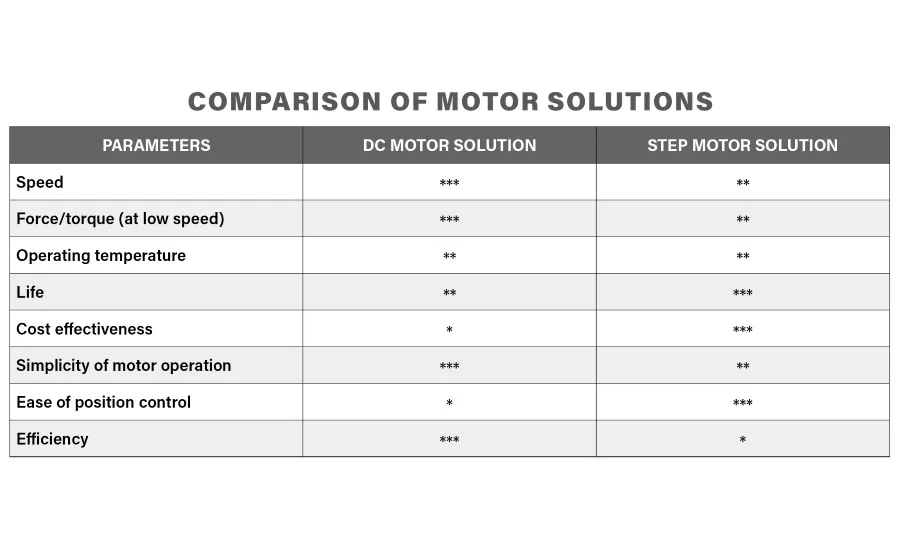
Brushed DC or stepper motors fit the performance and cost requirements of the gas valve actuator. While both can deliver the necessary torque and speed for the application, designers must decide how to configure the overall motion system which includes both a motor and a positioning system.
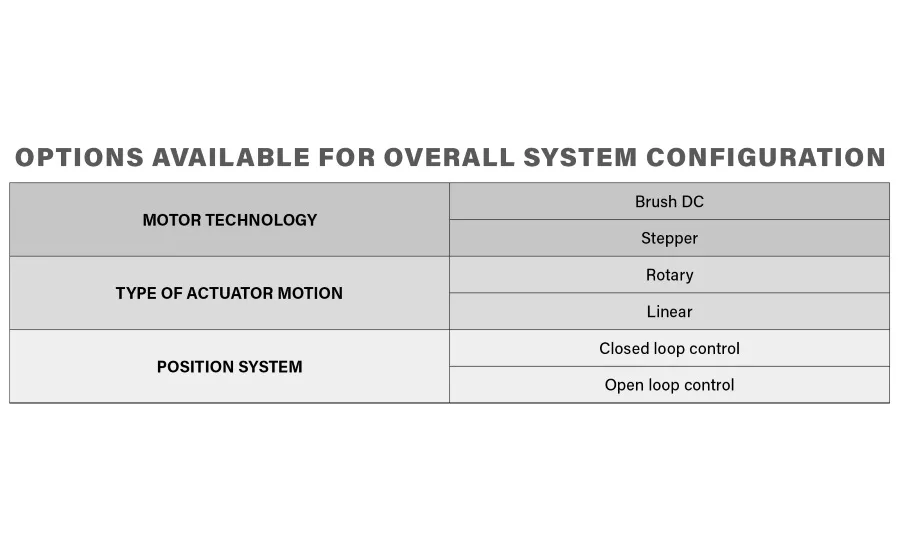
For the gas valve actuator, a combination of motor technology, motion type, and positioning system will determine the overall motion system’s complexity and costs. Options for the motion system are:
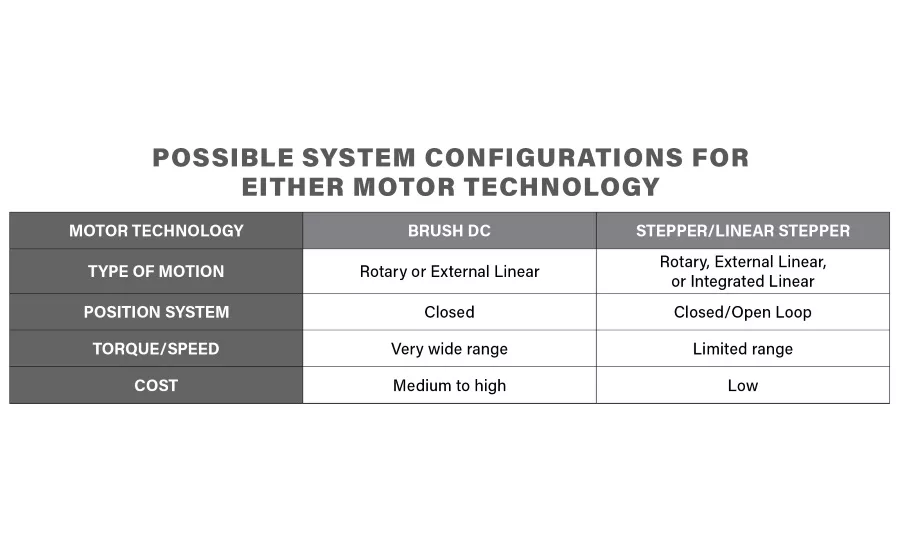
- Brushed DC motors provide rotary motion or linear motion with the addition of an external lead screw to convert rotary to linear motion. In both cases, an encoder is needed to provide closed loop operation;
- Stepper motors produce rotary motion or linear motion with the addition of an external lead screw. In both cases, the driver can provide direct open loop control; and
- Linear stepper motors have an integrated lead screw as part of a single robust package to deliver direct linear motion output, with the driver providing open loop control.
Motor Technology Overview
Thanks to its simplicity, a DC motor does not require complex electronics to drive the motor. However, if the application calls for linear motion, the DC motor will require an additional lead screw and gearing system to convert the rotational motion to linear motion. It will also need a feedback mechanism, like an optical sensor or encoder, for accurate linear position control. Because the rotor has high inertia, consider adding a braking system.
A stepper motor is a DC motor that rotates in several small, equal, and discrete increments called steps. Driving a stepper motor requires a dedicated control unit. The stepper motor’s construction and design offer some inherent benefits. For example, the motor can operate in open loop with good accuracy when properly sized thanks to the discrete steps that provide built-in positioning control. Its design also makes possible the use of detent torque to provide holding position, and the motor offers an excellent response for start, stop, and reversing operations. If linear motion is required, an additional lead screw and gearing system are necessary to convert rotational motion to linear motion.
Typically, stepper motors can be used for output speed up to 1,000 rpm and torque up to 170 millinewton-meters. Actual torque and speed also depend on whether the driving mode is full step, half step, or micro-step. Depending on the working load point of the application, designers can add gearbox and lead screw systems.
A stepper linear actuator is a compact device that combines a can stack stepper motor with a threaded rotor and an integrated lead screw to provide direct linear motion. The stepper linear actuator lead screw moves up and down in discrete step increments when electrical pulses are applied. Because a stepper linear actuator can be controlled accurately in an open loop system, no expensive feedback device or braking system is needed for positioning.
Typically, linear actuators can be used for output speed up to 80 millimeters per second, and they provide up to 100 Newtons of force. Actual force and speed also depend on lead screw efficiency and driving mode — full step, half step, or micro-step. Depending on the working load point of the application, a gearbox can be added.
Key Considerations for Motor Selection
Gas valve applications vary by valve stem type, desired operation, and precision. When selecting a motor, keep these considerations in mind:
- Maximum and running torque and force required;
- Speed requirement: Typically, force and torque is required at low speeds for valve applications;
- Overall price of the system;
- Control system: Typically, closed loop control is not required;
- Temperature of the application environment;
- Type of motion needed for actuation: rotary or linear motion;
- Expected lifetime of the system before replacement;
- The required linear or rotary resolution; and
- Maximum current and voltage available.
Based on the motion options available and HVAC requirements, a stepper motor is well-suited for a rotary application, and a linear step motor is desirable for a linear application.
Looking for a reprint of this article?
From high-res PDFs to custom plaques, order your copy today!