Code Requirements: Monitoring Boiler Water Levels
Monitoring and maintaining a safe operating water level on any steam boiler plant is an important part of the control area operator’s job function. There are specific minimum requirements for water level instrumentation that are documented in Section I of the ASME Boiler and Pressure Vessel (BPV) code.
Furthermore, a plant owner or insurance carrier may specify additional water level monitoring instrumentation to be installed beyond the minimum requirements. This way, the boiler can remain in compliance during operation, even if any single level indicating instrument is out of service for maintenance.
To review the background, Section I of the ASME Boiler Code is the construction code for any power boiler that is manufactured and designed to operate above 15 psi. Subsection PG-60 in the code requires all water-tube and fire-tube-type boilers to be equipped with at least one gage glass. Further, if the gage glass cannot be seen from the area where control actions are taken (typically an air conditioned control room), two independent means of continuously displayed level indication are required for each boiler. Some examples include two independent remote level indication systems or one remote level indication system and a camera system that remotely displays the level in the gage glass.
If two independent remote level indication systems are installed, these level indications must be continuously displayed. If one of the level indicators is displayed on a monitor that is also used for other purposes, which may result in momentary loss of sight of the water level, it would be considered to be in violation of the code.
 Figure 2: A typical conductivity-type level indicator with isolation and drain valves.
Furthermore, the code requires that all boilers operated up to 400 psi must have the water gage glass in service at all times. This enables the vast number of these boilers in existence to have ready determination of the water level anytime an operator is near the boiler.
When a boiler is designed and manufactured to operate above 400 psi, the gage glass may be isolated only when at least two independent remote level indication systems are installed for operator view, and the isolated gage glass must be kept in good working order, if needed. For example, a water gage glass would be needed if the two remote level indicators begin to suddenly disagree and a referee is needed to determine which system is at fault. In addition, the gage glass is typically used to confirm the water level prior to starting up the boiler.
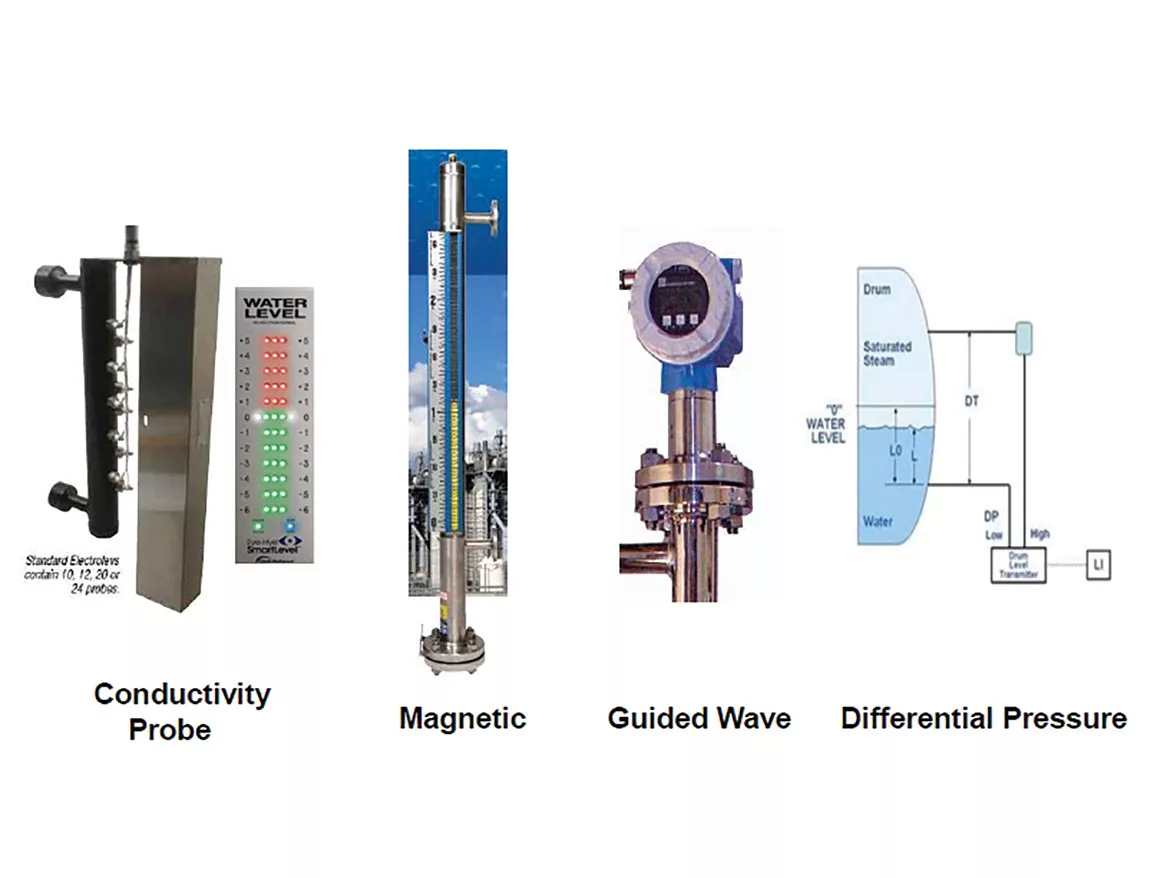
The most common types of remote water level monitoring systems are shown in Figure 1.
Of these technologies, conductivity probe and differential pressure (DP) types are the most common technologies. The benefit of the conductivity-type systems is they have no moving parts. DP-type systems have been used successfully for many years. However, if DP systems are not maintained properly, sediment blockage can result in the associated small diameter-sensing lines. Loss of indication may result as well during freezing conditions if these systems are not properly heat-traced. The use of magnetic-type technology is limited to applications up to 900 psi. This code limitation reduces the risk of false indications that may otherwise occur if this technology was applied to broader operating pressure ranges. Guided wave radar technology is gaining popularity, but it is the newest technology of all types.
 Figure 3: A typical conductivity-type level indicator with double isolation valves and a drain valve.
 All externally mounted level-indicating devices must be installed with isolation and drain valves. Double isolation valves are permitted. The drain valve must be routed to a safe point of discharge away from the valve operator, especially on applications operating above 100 psi (see Figure 2)
In summary, it is vital for the safety of the plant and personnel to be certain these instruments are properly installed, maintained, and routinely inspected. Any concerns, such as steam or water leakage or missing insulation, that may present a hazard should be remedied immediately
Finally, we always suggest that users consult with their own safety staff, insurance carrier, and local jurisdiction inspection authority to verify any specific requirements for their location. An additional resource for helpful information is ASME Section VII (Recommendations for the Proper Care of Power Boilers). This code includes more helpful information for operators and owners.
Looking for a reprint of this article?
From high-res PDFs to custom plaques, order your copy today!