Nanomaterials Enable Passive Dual-Mode Heating and Cooling Device
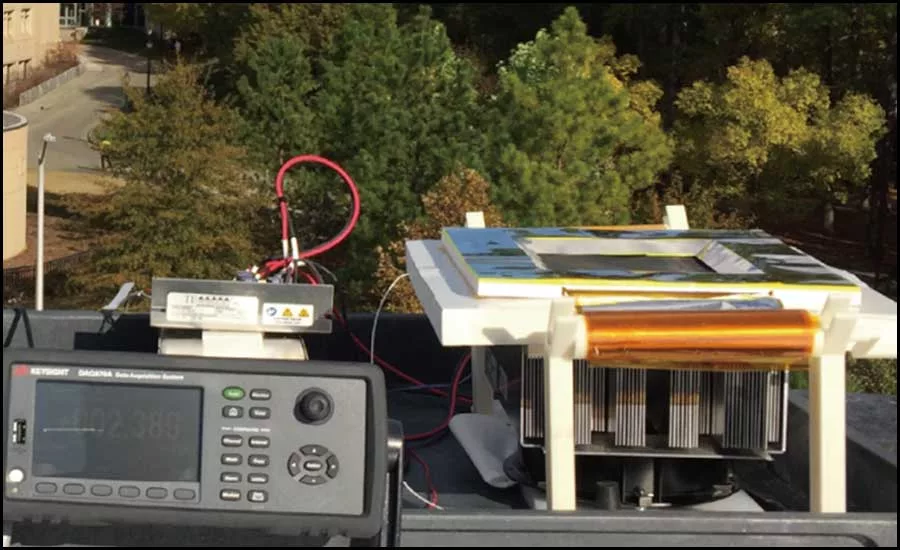
Dual-mode heating and cooling device testing system for solar building climate control.
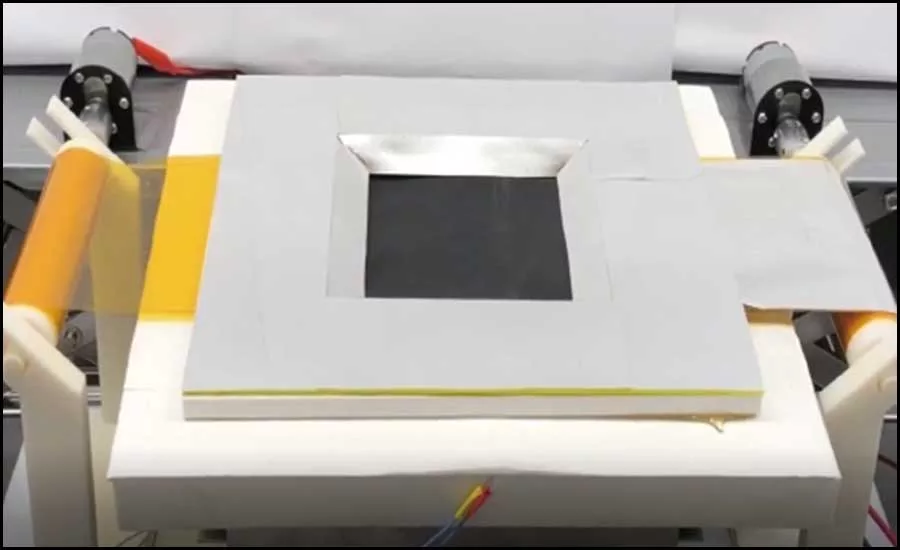
Dual device in heating mode showing square of material that absorbs solar energy and conveys it to the building's HVAC system.
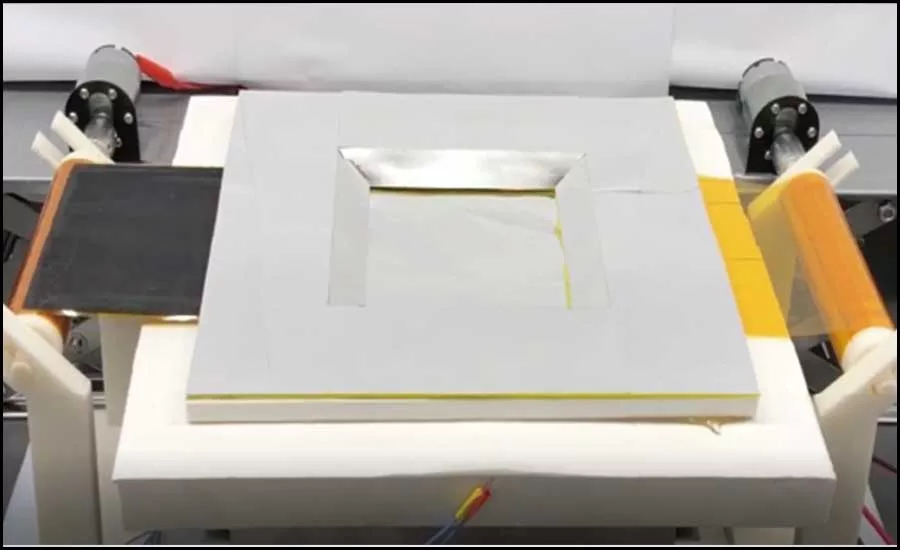
Dual device in cooling mode showing square of material that reflects solar energy into outer space and achieves sub-ambient cooling.

Po-chun Hsu.
Engineers at Duke University have demonstrated a dual-mode heating and cooling device for building climate control that, if widely deployed in the U.S., could cut HVAC energy use by nearly 20%.
The invention uses a combination of mechanics and materials science to either harness or expel certain wavelengths of light. Depending on conditions, rollers move a sheet back and forth to expose either heat-trapping materials on one half or cooling materials on the other. Specially designed at the nanoscale, one material absorbs the sun’s energy and traps existing heat, while the other reflects light and allows heat to escape through the Earth’s atmosphere and into space.
“I think we are the first to demonstrate a reversible thermal contact, which allows us to switch between the two modes for heating or cooling,” said Po-Chun Hsu, assistant professor of mechanical engineering and materials science at Duke and leader of the team. “This allows the material to be movable while still maintaining a good thermal contact with the building to either bring heat in or let heat out.”
The results appeared online November 30, in the journal Nature Communications.
About 15% of energy consumption in the U.S., and over 30% globally, is for the heating and cooling of buildings and responsible for 10% of global greenhouse gas emissions. Yet, up to now, most approaches to minimize the carbon footprint have only addressed either heating or cooling. That leaves the world’s temperate climate zones that require both heating and cooling during the year — or sometimes in a single 24 hours — out in the cold. In the new paper, Hsu and his team demonstrate a device that potentially could keep us either cozy or cool as the weather changes.
The specially designed sheet starts with a metallized polymer composite as the base that can generate electrostatic force by applying voltage. This allows the device to maintain contact with the building for transmitting energy while still being able to disengage so that the rollers can switch between modes.
The cooling portion of the sheet has an ultra-thin silver film covered by an even thinner layer of clear silicone, which together reflect the sun’s rays like a mirror and emit mid-range infrared light. The unique properties of these materials also convert energy into and emit mid-range infrared light, which does not interact with the gasses in the Earth’s atmosphere and easily passes into outer space and peform sub-ambient cooling.
When a change in weather brings the need for heating, the electrical charge releases and the rollers pull the sheet along a track. This swaps the cooling, reflective half of the sheet for the heat-absorbing half.
To heat the building beneath, the engineers used an ultra-thin layer of copper topped by a layer of zinc-copper nanoparticles. By making the nanoparticles a specific size and spacing them a certain distance apart, they trap light onto their surface, allowing the material to absorb more than 93% of the sunlight’s heat.
Hsu and his team see the device as something that could work with existing HVAC systems, rather than a full replacement.
“Instead of directly heating and cooling the building, we could use a water panel to take hot or cold water to a heat pump or boiler system,” said Hsu. “I also imagine that with additional engineering, this could also be used on walls, forming a sort of switchable building envelop.” said Hsu.
Moving forward, the team is working on several aspects of the design to advance it from a prototype to one scalable for manufacturing. Among these, explained Hsu, are concerns about the long-term wear and tear of the moving parts and costs of the specialized materials. For example, they will investigate whether lower-cost aluminum can substitute for the silver and are also working on a static version that can switch modes chemically rather than mechanically.
Despite the many obstacles, Hsu believes this technology could be an energy-saving boon in the future. And he’s not alone.
“We’re already working with industry partners to determine the ideal locations for deploying this technology,” said Hsu. “And because almost every climate zone in the United States requires both heating and cooling at some point throughout the year, the advantages of a dual-mode device such as this are obvious.”
CITATION
“Integration of daytime radiative cooling and solar heating for year-round energy saving in buildings.” Xiuqiang Li, Bowen Sun, Chenxi Sui, Ankita Nandi, Haoming Fang, Yucan Peng, Gang Tan & Po-Chun Hsu. Nature Communications, 2020. DOI: 10.1038/s41467-020-19790-x
This article originally appeared on Duke’s Pratt School of Engineering website. See the original article in its entirety at https://pratt.duke.edu/about/news/nanomaterials-enable-passive-dual-mode-heating-and-cooling-device
Looking for a reprint of this article?
From high-res PDFs to custom plaques, order your copy today!