Under the Microscope: Burner Performance and Efficiency
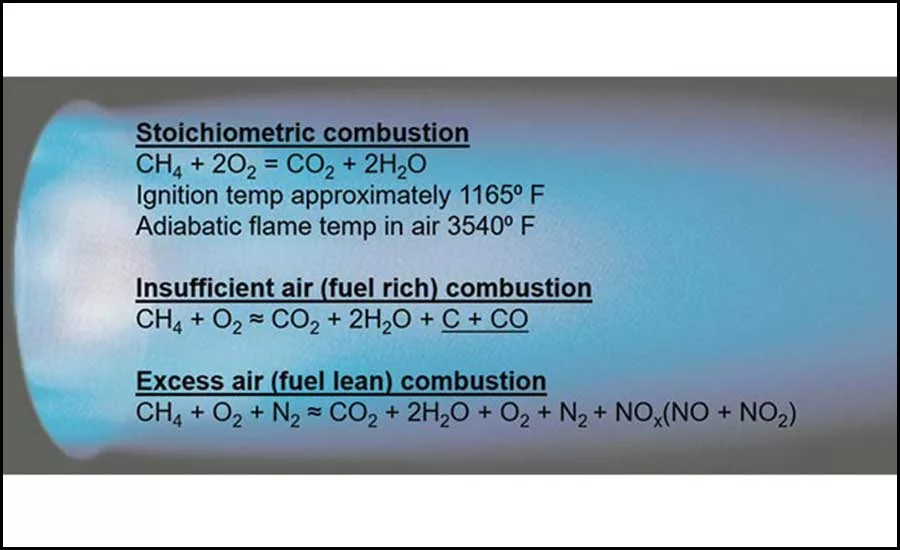
Chemical formulas for stoichiometric, fuel rich, and fuel lean combustion.
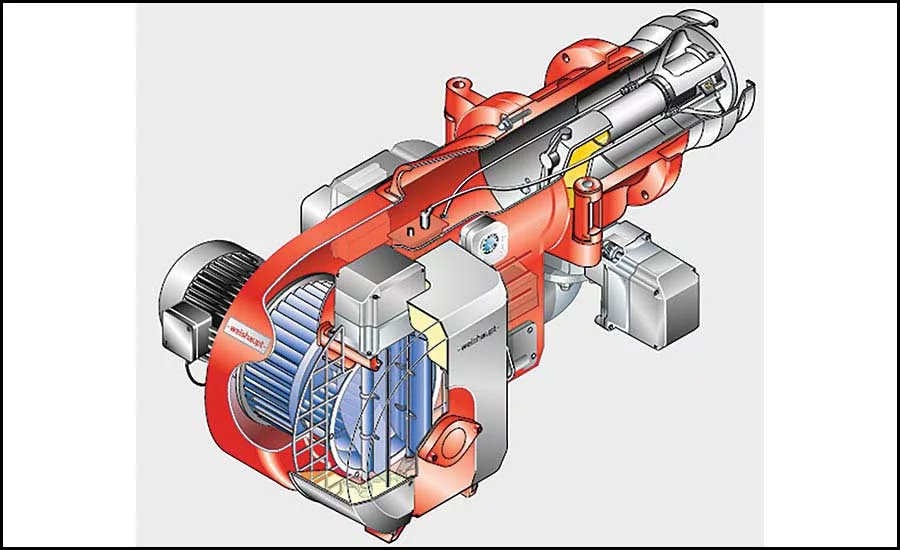
A design of a modern burner with linkage-less controls.
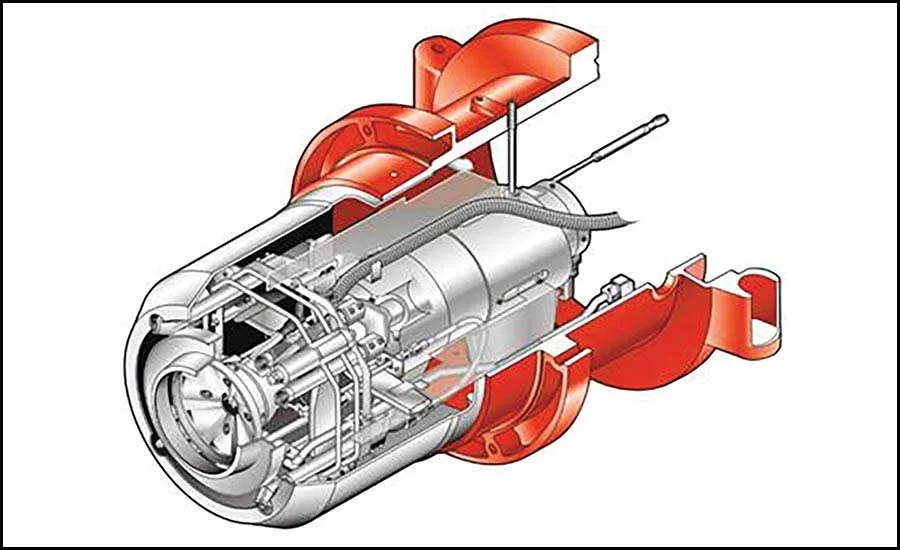
A burner mixing chamber.
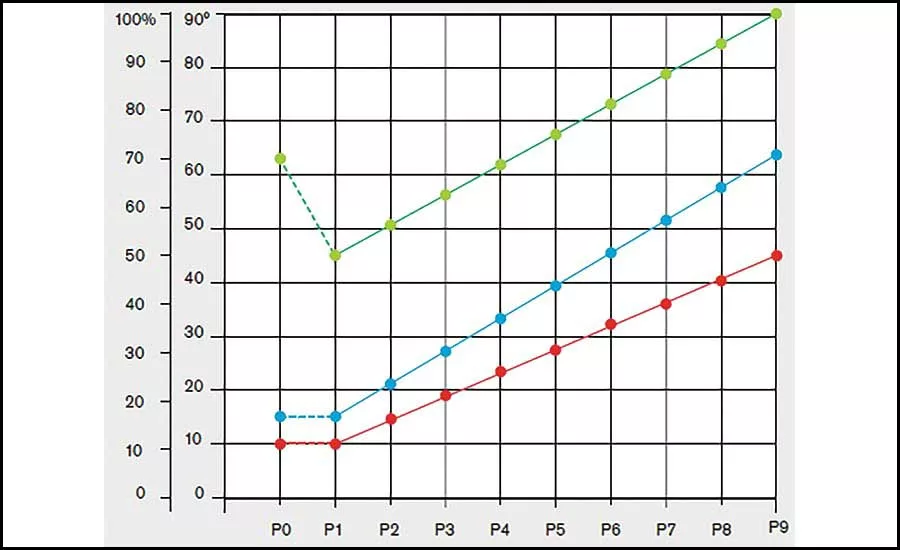
A burner fuel-air profile.
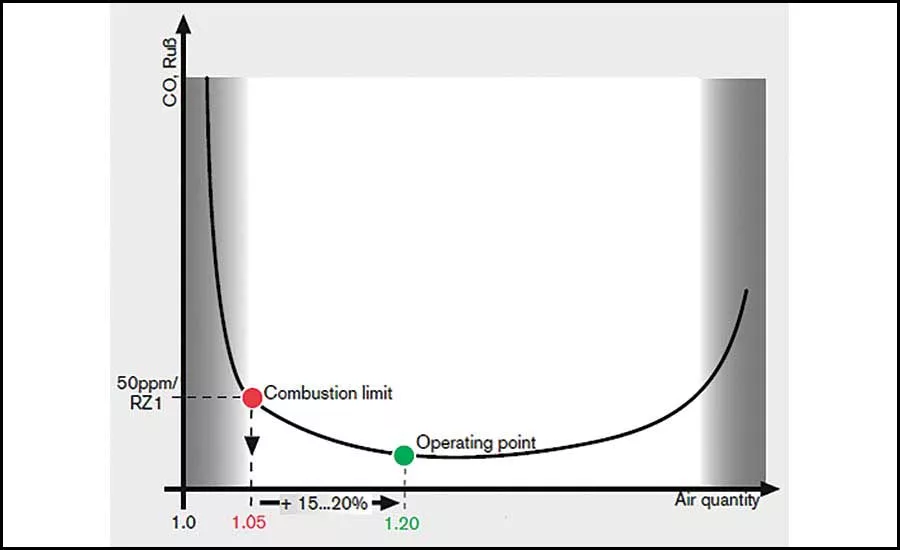
A graph charting the combustion changeover point.
The definable measure of burner performance and efficiency resides within burner construction and the ability to generate high mixing pressure. This results in emissions control with lower excess oxygen (O2) values across a higher turndown ratio. The amount of pressure generated in the burner envelope — the space between the fan discharge and the burner mixing head diffuser — is how this is achieved; performance and safety can then be validated by determining the combustion changeover point.
So, what does all of this actually mean?
In the evolution of power burner design, there have been many advancements. From the early days of low-speed burner motors turning at 1,725 rpm with oversized blower wheels to high-speed, high-efficiency blower motors equipped with integrated or remote-mounted frequency converters (VFD’s). The industry and burner performance have come a long way — from on/off burner sequencing to intricate, complex linkages for modulation to digital parallel positioning fuel-air ratio controls. Burners once constructed and fabricated from sheet metal are now created using precision cast aluminum burner bodies.
When talking about burners, it is essential to address the fundamentals of combustion and fuel burning efficiency, recognizing that higher excess oxygen in a flue gas sample directly correlates to reduced efficiency and higher overall emissions. Modern burner design along with proper field adjustment strive to ensure complete combustion with minimal excess oxygen while maintaining flame stability and limiting, or eliminating, the presence of carbon monoxide in a flue sample.
The Oxford dictionary defines combustion as the “rapid chemical combination of a substance with oxygen, involving the production of heat and light.” Literally, the first thing that stands out is the word “rapid,” which is key. High-performance, high-efficiency burner operation requires high-velocity turbulence in the low-pressure zone on the downstream side of the burner diffuser. Therefore, burner mixing head design is the cornerstone of efficiency and stability. Modern burner design provides for high static pressures in the burner envelope — the generated pressure between the blower discharge and the mixing head diffuser. Many modern burners have a pressure port tap in the burner air housing allowing this generated static pressure to be measured. Optimizing the air housing (mixing) pressure provides a reference point where reliable mixing ensures trouble free ignition as well as full burner fuel-air ratio performance and turndown.
Historically, the method of maintaining a high pressure drop across a burner diffuser and providing enough combustion air in the combustion zone was achieved with high levels of excess oxygen. This excess oxygen directly results in lower efficiency, as some of the usable heat is pushed through the appliance. This added dilution of flue gases contributes to reduced residence time within the flue passes, diminishing optimal heat transfer. Additionally, the flame temperature may be reduced, which, if dropped too low, can lead to reliability and stability issues. This can also result in carbon monoxide production due to an incomplete, or quenched, reaction; it is important to consider that carbon monoxide can be generated in a fuel lean condition as well as one that is fuel rich. The real goal in burner design is to manufacture an air delivery system and mixing head that can generate high, repeatable mixing pressure. If the burner envelope is porous, where there is space for air leakage from the burner body, this can limit the amount of pressure that can be generated in this critical space. Fluid dynamics play a role here as well; simply delivering air with a blower fan does not ensure equalized pressure against the upstream side of the diffuser. Equalizing upstream pressure generates uniformed turbulence downstream of the diffuser, which impacts flame stability, retention, mixing, and ultimately efficiency. The high-speed mixing, which occurs as a result of this pressure drop and high rate of turbulence, is where the word “rapid” in the combustion definition is achieved.
Further optimization of burner performance is designing for repeatability of the fuel-air ratio throughout the burner firing range. The most effective method of ensuring repeatability is through the use of a digital fuel-air ratio controller — or a “linkageless” control. There are countless articles written on the elimination of mechanical linkages, which are subject to slipping, drift, and wear, in favor a direct drive fuel-air ratio combustion manager. This in repeatability and virtually eliminates the need for excessive O2 compensation due to drift and hysteresis. This, alone, has transformed the power burner industry by shifting safe excess oxygen (O2) compensation values from as high as 5%-6% for some burners to 4%-5% and as low as 3%-3.5% for others. Even further optimization can be achieved with an oxygen trim system, but this is only part of the equation. Industry-wide, power burners are adjusted in the field with the assistance of an electronic combustion analyzer, where the technician selects an optimum excess oxygen level to develop their fuel-air profile. Often the target is 3%-4% O2 at full fire, trimming the burner curve while modulating down to low fire. However, performance is often limited as many burners require high levels of excess oxygen at low fire to maintain velocity over the mixing head diffuser, in some cases requiring as much as 7%-10% excess oxygen at low fire. These high partial load excess air levels reduce fuel efficiency. Compounding this limitation, some burners require high levels of excess oxygen at low fire to keep the combustion head from overheating, leading to premature failure due to material selection and combustion head design. Burners with high-precision air housings and precision mixing head designs are more capable of maintaining an on-ratio turndown, where the fuel-air ratio profile is adjusted to maintain close to a fixed excess oxygen level at high fire throughout the burner range to low fire. As most equipment runs at partial load during the majority of operation, performance across the entire firing curve is an essential consideration.
The main reason for compensation with excess combustion air throughout the burner profile is to ensure that when conditions change, flame stability, reliability, and safety limits are maintained. However, without identifying the combustion changeover point — the point where carbon monoxide begins to develop due to reduced excess O2 — a technician does not actually know how much safety margin has been achieved(i). When commissioning the fuel air ratio profile at 3.5% O2 (high fire) and 4.5% O2 (low fire), many industry experts are satisfied. Upon further inspection, many installations begin to generate carbon monoxide at 2.5% O2, where a more precision burner under the same conditions may not begin to produce CO until 1% O2. Higher changeover point leads directly to a lower safety margin. Identifying the changeover point results in a more effective, safe, and efficient burner commissioning.
In this industry, we have been taught that carbon monoxide is an indication that something is wrong and must be avoided at all costs. Although this is true, it is also true that two things can exist simultaneously. When CO is safely measured as a reference point, it can provide information to ensure safety and fuel savings.
Whether you are looking at a digital combustion analyzer, stack temperature, water temperature rise (delta T), steam pressure, carbon monoxide, etc., these are all critical pieces of the big picture in determining final burner tuning to provide optimal performance, safety, and efficiency for any plant.
Looking for a reprint of this article?
From high-res PDFs to custom plaques, order your copy today!