How the Right Filter Choice Impacts Indoor Air Quality, System Performance, and Energy Efficiency
Simple steps for choosing, replacing, and maintaining filters in any HVAC system
FILTER: Regularly changed filters is essential for indoor air quality. (Courtesy of Full Throttle Furnace & Duct Cleaning Inc.)
Air filtration within a central air system – whether serving a residential unit, commercial space, industrial or institutional area, or healthcare facility – is always money well spent when choosing the optimum filter. Why is that? The benefits to building occupants and the certification of specific spaces far outweigh the cost to furnish and install these filters when it comes to indoor air quality. As the HVAC design engineer or filter replacement technician, each should educate their clients on the benefits of always using the optimum air filters – raising the client’s knowledge and serving as a useful marketing tool for doing the best job possible.
One consideration for residential customers is that the heating or heating and air-conditioning unit cycles on and off on demand for heat or cooling, as opposed to operating continuously. As a result, these central air systems will not be constantly filtering the return air to the air handler. Therefore, the replacement of air filters can be extended without compromising air filter performance. For all other HVAC applications, a filter replacement schedule should be implemented for central air system(s) operating continuously 24/7, or in a building or specific area delivering continuous supply air on an occupied–unoccupied automation schedule. See the "Sample Air Filter Preventive Maintenance (PM) Work Order" embedded at the bottom of this story.
 It is recommended that design engineers, as well as HVAC contractors and service contractors, refresh their knowledge of air filtration by reviewing the ASHRAE 2024 Handbook, HVAC Systems and Equipment, Chapter 29, titled Air-Cleaners for Particulate Contamination, Table 3 Application Guidelines for MERV Filters. This volume, one of the four ASHRAE Handbook volumes, provides a great overview of filter types, the diversity of these air cleaning devices, their applications, testing, standards, and maintenance.
The cornerstone of indoor air quality is following the industry-standard MERV (Minimum Efficiency Reporting Value) method of rating air filters. There are other ratings found on filter manufacturers’ packaging, but MERV should be the benchmark.
In my opinion, no central air system serving occupants should use less than a MERV-13 filter. This type of filter outperforms MERV-12 and lesser filters, and there is little added cost premium for MERV-13 versus the lower-rated filters. And you get what you pay for!
Applying higher MERV-rated filters depends on the application – e.g., an operating room, a pharmaceutical clean room (Class 1000), etc. There are also special air cleaning devices such as carbon filters, which are not designed to filter air particles, but instead excel at removing a wide range of contaminants – including chlorine, chloramine, VOCs, pesticides, and odors.
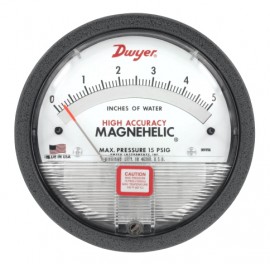
Most residential filter installations lack magnehelic gauges (Figure 1) to record the initial air resistance/pressure drop and to designate the maximum filter manufacturer’s recommended air resistance/pressure drop before replacing the filter(s).
For the residential building owner, it is much easier to simply change filters based on a specific timeline – e.g., semi-annually. In other applications, such as a school central air handling unit, magnehelic gauges should always be furnished and installed, serving as the maintenance tool to let the filter replacement technician know when to change air filters. Some might question this and simply replace filters on a specific timeline, such as each quarter. Unfortunately, in spring, a filter may be replaced per schedule just prior to peak pollen season, and these filters can become loaded up (a.k.a. pollen dust) with a significant increase in resistance/air pressure drop long before the next scheduled filter change.
When selecting the type of filter to be used, consideration should be given to the type of contaminants to be captured/filtered and the contaminant size and concentration. Filter efficiency should be taken into account, and here is where MERV-13 could be considered the minimum performance criterion.
When it comes to servicing the air handling unit, building owners in the residential market may opt to have a local HVAC service company perform filter replacement along with the air system’s seasonal service under an annual service contract. For all other applications – e.g., schools – the building owner may have in-house maintenance staff perform this work, or they too may contract a local service company to provide this task at seasonal startup, shutdown, and quarterly inspection. Whichever way the filter replacement is completed, it must be done. Filters – “out of sight and out of mind” – will result in operational issues, performance issues, and increased energy consumption.
Looking for a reprint of this article?
From high-res PDFs to custom plaques, order your copy today!