Steam Boiler Safety in an Age of Public Health Concerns
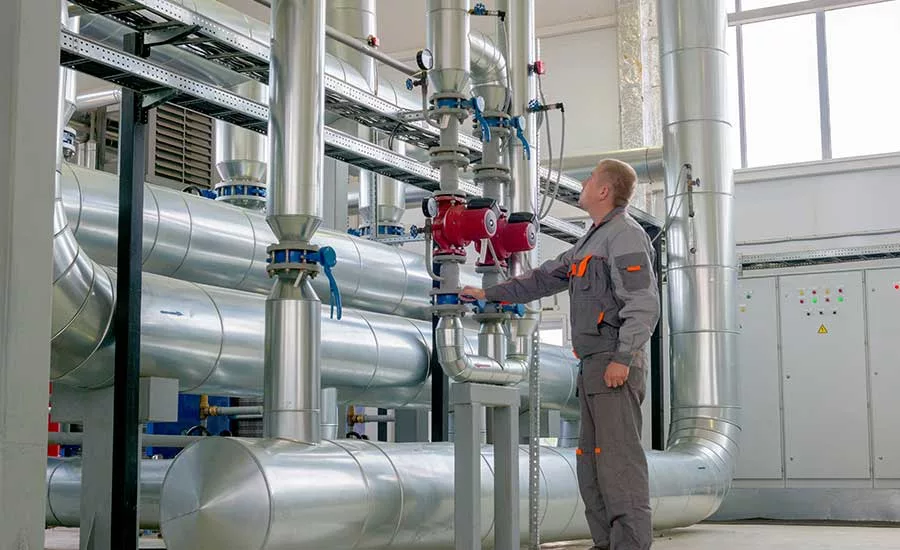
As COVID-19 impacts workforces, more companies recognize the need to invest in boilers that minimize the potential for physical risk and related loss of work in their installation, operation, and maintenance — especially in an already strenuous time.
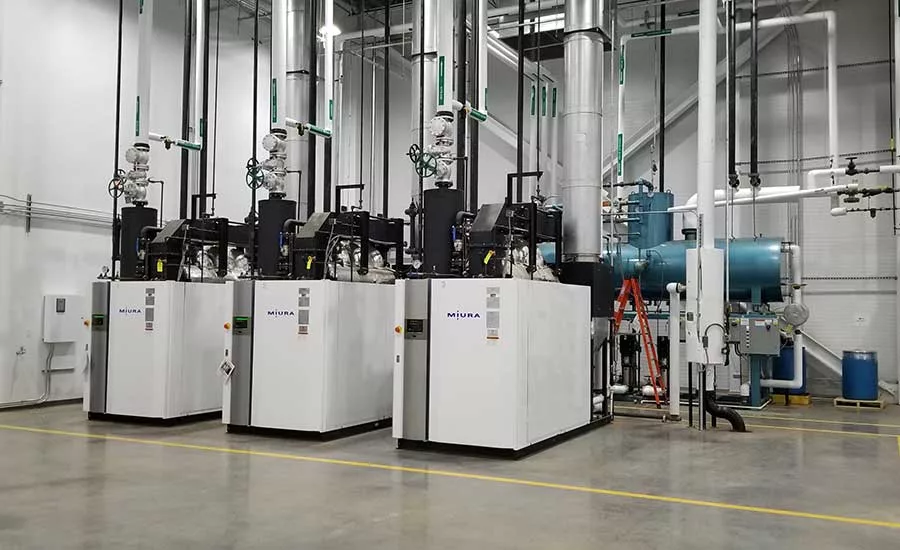
FIGURE 1. Miura’s modular, once-through, watertube design boasts the ability to rapidly generate full steam, even from a cold start (on-demand steam).
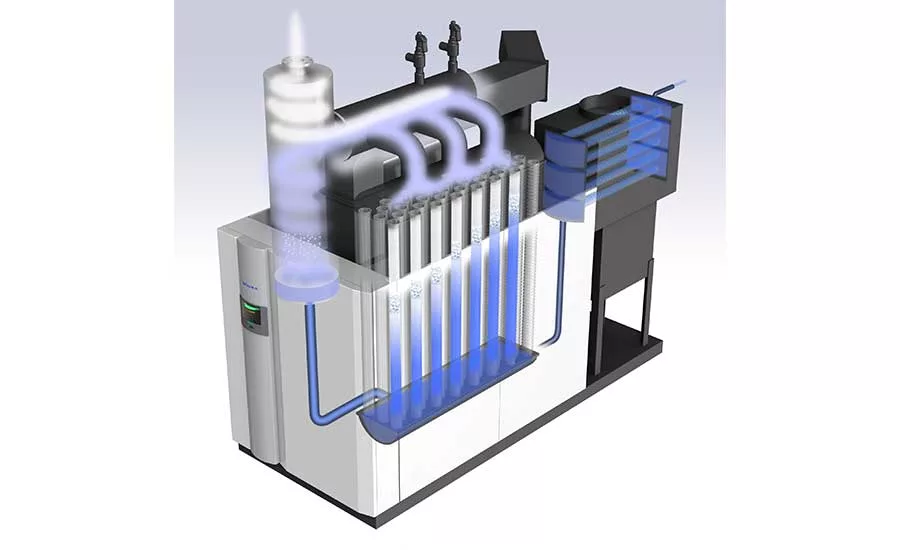
FIGURE 2. Miura’s once-through, watertube boiler has a compact design, where water flows through the tubes and transforms from liquid to steam in a single pass within the tube.
Physics and the physical design of an industrial or process steam boiler play a key role in determining the overall and day-to-day safety of a steam boiler.
When it comes to the overall operation, the majority of current steam boilers meet the required safety standards, and catastrophic explosions are rare.
However, many in the industry believe watertube boilers have less intrinsic risk than firetubes, not only based on the reduced potential energy stored within the smaller water content but on the physical design and day-to-day concerns.
As COVID-19 impacts workforces, more companies recognize the need to invest in boilers that minimize the potential for physical risk and related loss of work in their installation, operation, and maintenance — especially in an already strenuous time.
Modular, once-through, watertube boilers have compact designs where water flows through tubes and transforms from liquid to steam in a single pass within the tube. Traditional watertube boilers include an upper steam drum partially filled with water and a relatively complex tube and feedwater recirculation system.
Due to the once-through design’s reduced thermal mass, steam generation reaction time is less than both traditional watertube and firetube designs. This faster reaction time plus the optimized, compact design allows multiple once-through boilers to be installed and work together to provide a boiler system that optimizes space and fuel while reducing emissions and conserving resources.
Two benefits of the modular, once-through, watertube design include the ability to rapidly generate full steam, even from a cold start (on-demand steam), and functionality that allows boilers to turn off quickly according to current load requirements.
On-demand steam can revolutionize steam generation operations by matching the actual load demand with boiler output in real time. Unlike traditional boilers, operators do not need to preempt steam demand and waste fuel. Traditional boilers are typically placed in a standby or idle mode when not in use, which adds hours of run time, increases fuel costs, and requires personnel attention.
There’s also a considerable difference in size between the two types of boilers. A traditional boiler takes up larger floor space and is difficult to transport and install, whereas some once-through, watertube boilers can fit through a standard roll-up doorway.
If you have one or two large firetube boilers, as opposed to several modular boilers, when one of the firetubes goes down or requires maintenance, downtime and loss of production is a concern. Firetube maintenance can also result in heightened safety concerns.
While the physics of modular, once-through, watertube boilers have less intrinsic risk than firetube boilers, they also offer several safety advantages due to physical design and operation. These advantages typically result in fewer injuries, less time off from work due to injury, greater productivity, and potentially lower insurance costs.
Consider, for example, the enormous weight of doors that open and close during routine maintenance of traditional firetube boilers, compared to modular, once-through, watertube boilers that have no doors. This also means there is no confined space requirement.
Mounted on a davit arm with heavy steel on the front and refractory in the back, firetube doors can weigh thousands of pounds and present enormous physical challenges. Often, jacks are required to line up doors with bolts screwed in using an impact wrench while workers are standing on a ladder, causing an additional safety concern and a slew of potential injuries.
Firetube boilers also require continual maintenance procedures to replace the tubes and refractory, adding to the potential for injury.
Modular, once-through, watertube boilers offer several other safety and efficiency advantages over traditional firetube boilers. These include heavy-duty, threaded plugs instead of hand holes that reduce the potential for steam leaks and burns. The boilers provide a clean, open environment with no clutter; easy-to-read gauges; easy-to-do water checks; simple testing methods; and full steam in 5 minutes.
LOW-WATER CONTENT DESIGN MAXIMIZES SAFETY
The low-water content, modular, once-through, watertube, steam boiler design is crucial in reducing the potential for injury and maximizing safety.
The founding of the American Society of Mechanical Engineers (ASME) in 1880, which was done in response to increasing steam boiler explosions, exemplified the importance of having safety regulations in place to protect the lives and well-being of the people.
There are several reasons for requiring steam boiler safeguards, considering that a pound of water takes up a different volume than a pound of steam. That ratio is about 1:1,600 between water and steam. That is, a pound of steam takes up 1,600 times the volume of a pound of water. That’s a big difference.
Saturated steam contains sensible and latent heat for the phase change from liquid to gas. Sensible heat is the energy added to water to bring it to the boiler temperature at a specific pressure. Latent heat is the energy added to turn water into steam.
Finally, the effects of pressure and temperature impact the physical state of water. Atmospheric conditions vary with altitude above sea level, and it is worth noting that water tends to boil at a slightly lower temperature in Denver than in Los Angeles.
Likewise, as pressure increases above atmospheric pressure, boiling occurs at even higher temperatures than 212°F. In fact, there is a direct correlation between the temperature at which water boils and the pressure acting on that water. We’ll refer to this phenomenon as saturation conditions. For instance, at just 15 psig, or approximately two atmospheres, water won’t boil until it reaches approximately 250°.
Notably, this also works in the opposite direction with pressure, which brings us to the subject of flash steam. Should pressurized water at saturation conditions of 250° and 15 psig suddenly have a pressure drop to 0 psig, or atmospheric pressure, the sensible energy present causes a portion of that water to immediately flash to steam.
The proportion of pressurized water volume that will flash instantly to steam increases as the pressure differential from atmospheric conditions increases. For instance, to flash off an entire gallon of 250° pressurized water by reducing pressure from 15 psig to 0 psig, there would need to be 25 gallons present, since the percentage of flash steam resulting from that pressure drop is approximately 4%. Should saturation conditions corresponding to 60 psig be present, that percentage jumps to approximately 10%. At saturation conditions corresponding to 250 psig, the percentage of flash steam would be approximately 20% of available pressurized water volume.
To bring some perspective to the situation, consider that a small 200-hp Scotch-Marine-type firetube boiler capable of operating up to 150 psig contains a little more than 1,000 gallons of water during operation. That’s approximately 2.7 million Btu of stored energy in the form of sensible heat. Now imagine a pressure vessel breach, and 160 gallons (16% of 1,000) of that water suddenly trying to occupy 1,600 times that volume, the equivalent of 256,000 gallons of water or roughly 40% volume of an Olympic-sized swimming pool.
To put it another way, if 160 gallons occupies approximately 21 cubic feet of volume, then when that same volume flashes to steam, it would be trying to take up 34,000 cubic feet, and, most likely, that is much more volume than is contained within the boiler room. That is quite an explosive force.
So, as you can see, there is an inherent danger present when water exists in saturated conditions at pressures well above atmospheric pressure. The amount of danger is directly related to two things: 1) the volume of saturated water present, and 2) the pressurization of that volume above atmospheric pressure, but, practically speaking, only one of these two factors — that of water volume — can be addressed without completely negating the value of high-pressure steam in the first place.
The low-water content, modular, once-through, watertube steam boiler design is all the more impressive when you recognize that reducing water volume in a steam boiler poses a few challenges.
That’s because the water volume in a steam boiler serves dual purposes. First, and most obviously, boiling water generates steam. So, there must be enough water present in the pressure vessel to produce the required steam capacity at the required temperature and pressure.
Secondly, and just as importantly, the furnace side of the boiler, which generates the flame and hot combustion, is at a flame temperature typically exceeding 2,000°. The pressure vessel materials, typically plain carbon steel, cannot maintain structural integrity at temperatures of even less than half that.
So, the water content of the boiler also serves to cool the pressure vessel. The trick is to design a boiler that can contain the minimum amount of water required to produce a given capacity of steam while still having enough cooling capacity to maintain the integrity of the vessel.
That is just what Miura accomplished several decades ago when it developed the technology to create the modular, once-through, watertube boiler based on its primary goal of maximum safety.
Today, the design is well advanced and provides the market with reliable, modular, once-through, watertube boilers that generate steam in less than 5 minutes from a cold start and are much safer by design.
JUST HOW SAFE ARE SOME ONCE-THROUGH BOILER DESIGNS?
Let’s return to the example of a 200-hp boiler operating at 150 psig saturated steam conditions. While the firetube we discussed held more than 1,000 gallons of water, a low-water content, on-demand boiler of the same output maintains only up to 75 gallons of water — less than 7.5% of the volume of a firetube.
Not only that, but the direct flame impingement on heat transfer tubes and the fast feeding of feedwater into a hot boiler — two dangerous operational “no-nos” when discussing traditional boiler types — are a nonissue for once-through boilers. They occur by design during typical operation.
In a commonly cited worst-case scenario, where all controls and safeties fail with the water level dropping below the low water cut off (LWCO) and where the burner remains firing, by the time there isn’t enough water remaining to cool the tubes and a rupture occurs, the volume of water flashing to steam could be contained within the furnace volume of the boiler, and safely vented up the exhaust stack.
In short, modular, once-through, watertube boiler technology reflects some of today’s most notable safety and efficiency advances in industrial steam generation and addresses the growing concern for creating safer environments.
FOOTNOTE
In his book, “Boiler Operator’s Workbook,” a well-accepted reference tool, the author, R. Dean Wilson, writes “Why is an explosion generally less disastrous in a watertube boiler than in a firetube boiler?
“In a watertube boiler, the large volume of water is distributed into many small tubes, and the volume of water in the drum is comparatively small,” he continues. “If one water tube bursts, the pressure in the entire pressure vessel is bled off slowly, and the tendency of the large body of water to flash into steam is minimized. Usually only one watertube bursts. This may steam-cut a small number of nearby water tubes.
“In a firetube boiler, a sudden crack in the shell or a flue pulled loose at the end causes the entire body of water to be subjected to a sudden and substantial drop in pressure,” he concludes. “The huge volume of flash steam that results can cause an explosion of tremendous force.”
Looking for a reprint of this article?
From high-res PDFs to custom plaques, order your copy today!