The IoT in HVAC: Digital Twins, Optimized Sequences, and More

The IoT not only allows access to comfort data, it grants the opportunity to navigate the mechanical, electrical, plumbing, and fire (MEPF) controls according to this data and even act predictively.
What is the Internet of Things (IoT)? The IoT is a system of devices with the ability to send, receive, and exchange data via an internet connection. These devices are then able to operate with little human intervention based on the data received from the internet or other devices on the cloud network. In general, for commercial buildings, the current approach to the design of building automation systems (BASs) is to treat the building as a vacuum, unaffected by the surrounding climate, environment, societal patterns, and historical HVAC system data. The IoT not only allows access to this data, it grants the opportunity to navigate the mechanical, electrical, plumbing, and fire (MEPF) controls according to this data and even act predictively.
IOT IN HVAC
For HVAC systems, the IoT is a system of data collection through physical sensors and data retrieval from the internet to develop commands to equipment. The IoT can enable controls systems to respond in a proactive approach based on tangible data from sensors and the internet instead of operating in a reactive mode. With tangible data, building design engineers would be able to create more optimized sequences. For example, lighting control could adjust accordingly to either light sensors in the space; manual occupant control; and weather data retrieved online, such as cloud cover, sun position, etc. With online data, the lighting control could even act predictively by learning relationships between weather data and manual occupant control before adjusting the temperature in anticipation of manual occupant control. This means devices, such as manual lighting controllers, can be made into sensors themselves by sending important user data back to the cloud for trend analysis.
In a completely centralized IoT system, the HVAC system will have a digital twin on the cloud to represent values of sensors, actuators, equipment, and any other MEPF devices in the building as points. These points are then filtered, analyzed for patterns with online data, and stored in the cloud. These points, such as sensor readings or actuator positions, can be viewed in real time on the central user interface software. The central software mimics traditional BAS operator workstation software (OWS) as it allows users to monitor and change values of points on the HVAC system, but an IoT system comes with a few extra benefits. The central system has other features, such as a streamlined maintenance process, historical trend data for points on the network, floor plans, scheduling, etc.
BENEFITS TO IOT IN HVAC
- Energy Monitoring — Typically, in a standard BAS, the energy consumption of mechanical and electrical systems is trended and displayed at the OWS; the BAS will then create a series of reports for users to analyze and implement corrective actions, where and when they’re needed. Having the BAS supported by IoT applications, it gives owners the capability to set a benchmark for energy use such that if the use exceeds the benchmark for a certain amount of time, the system can send a notification to the owner to check what piece of equipment may be drawing too much energy. The system can also automatically adjust settings on thermostats if an event, such as overconsumption, is detected. This system can also be used for water metering to limit water use. Utility rates may also be monitored and predicted to determine the costs associated with certain modes of operation.
-
More Efficient Equipment — Proportional-integral-derivate (PID) loops are, by their design, reactive; a typical PID loop monitors one sensor and then controls an actuator to maintain a set point. Implementing a predictive approach to the control of building systems could help the equipment run more efficiently. A typical BAS controller that serves a standard single-duct variable air volume (VAV) box provided with a hydronic coil does not have the capability to determine when the heating load will increase or decrease in response to the load. Typically, the controller will start modulating the heating hot water control valve and/or the primary airflow when the space temperature starts increasing or decreasing relative to the set point. Heating a space enough to notably change the temperature reading is not an immediate action. The box plays “catch-up” of overcoming the heat loss of the space with the spatial temperature reading lagging behind. If the box had a predictive approach, the VAV box would have a more immediate response to spatial temperature changes. The IoT equivalent of a central BAS would retrieve weather data, analyze various data from the HVAC and lighting sensors, and then start controlling/commanding the VAV box controller accordingly. The IoT algorithm would then continuously “tweak” its learning patterns to allow for a more tailored approach for thermal comfort while operating the HVAC system more efficiently.
-
Streamlined Maintenance — Another benefit to having a cloud-based approach in the control of building systems is the ability to monitor, operate, and make changes remotely. The building owner would be able to view equipment performance data, note any issues, and schedule a maintenance appointment through the software. The technician would be able to view the same performance data and any issues online/off-site, streamlining any maintenance visits. Some programs even offer the ability to directly send error notifications to other service providers. Certain signals can be tied directly to a predictive maintenance request as well. For example, high energy use or high air pressure drop readings could indicate a dirty filter, and the system can send out a maintenance request and even predict the optimum time to schedule a request based on the trended performance. By being able to immediately detect and respond to problems, the longevity of the equipment can be extended.
- Occupant Comfort — The IoT could allow HVAC systems to predict occupant loads. Tying into Outlook calendars can allow the BAS to increase the outside airflow into a conference room prior to the start of a meeting so that the conference room is heated/cooled beforehand. Traditional HVAC systems operate on an occupied/unoccupied schedule or with occupancy sensors. IoT-enabled devices would be able to save energy by turning off when not in use and operating more efficiently, i.e., starting ahead of schedule, when in use. Some systems even offer mobile apps for occupants to manually adjust heating/humidity set points for individual comfort. As previously mentioned, this information can be used by various artificial intelligence (AI) algorithms so that the HVAC system can predict ideal set points for individual occupant comfort.
EDGE DEVICES
Sending and receiving data through the cloud can come with delays. Edge devices can help mitigate this by giving cloud computing capabilities to devices at a local level. Edge devices are sensors and actuators that can exchange data with the cloud directly without going through the BAS. For example, a smart light may be able to turn on according to online sunset/sunrise data. Many of these devices may also have their own embedded machine learning capabilities to operate in a predictive manner, allowing these devices to operate independently of commands sent from the BAS. However, it should be noted that these edge devices are still able to interface with the BAS by sending data and receiving commands as needed. Because edge devices operate more autonomously from the central system, these devices tend to only relay changes to the system instead of continuously pollling raw data and can independently filter through outliers or extraneous data prior to sending it back to the cloud. This helps to eliminate virtual traffic between the cloud and devices. In addition to saving time, edge devices could decrease the maintenance and operational costs associated with an IoT application.
On the flip side, edge devices remove some of the centralization benefits as they will be widely distributed throughout the building. If a maintenance worker needs to access any software on the sensors themselves, he or she may not be able to do it from the central system. Having separate software systems on the device may also cause issues with updates. If an edge device encounters a bug from a recent update, that may not be shown on the central software. Consequently, technicians may need to routinely check on these devices. Another criticism of edge devices is an enhanced need for stricter cybersecurity measures. That said, there are still benefits to using edge device systems, and it may even be of interest to do a mix of edge devices and regular devices.
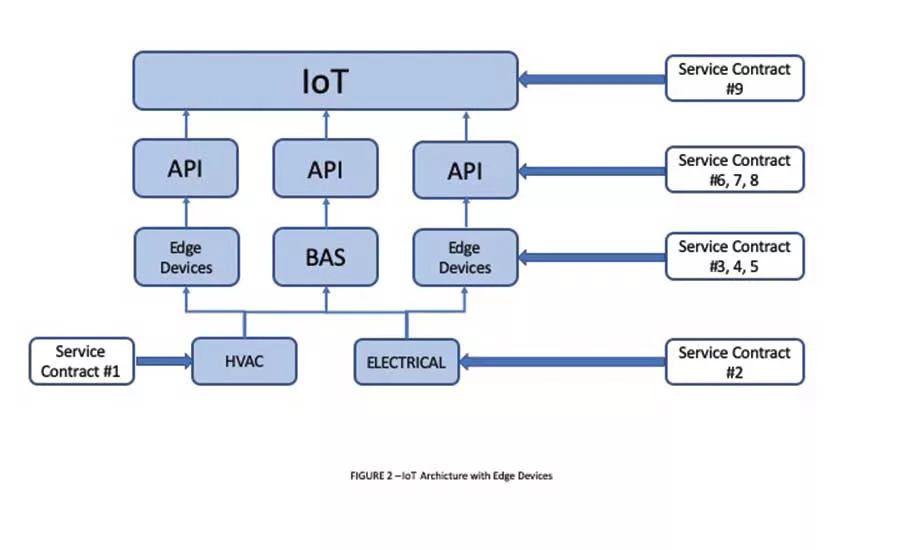
One could make the case that the operational history (i.e., energy performance, maintenance, etc.) of using the IoT to control building systems has demonstrated the benefits described in this article; however, of equal importance are the contractual requirements and associated service agreements an owner must understand and implement to properly use IoT applications and devices for the control of building systems. Typically, and as shown in Figure 1, adding IoT applications on top of a standard BAS involves additional licensing and service agreements. At minimum, there will need to be a service agreement for the application programming interface (API) and the IoT application. It is not unusual for a BAS vendor to provide the API and IoT as a part of a single package/software agreement. The challenge an owner may encounter is when the vendor for the BAS is different than the vendor(s) for the API and the IoT application, significant efforts will need to be implemented in order to make the BAS and the IoT application ‘talk’ to each other. Further, the vendors may have different upgrade schedules and/or offerings. This means that if the BAS was to require a software update, the owner will most likely have to involve/pay for the IoT vendor to coordinate with the BAS upgrade. Things could get even more complicated when using third-party edge devices. As shown in Figure 2, edge devices could add another layer of contractual/licensing agreements.
Lastly, but not less important, implementing IoT applications for the control of building systems requires additional training for the building engineers. In some instances, and depending on the complexity of the IoT application, the owner may need to hire additional staff that is capable of understanding the data/reports from the IoT application and ‘translating’ it into action items for the building engineers to implement.
Looking for a reprint of this article?
From high-res PDFs to custom plaques, order your copy today!