Creating a Safe Environment for In-Person Mechanical Engineering Classes
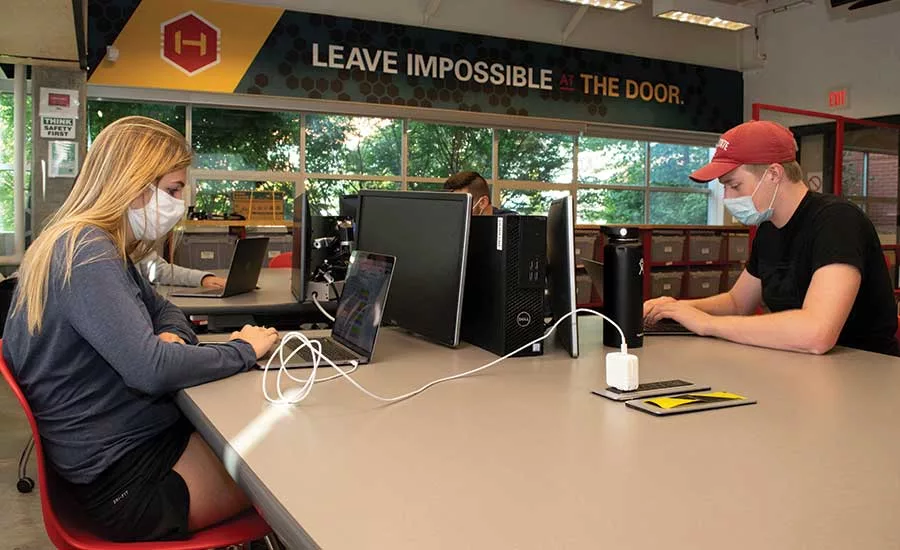

Evan Christianson works on his laptop during ME 270: Introduction to Mechanical Engineering Design.
When Iowa State University was given the go-ahead to open up for fall classes, faculty, staff, and student technicians in the mechanical engineering department quickly made every effort to prepare lesson plans, classrooms, labs, and other spaces to be as safe as possible so students can get the hands-on engineering education Iowa State is known for while also taking the necessary steps to reduce the spread of COVID-19.
Much of this effort has been coordinated by mechanical engineering (ME) department chair Caroline Hayes. Hayes, who also serves as the Lynn Gleason Professor of Interdisciplinary Engineering, said that all of the “unknowns” early on made planning for the fall exceedingly difficult.
“Back in March, when we first started planning for fall semester in a COVID world, we didn’t know yet whether we would be teaching online or in person,” said Hayes. “The virus was so new that scientists did not how it would behave, or how one can best guard against it.”
In May the uncertainty continued as disruptions in supply chains left Hayes questioning if they would even have access to disinfectants, hand sanitizer, personal protective equipment (PPE), and other gear that has become essential during the COVID-19 era.
“It was really scary to think that we might have to start the semester in-person without those things,” said Hayes. “We were considering making both hand sanitizer and masks if we could not get them through the normal channels.”
Though the department did procure the necessary supplies, it was also involved in its own efforts to produce PPE using both traditional means as well as 3D printing. Hayes even drove to Iowa City twice to hand deliver boxes of face shields to the University of Iowa Hospitals and Clinics and other health care organizations.
“The sports rivalry side of things is fun, but in times like these it’s important for us to come together,” Hayes said.
The virus has drastically changed the way courses are delivered and the way that classrooms and labs are set up. Hayes said that masks, physical distancing, and good ventilation were the three key necessities they kept in mind for designing safe in-person instruction. Of these three, the need for physical distancing in teaching spaces has had the largest repercussions.
“It jointly impacts the physical layout of teaching spaces and the way in which each class is structured,” said Hayes. “In order to give students adequate space for physical distancing, you need bigger teaching spaces. Unfortunately, for laboratories requiring special equipment, which is wired or plumed into a specific room, you can’t easily move it to a bigger room without major construction — assuming we even had a bigger room.”
Instead, personnel in the department have thought of new ways of effectively using the existing space. For example, by temporarily removing half the lab stations to make space and then scheduling half the students to gather data on any given day. In another model, half the students on a lab team come in person while the other half connect with their teammates remotely. Then they switch for the next lab session.
Sebastien Feve, associate teaching professor of mechanical engineering, has made adaptations to his sections of ME 270: Intro to Mechanical Engineering design this semester. Part of these adaptations included activities such as team quizzes (in-person) and early assignment work check-ins (in-person and remote hybrid). Students have even had to adapt the way in which they communicate with more emphasis on web calls and email.
“The learning curve for this new style of communication was steep at first, but I’m proud to see everyone has been coming along nicely since the start of the semester,” said Feve.
Sandy Sayer, program coordinator for ME and a member of the department’s safety committee, led her team of teaching lab coordinators and student techs in making adaptations to the teaching spaces to ensure safety. It required constant, summer-longer collaboration between her team and the instructors to ensure the new set-up would support instruction, and vice versa.
“What I hear most from students is that they are happy to be here,” said Sayer. “The students that I am around are careful to wear their masks and physically distance because they want to continue to have hands-on opportunities on campus.”
The final challenge, and perhaps the most difficult of all, was to provide preferred solutions that could meet the students’ varied needs. Some students preferred in-person instruction, while others felt safer to continue remotely until the virus subsides.
“We needed to serve all of our students,” Sayer said. “You can’t simply deliver all classes in-person or all classes on-line and still meet the needs of the students. They need options.”
Department personnel now look ahead to the spring semester, though many uncertainties remain. Hayes and others in the department will continue to monitor the situation and will do everything possible to provide a top-notch engineering education while taking the necessary precautions to lessen the spread of COVID-19.
“It’s a work in progress, but I am proud of the efforts from everyone,” said Hayes. “We are still learning and watching carefully to see how the fall goes. So far, it has gone surprisingly smoothly considering everything. But continued success of in-person learning in the COVID-19 era depends on the whole community, faculty, staff, and students, continuing to be very careful, and very proactive, both on campus and also in their personal lives.”
This article originally appeared on Iowa State University’s College of Engineering News website. See the article in its entirety by clicking here.
Looking for a reprint of this article?
From high-res PDFs to custom plaques, order your copy today!