Fabric Duct Solves HVAC Engineering Challenges for $48 Million Aquatics Center
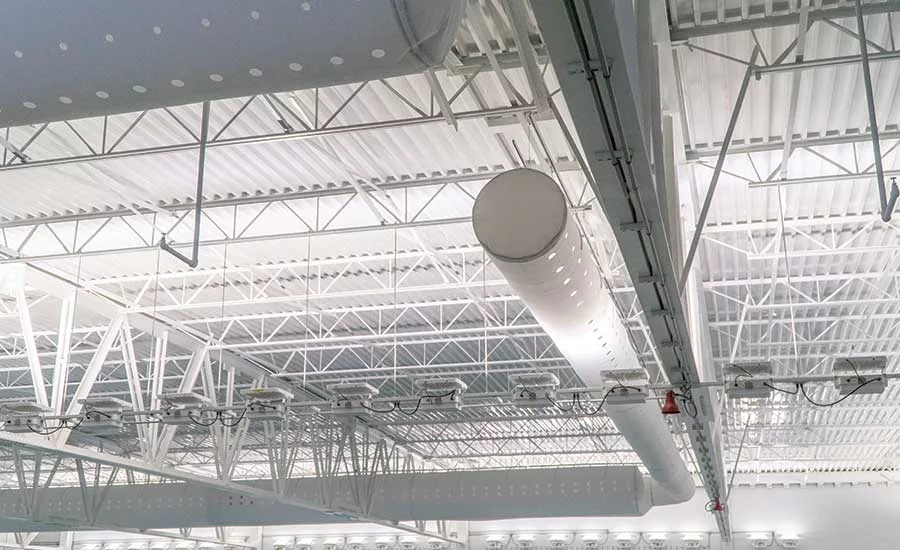
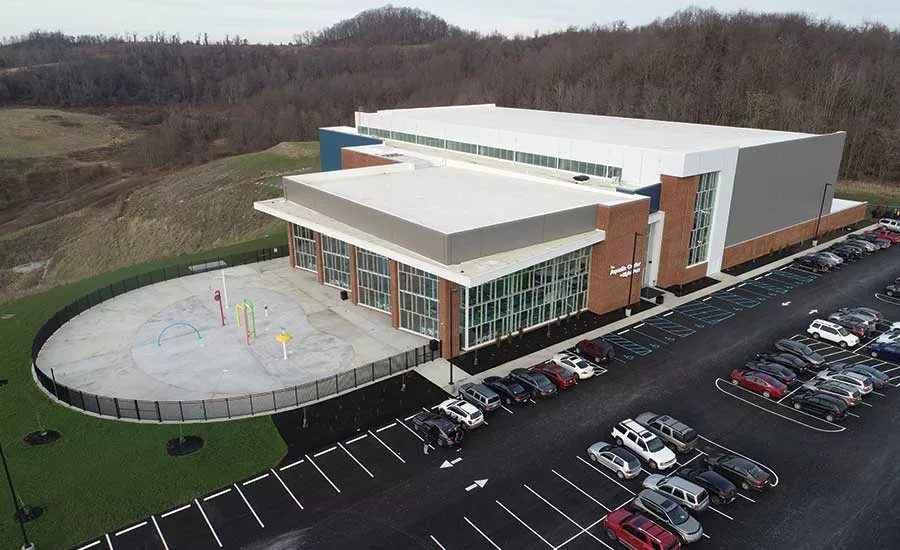
The design team, led by Morgantown firms, general contractor March-Westin Co., and Paradigm Architecture, called on design-build mechanical contractor, A. Durer Inc. (ADI) and its HVAC vendors to help value engineer hundreds of thousands of dollars’ worth of HVAC-related equipment originally specified for the project.
Value HVAC Engineering
For example, the original design’s polyvinyl chloride (PVC)-coated, single-wall spiral metal duct was substituted with fabric duct manufactured by FabricAir, which reduced ductwork material costs by $55,000, according to Chris Myers, general manager, ADI. Another critical value engineering strategy was switching the original mechanical design from split-system indoor pool dehumidifiers to semi-custom packaged systems manufactured by AAON, which saved in excess of $550,000 in equipment and piping costs.
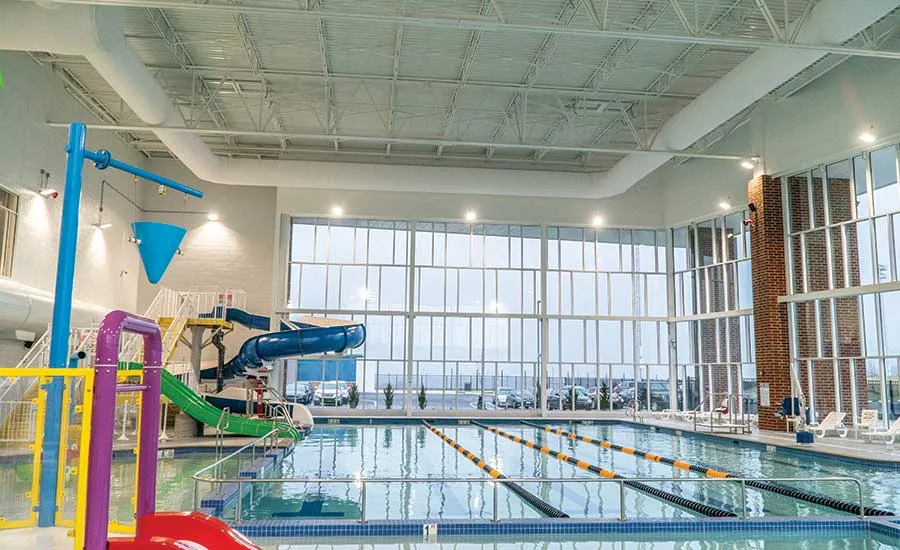
Fabric duct also decreased labor costs and reduced trade stacking, because it installs up to 60% faster than metal duct. The fast installation shaved six to eight weeks off the ductwork installation time, according to Myers. Furthermore, the fast-tracking allowed other trades to complete their work sooner than would have been possible if conventional metal ductwork had been used. The fabric duct’s single-point aluminum suspension system serving the Olympic-sized competition pool and six-lane diving well was installed in just 10 days. Afterward, only five days were needed to hang the 980 linear feet of fabric ductwork, consisting of 96-inch-diameter headers and branches ranging from 48-56 inches in diameter. The 150,000-gallon community pool’s suspension system and 360 linear feet of perimeter air dispersion installed in less than a week.
The white fabric duct also eliminated additional costs for field-applied anti-corrosion coatings and paint to match the interior white décor scheme. In addition, condensation is always a concern in a pool environment; however, fabric duct’s engineered permeability allows airflow through the fabric surface to prevent condensation.
Fabric duct’s design flexibility helped solve the challenge of fitting the originally specified large diameter spiral ductwork through truss openings to create clean sightlines for spectators. Leaning on the expertise of FabricAir’s factory engineers and manufacturer’s representative, Joe Paul, president, Deckman Co., ADI designed a center-positioned 96-inch-diameter trunk line to run between the trusses with smaller diameter branches to fit through the truss supports. The result was an aesthetically pleasing layout with minimal cost changes compared to spiral ductwork systems.
“Installing the ductwork under the trusses would have deterred the design team’s clean sight line goals, plus it would have made the high seat spectator section a bit claustrophobic,” said Myers, who joined ADI as a project manager in 2008 and became general manager in 2011.
Fabric duct’s subliminal benefits included workplace safety and reduced equipment costs. Lifting and installing the 90% lighter fabric duct to a 50-foot ceiling was a safer task for ADI employees versus 72-inch-diameter metal ductwork installation with more expensive lift equipment.
The value-engineered final mechanical design features two 150-ton, 65,000-cfm, ground-mounted dehumidifiers that remove up to 1,320 pounds of moisture per hour from the competitive pool area, and a 90-ton, 30,000-cfm rooftop dehumidifier for the community pool. All three dehumidifiers recover energy with hot gas reheat coils energized during the dehumidification cycles. They also recover return air energy to pre-condition outdoor air via a sensible energy recovery wheel manufactured by AirXChange.
Designing a Superior IAQ
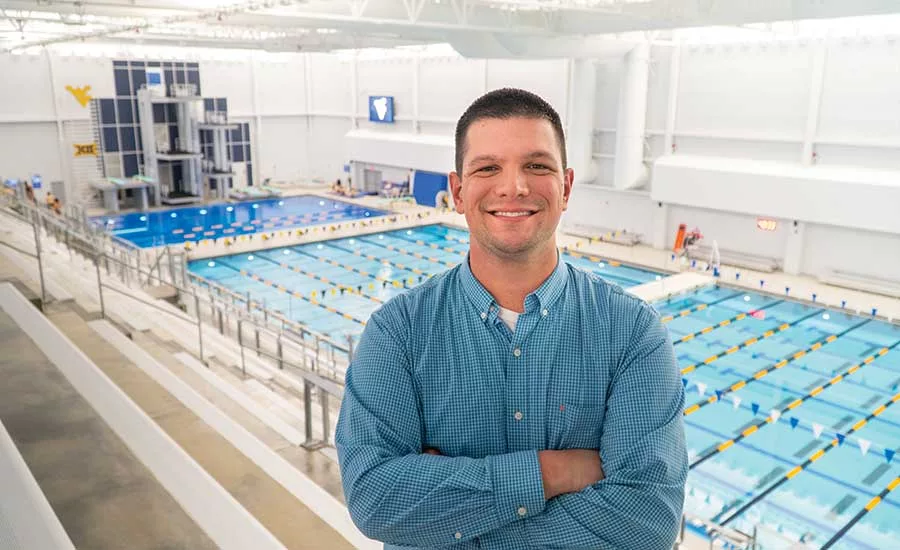
Superior IAQ that surpasses ASHRAE Standard 62.1 was an important design goal. ACMP, which is now the West Virginia University swimming/diving team’s home pool, passed its first major IAQ test while hosting the 2020 Big 12 Conference Championship last February, according to Keith Hernstrom, general manager/executive director, of Mylan Park. The 400-acre, mixed-use, sports, recreation, and event complex that includes the ACMP is operated by recreation management firm, Centers LLC, Washington, D.C.
The championship included hundreds of swimmers and was attended by 1,500-plus spectators. ACMP’s design didn’t take shortcuts with IAQ, because indoor pool health has become a global issue. Respiratory issues caused by water surface chloramines accumulation at poorly ventilated facilities across the nation have resulted in swim meet stoppages and in some cases, emergency room visits by swimmers.
“As operational managers and consultants, Centers LLC and our parent company’s [Brailsford & Dunlavey] extensive experience with other indoor pools’ IAQ was a critical element we brought to the design,” added Hernstrom.
The fabric supply air dispersion layout along with the ACMP’s return air strategy and source-capture Evacuator system, manufactured by Paddock Pool Equipment, promote IAQ by preventing chloramine accumulation. The competition pool has a return air system that’s wall-mounted 10 feet above the deck and spans the entire length of the pool opposite the spectator section. The community pool has a 54-inch-diameter, wall-mounted, spiral return air duct with registers 10 feet off the deck that also draw the supply air across the pool. The fabric duct’s OriFlow linear vents easily distribute airflow 45 feet down to the breathing zone, and the aforementioned return air layout creates a “cross flow” that helps the return air systems draw air uniformly back to the dehumidifiers and the source capture exhaust systems.
The source capture is the heart of the exhaust strategy. There are intakes built into one gutter along the competition pool length and along two sides of the diving well. The 15,000-cfm system draws the heavy, toxic chloramines off the water surface and exhausts them outdoors through underdeck fiberglass ducts. ASHRAE code requires negative building pressure for pools, therefore the source capture system contributes to the exhaust/supply ratio along with the dehumidifiers’ exhaust fans to maintain a minus 0.05-w.g. negative pressure between the pool rooms and the attached common spaces. A similar source-capture strategy was used for the community pool’s chloramines. It’s connected to the same linear grill that captures deck surface pool water overflow but uses a separate underdeck duct to exhaust the chloramines outdoors. The underground duct also includes drains for pool water spillage into the duct.
ADI also installed a 40-ton AAON packaged DX rooftop that supplies 21 variable air volume boxes with electric reheat for the facility’s common area between the two separate pools. The unit also includes an energy recovery wheel to recover common area heat as well as the bathrooms’ exhaust.
The entire facility is monitored and controlled by ASI Controls and Siemens building automation systems. The relative humidity is maintained at 60% for both facilities. The water temperature is 78° and 82°F for the competition and community pools, respectively, and the air temperature is maintained two degrees above the water temperature to minimize evaporation in accordance with ASHRAE Handbook guidelines on natatoriums.
As more recreation organizations opt for facilities that serve more residents with both indoor pool competitive and community leisure swimming, the ACMP will surely be a role model for HVAC engineers and contractors.
Looking for a reprint of this article?
From high-res PDFs to custom plaques, order your copy today!