Case In Point
Fabric duct solution unburdens data center build-outs

|
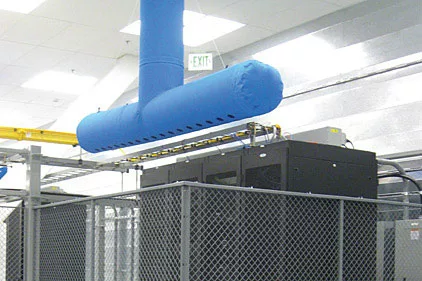
| T-shaped fabric fittings were used at a redIT data center in an effort to expand as more customers come online. Fabric duct was chosen to avoid other options’ risks such as airborne particulates. |
Cooling build-outs can be one of the highest operational costs facing data storage facilities. However, executives at San Diego-based redIT says it has implemented a new cost-saving measure at its data centers. The new procedure involves adding cooling drops for individual partitions inexpensively, and only as new customers come onboard.
To ensure redundant capacity, datacenter construction requires a complete and expensive build-out of a space’s HVAC system, including ductwork and diffusers. Because it may take years to lease out the entire space, this upfront cooling build-out can be a costly practice. redIT officials have found a short-term, more cost-effective alternative by installing each sheet metal drop and diffuser only after a customer comes onboard. This approach postpones construction costs while saving data centers time and resources.
That said, this phased sheet metal construction approach also has disadvantages. Sheet metal construction creates airborne particulates and poses other unnecessary risks to neighboring computer equipment. It also costs thousands of dollars in installation labor and material associated with each new cooling drop. Additionally, outsourced sheet metal contractors in highly restricted access control areas can potentially jeopardize security efforts.
redIT, operating multi-tenant facilities with many Fortune 500 clients, realized these challenges. Furthermore, the firm wasn’t satisfied with the prices, performance, or flexibility of conventional CRAC air distribution systems.
redIT used this cost-saving phased cooling approach during the build-out of the first 14,800-sq-ft datacenter phase of its 88,000-sq-ft facility in San Diego. The HVAC service contractor, Countywide Mechanical Systems, introduced fabric ductwork to redIT’s design team. The team included Mark Hopperton, chief technology officer, and Gabriel Faulkner, facility manager.
Factory engineers from fabric duct manufacturer DuctSox Corp., and the redIT team, partnered with Gilbert Dominguez, manager of manufacturer’s representative Toro-Aire, to design a custom-fabricated fabric ductwork drop as an alternative to conventional sheet metal drops. The application was the first case for the manufacturer where a custom-fabricated, inverted T-shaped fabric fitting was used for data center equipment spot cooling.
Fabric Installation
Each fabric T connects to a sheet metal trunk line supplied by several redundant 55,000-CFM units by MarCraft. The AHUs are supplied by multiple redundant 440-ton chillers by the York division of Johnson Controls. Each air handler has a piped-in soft water supply for humidifying San Diego’s inherent dry outdoor air. Humidifying the air helps to maintain ASHRAE standards with respect to relative humidity and potential static electricity risks within the facility. The air handlers reside in a secure, remote outdoor yard, removing the risk of water pipe leaks in the datacenter.
The Ts are connected via a round metal/fabric collar adaptor called a DuctSox DuctBuckle. The DuctBuckle clamp is manufactured for the sole purpose of clamping tightly onto round metal connections without the use of screws or other fasteners. Each drop area can accommodate up to three Ts, which can produce higher cooling densities and greater flexibility of additional airflow. The Ts drop as low as necessary to accommodate the different heights of customer cabinets within the datacenter. The ends of each T’s run are capped; however, they can easily be removed for zippering in extra lengths in-line and extending airflow over a cage’s equipment rack reconfiguration.
The application’s needs necessitated a custom-designed suspension system. Typically, ceiling-hung round fabric ductwork in conventional applications is installed in long runs suspended by horizontal cable or cable/track hanging systems. The T’s bullhead would have obstructed this suspension method. Instead, Faulkner used thin, undetectable aircraft-style cable and adjustable clamps for attaining proper hanging tension. The vertical cables attach to the metal collar on one end. The Ts run on the other end where the manufacturer sewed in receiving clips.
redIT keeps an inventory of Ts, and redIT’s in-house staff can install these Ts for new clients in approximately 10 to 15 minutes without creating airborne debris. According to Faulkner, who supervises the fabric duct installations, installing and suspending a sheet metal drop and diffuser would require an outsourced contractor, a minimum one day of construction, plus the aforementioned risks to surrounding equipment.
Future Build-Outs
redIT is planning a new build-out phase, possibly using the same cooling design strategy. Until then, redIT’s ongoing green mission includes making the current system more efficient. They recently added a BAS by the Allen-Bradley division of Rockwell Automation. The system will control all of the air handlers’ economizer dampers to take full advantage of outdoor air when outdoor temperature and humidity are ideal.
Current refinements to the system include a matching blue fabric-based containment plenum above certain equipment to help contain cool air in and around the equipment for longer. This containment plenum creates more total energy efficiency and savings, according to Faulkner.
The fabric Ts are inherently flexible. Factory engineers can accommodate most any reconfiguration or special request for airflow, which according to redIT, has convinced many companies to become customers as they weigh their data center options.
Looking for a reprint of this article?
From high-res PDFs to custom plaques, order your copy today!