Dehumidifier Replacement Improves Conditions, Lowers Maintenance, Operating Costs at Austin YMCA
When interior conditions start drifting, and the can repair bills can be stacked up to the ceiling, it’s a good time to think about a dehumidifier replacement.
That was the situation the Austin Northwest Family YMCA faced with its two aging units in 2017, leading to a complete overhaul of the facility’s dehumidification system. By the time Jon-Erik Johnson, P.E., of Texas AirSystems, paid a site visit to help review the facility, the old metal ducts had significantly corroded and the approximately 15-year-old dehumidifiers were plagued by leaks, dead compressors, and other ailments typical of outmoded HVAC equipment. Plus, the sizable refrigerant charge in the archaic split-DX design meant further leaks posed a major liability due to astronomical costs of the R-22 used by the outdated units, a refrigerant that is in the later stages of being phased out.
More Efficient, Less Refrigerant
When it comes to the Austin Y’s new system, less really is more. The old 30-ton units were equipped with split-DX condensers, filled with R-22, and connected by copper pipes. Split-DX for this application uses a substantial refrigerant charge to operate, which can be devastating if a leak happens. Years ago, R-22 was readily available and inexpensive, so large refrigerant charges weren’t much of a worry. Things are very different today.
The design, used on indoor pool dehumidifiers for more than 40 years, has many hassles associated with operating it. The copper pipes are sometimes stolen by thieves looking to resell the metal. One of the most notorious challenges with split-DX dehumidifiers is refrigerant and oil migration, which is when liquid in the system is drawn to the outdoor condenser when it is relatively cool outside and air conditioning mode is not active. When the a/c is turned back on, the entire outdoor section is now full of liquid refrigerant that is difficult to get moving to allow for the refrigerant hot gas from the compressor, which can create operational problems. Systems using this design often trip on high pressure and then have to reset to get back into a/c mode. These operational problems translate into increased component wear and tear over time.
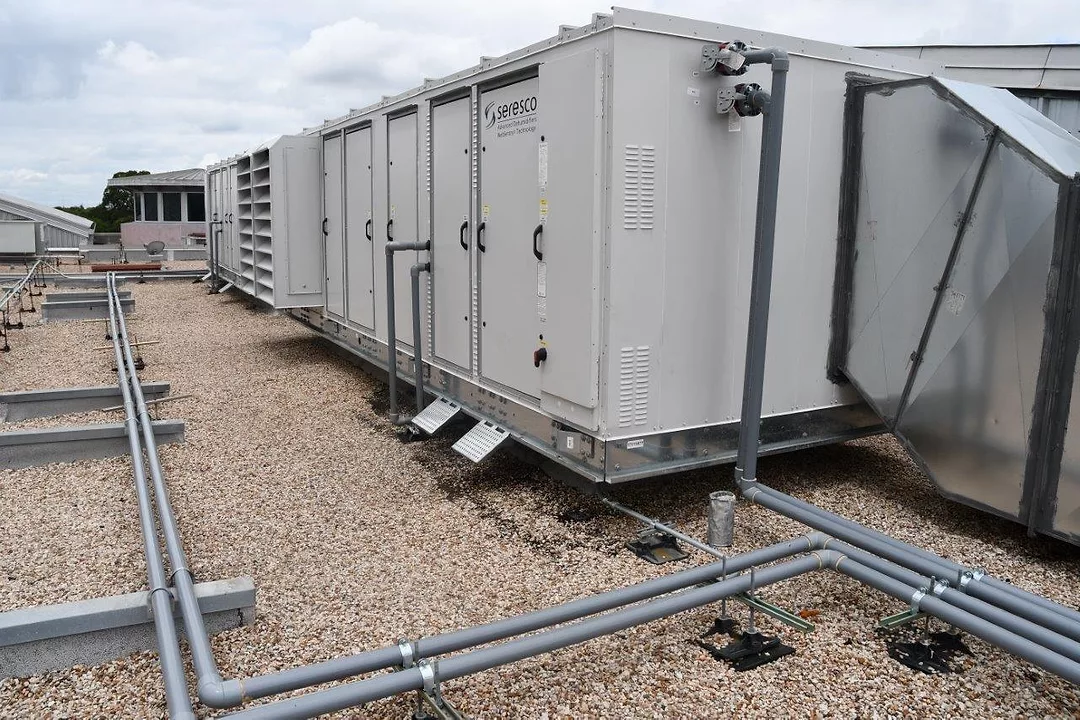
The new units — two Seresco NP-030s — solve these challenges by using factory-provided dry coolers to provide air conditioning heat rejection. These heat exchangers are filled with water and a small amount of glycol, with all refrigerant kept within factory-sealed circuits inside the dehumidifiers. The total volume of R-410A used in the system is about 60% less what would have been needed with a split-DX design. The chance of a leak is nil and refrigerant migration is not an issue because only the water/glycol mix is present in the lines outside the dehumidifiers. Additionally, the dry coolers use a PVC lineset, saving costs on installation as there was no need for a certified contractor to purge and braze them on-site.
“Ongoing maintenance will be less of a hassle for the Y, because these dry coolers require a lot less attention than refrigerant condensers,” said Johnson. “Normal maintenance for a dry cooler consists of checking for free airflow around the fan every so often plus a water and glycol replenishment every few years. It’s far simpler.”
The heat exchanger coils for Seresco’s dry coolers are practically self-cleaning whenever it rains, because of their smooth hydrophilic coating.
The dehumidifiers themselves offer improved efficiency compared to legacy designs, too. One example is through their use of direct-drive fans, which don’t suffer the kind of energy losses that belt-driven fans do. Fan energy is a close second to compressor energy (since fans operate 24/7 and compressors do not), so these savings are considerable.
The NP recycles compressor waste heat to reheat the cold, dehumidified air off the evaporator coil when full cooling is not needed. Heat from the compressor can also be used to provide free pool water heating. This heat recycling is incredibly efficient and can save thousands of dollars a year on energy costs by reducing auxiliary heating requirements, which are typically electric or natural gas.
For the first time ever, the Y will have stable room conditions thanks to the use of modulating reheat. This control modulates, up to 100%, the amount of compressor heat used to reheat the air. Extra heat can also be directed to the pool water or, if there are no avenues left to recycle it, rejected outside. This compared to traditional dehumidifiers, which use binary hot gas reheat coils that either take 100% of the compressor waste heat or none of it. This tends to overheat the space and then force air conditioning mode on, which then overcools the space before turning reheat back on and repeating the routine. With a modulating coil, only the precise amount of heat needed is added to the airstream.
“Using modulating reheat is one of the best things a dehumidifier can do from an efficiency and patron comfort perspective,” said Johnson. “You don’t have temperature and relative humidity bounces, and the various unit components experience less stress because they don’t cycle on and off. It’s a no-brainer but, unfortunately, is not standard in the industry.”
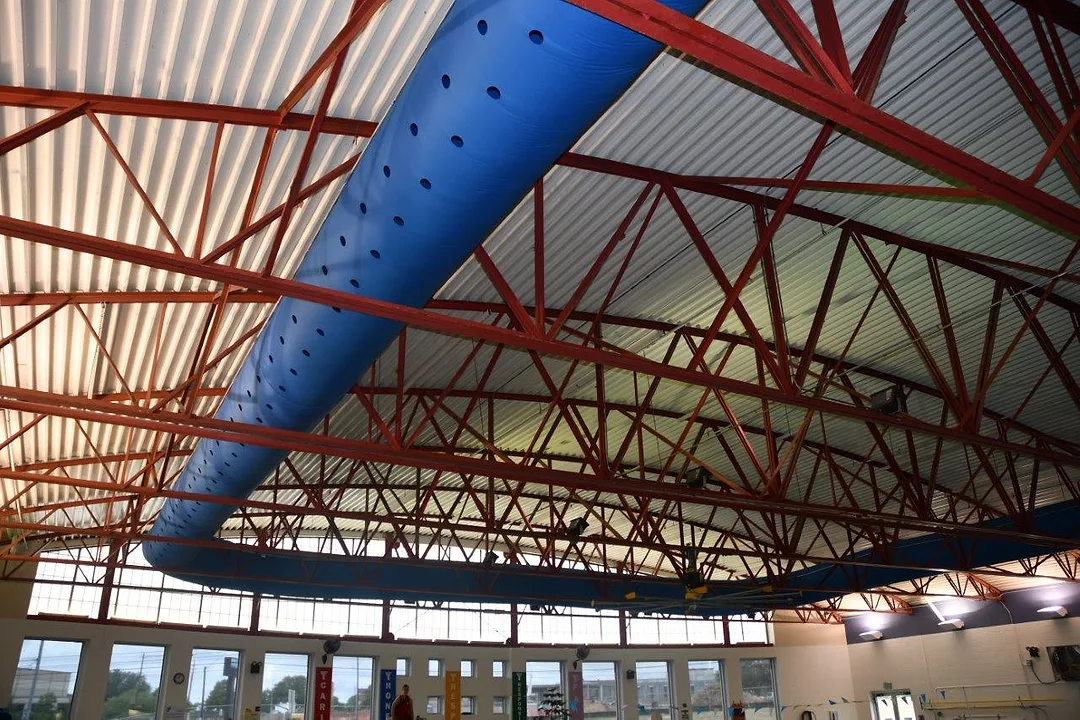
In addition to new dehumidifiers, the Y refurbished its ductwork by replacing the metal with a new fabric design. Fabric ducts are increasingly popular with indoor pool facilities due to their flexibility. The material is less expensive than metal, easy to install, and lightweight. It won’t corrode and can be ordered in practically any color. They can also be taken down for washing with ease.
All the same rules that apply to metal ducts must also be followed with fabric ducts — for example, diffusers with enough velocity and volume must still be used and must get air into the breathing zone and onto surfaces of potential condensation. When the proper design techniques are applied, fabric ducts perform just as well and are a great alternative to traditional galvanized steel when it comes to indoor pools.
Looking for a reprint of this article?
From high-res PDFs to custom plaques, order your copy today!